

62
2 Observations of Radio and X-ray Pulsars
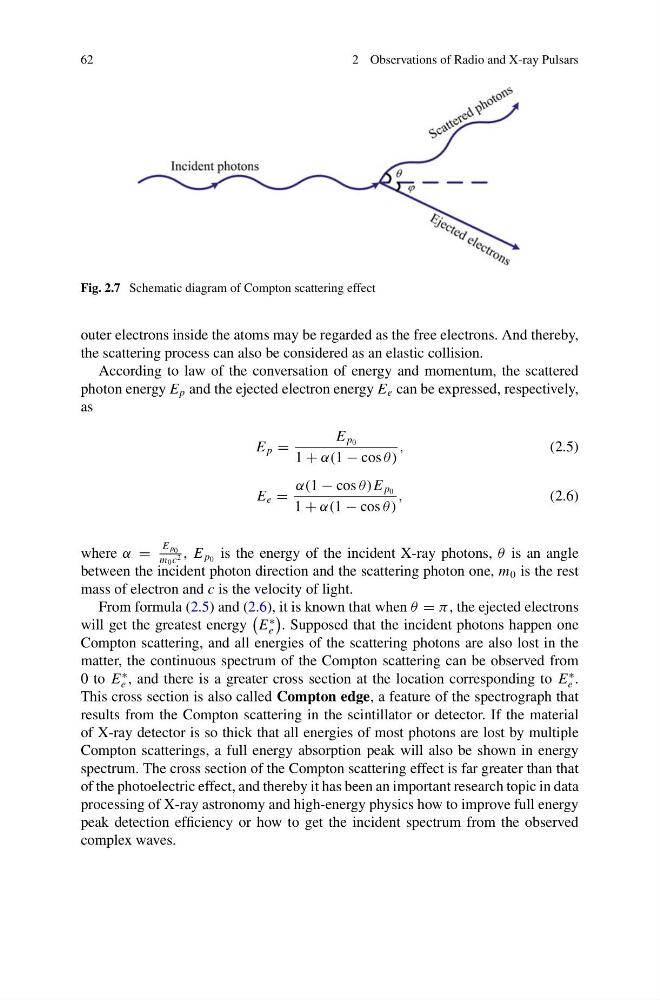
Fig. 2.7 Schematic diagram of Compton scattering effect
outer electrons inside the atoms may be regarded as the free electrons. And thereby,
the scattering process can also be considered as an elastic collision.
According to law of the conversation of energy and momentum, the scattered
photon energy E p and the ejected electron energy E e can be expressed, respectively,
as
E p =
E p 0
1 + α(1 − cos θ)
,
(2.5)
E e =
α(1 − cos θ )E p 0
1 + α(1 − cos θ )
,
(2.6)
where α =
E p 0
m 0 c 2 , E p 0 is the energy of the incident X-ray photons, θ is an angle
between the incident photon direction and the scattering photon one, m 0 is the rest
mass of electron and c is the velocity of light.
From formula (2.5) and (2.6), it is known that when θ = π , the ejected electrons
will get the greatest energy
E
∗
e
. Supposed that the incident photons happen one
Compton scattering, and all energies of the scattering photons are also lost in the
matter, the continuous spectrum of the Compton scattering can be observed from
0 to E
∗
e , and there is a greater cross section at the location corresponding to E
∗
e .
This cross section is also called Compton edge, a feature of the spectrograph that
results from the Compton scattering in the scintillator or detector. If the material
of X-ray detector is so thick that all energies of most photons are lost by multiple
Compton scatterings, a full energy absorption peak will also be shown in energy
spectrum. The cross section of the Compton scattering effect is far greater than that
of the photoelectric effect, and thereby it has been an important research topic in data
processing of X-ray astronomy and high-energy physics how to improve full energy
peak detection efficiency or how to get the incident spectrum from the observed
complex waves.
2 Observations of Radio and X-ray Pulsars
Fig. 2.7 Schematic diagram of Compton scattering effect
outer electrons inside the atoms may be regarded as the free electrons. And thereby,
the scattering process can also be considered as an elastic collision.
According to law of the conversation of energy and momentum, the scattered
photon energy E p and the ejected electron energy E e can be expressed, respectively,
as
E p =
E p 0
1 + α(1 − cos θ)
,
(2.5)
E e =
α(1 − cos θ )E p 0
1 + α(1 − cos θ )
,
(2.6)
where α =
E p 0
m 0 c 2 , E p 0 is the energy of the incident X-ray photons, θ is an angle
between the incident photon direction and the scattering photon one, m 0 is the rest
mass of electron and c is the velocity of light.
From formula (2.5) and (2.6), it is known that when θ = π , the ejected electrons
will get the greatest energy
E
∗
e
. Supposed that the incident photons happen one
Compton scattering, and all energies of the scattering photons are also lost in the
matter, the continuous spectrum of the Compton scattering can be observed from
0 to E
∗
e , and there is a greater cross section at the location corresponding to E
∗
e .
This cross section is also called Compton edge, a feature of the spectrograph that
results from the Compton scattering in the scintillator or detector. If the material
of X-ray detector is so thick that all energies of most photons are lost by multiple
Compton scatterings, a full energy absorption peak will also be shown in energy
spectrum. The cross section of the Compton scattering effect is far greater than that
of the photoelectric effect, and thereby it has been an important research topic in data
processing of X-ray astronomy and high-energy physics how to improve full energy
peak detection efficiency or how to get the incident spectrum from the observed
complex waves.