

2.2 Principles of Radio Telescopes
45
S min =
2kT s
A
√ τ · ν
,
(2.1)
where S min is the smallest observable flux density (at a unit of W/(m
2 ·Hz)), k is the
Boltzmann constant, T s is the antenna system noise temperature (at a unit of K), A
is the effective area of antenna ( at a unit of m
2 ), τ is the integrated time of signals (
at a unit of s) and ν is the effective noise bandwidth (at a unit of Hz).
It is known from formula (2.1) that the smallest observable flux density is inversely
proportional to the effective area of the antenna. Apparently, a significant approach to
enhance the sensitivity of radio telescope is to make large aperture antenna. Moreover,
there are also other effective ways to improve the sensitivity, such as increase in the
effective noise bandwidth and observational time, as well as decline in the antenna’s
system noise temperature.
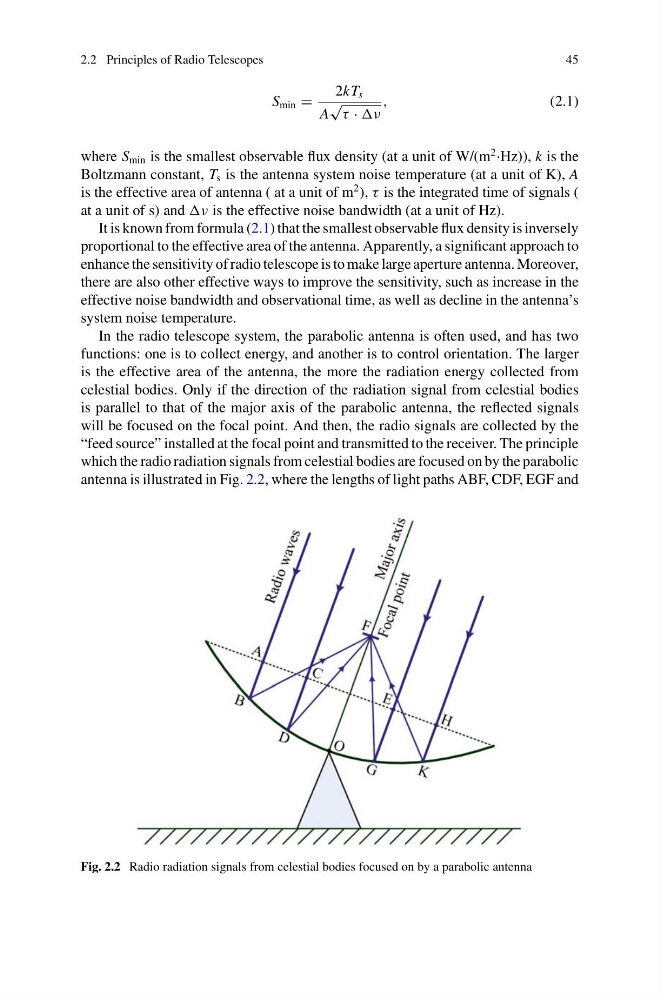
In the radio telescope system, the parabolic antenna is often used, and has two
functions: one is to collect energy, and another is to control orientation. The larger
is the effective area of the antenna, the more the radiation energy collected from
celestial bodies. Only if the direction of the radiation signal from celestial bodies
is parallel to that of the major axis of the parabolic antenna, the reflected signals
will be focused on the focal point. And then, the radio signals are collected by the
“feed source” installed at the focal point and transmitted to the receiver. The principle
which the radio radiation signals from celestial bodies are focused on by the parabolic
antenna is illustrated in Fig. 2.2, where the lengths of light paths ABF, CDF, EGF and
Fig. 2.2 Radio radiation signals from celestial bodies focused on by a parabolic antenna
45
S min =
2kT s
A
√ τ · ν
,
(2.1)
where S min is the smallest observable flux density (at a unit of W/(m
2 ·Hz)), k is the
Boltzmann constant, T s is the antenna system noise temperature (at a unit of K), A
is the effective area of antenna ( at a unit of m
2 ), τ is the integrated time of signals (
at a unit of s) and ν is the effective noise bandwidth (at a unit of Hz).
It is known from formula (2.1) that the smallest observable flux density is inversely
proportional to the effective area of the antenna. Apparently, a significant approach to
enhance the sensitivity of radio telescope is to make large aperture antenna. Moreover,
there are also other effective ways to improve the sensitivity, such as increase in the
effective noise bandwidth and observational time, as well as decline in the antenna’s
system noise temperature.
In the radio telescope system, the parabolic antenna is often used, and has two
functions: one is to collect energy, and another is to control orientation. The larger
is the effective area of the antenna, the more the radiation energy collected from
celestial bodies. Only if the direction of the radiation signal from celestial bodies
is parallel to that of the major axis of the parabolic antenna, the reflected signals
will be focused on the focal point. And then, the radio signals are collected by the
“feed source” installed at the focal point and transmitted to the receiver. The principle
which the radio radiation signals from celestial bodies are focused on by the parabolic
antenna is illustrated in Fig. 2.2, where the lengths of light paths ABF, CDF, EGF and
Fig. 2.2 Radio radiation signals from celestial bodies focused on by a parabolic antenna