

44
2 Observations of Radio and X-ray Pulsars
telescopes. Moreover, the radio observations are not affected from solar diffuse radiations and clouds, and can be conducted in the daytime and at night. Obviously, the
radio telescopes are really a kind of astronomical observation devices at all weather
and full time.
2.2.1 Composition of Radio Telescope System
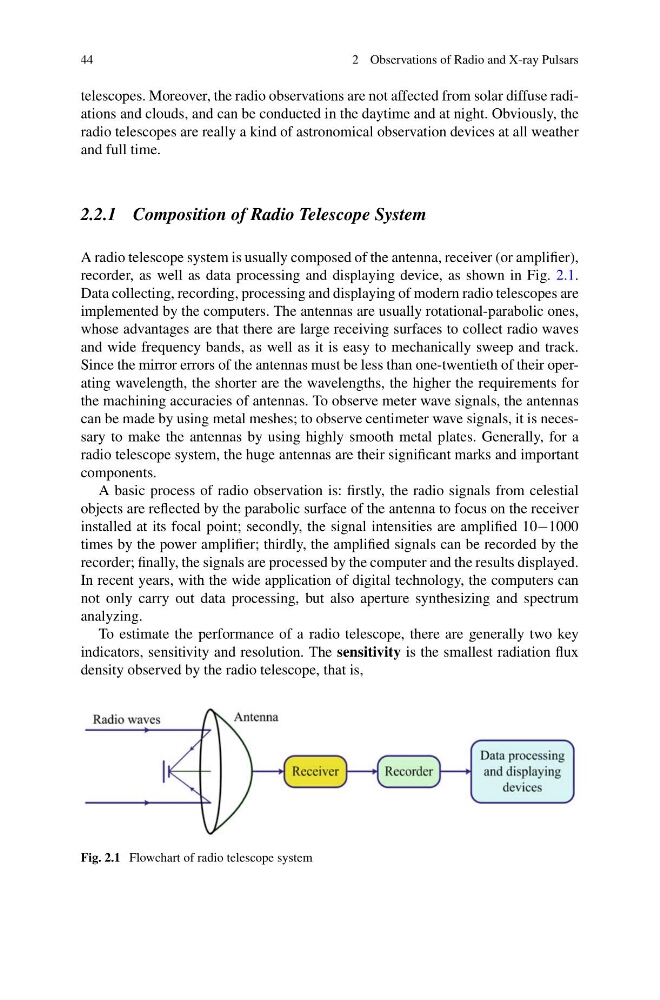
A radio telescope system is usually composed of the antenna, receiver (or amplifier),
recorder, as well as data processing and displaying device, as shown in Fig. 2.1.
Data collecting, recording, processing and displaying of modern radio telescopes are
implemented by the computers. The antennas are usually rotational-parabolic ones,
whose advantages are that there are large receiving surfaces to collect radio waves
and wide frequency bands, as well as it is easy to mechanically sweep and track.
Since the mirror errors of the antennas must be less than one-twentieth of their operating wavelength, the shorter are the wavelengths, the higher the requirements for
the machining accuracies of antennas. To observe meter wave signals, the antennas
can be made by using metal meshes; to observe centimeter wave signals, it is necessary to make the antennas by using highly smooth metal plates. Generally, for a
radio telescope system, the huge antennas are their significant marks and important
components.
A basic process of radio observation is: firstly, the radio signals from celestial
objects are reflected by the parabolic surface of the antenna to focus on the receiver
installed at its focal point; secondly, the signal intensities are amplified 10−1000
times by the power amplifier; thirdly, the amplified signals can be recorded by the
recorder; finally, the signals are processed by the computer and the results displayed.
In recent years, with the wide application of digital technology, the computers can
not only carry out data processing, but also aperture synthesizing and spectrum
analyzing.
To estimate the performance of a radio telescope, there are generally two key
indicators, sensitivity and resolution. The sensitivity is the smallest radiation flux
density observed by the radio telescope, that is,
Fig. 2.1 Flowchart of radio telescope system
2 Observations of Radio and X-ray Pulsars
telescopes. Moreover, the radio observations are not affected from solar diffuse radiations and clouds, and can be conducted in the daytime and at night. Obviously, the
radio telescopes are really a kind of astronomical observation devices at all weather
and full time.
2.2.1 Composition of Radio Telescope System
A radio telescope system is usually composed of the antenna, receiver (or amplifier),
recorder, as well as data processing and displaying device, as shown in Fig. 2.1.
Data collecting, recording, processing and displaying of modern radio telescopes are
implemented by the computers. The antennas are usually rotational-parabolic ones,
whose advantages are that there are large receiving surfaces to collect radio waves
and wide frequency bands, as well as it is easy to mechanically sweep and track.
Since the mirror errors of the antennas must be less than one-twentieth of their operating wavelength, the shorter are the wavelengths, the higher the requirements for
the machining accuracies of antennas. To observe meter wave signals, the antennas
can be made by using metal meshes; to observe centimeter wave signals, it is necessary to make the antennas by using highly smooth metal plates. Generally, for a
radio telescope system, the huge antennas are their significant marks and important
components.
A basic process of radio observation is: firstly, the radio signals from celestial
objects are reflected by the parabolic surface of the antenna to focus on the receiver
installed at its focal point; secondly, the signal intensities are amplified 10−1000
times by the power amplifier; thirdly, the amplified signals can be recorded by the
recorder; finally, the signals are processed by the computer and the results displayed.
In recent years, with the wide application of digital technology, the computers can
not only carry out data processing, but also aperture synthesizing and spectrum
analyzing.
To estimate the performance of a radio telescope, there are generally two key
indicators, sensitivity and resolution. The sensitivity is the smallest radiation flux
density observed by the radio telescope, that is,
Fig. 2.1 Flowchart of radio telescope system