

36
1 Introduction to the Pulsars
It is known from formula (1.10) that the group velocities from radio pulsars are
slightly less than the velocity of light in vacuum and associated with the frequencies of
the electromagnetic waves. The lower are the frequencies of electromagnetic waves,
the smaller the group velocities in the interstellar medium.
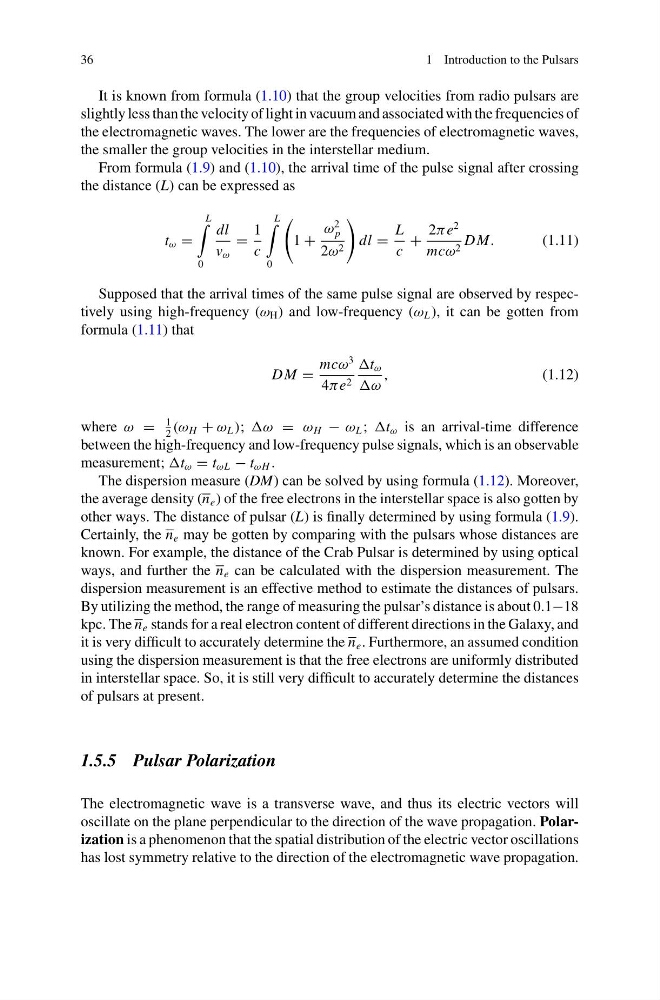
From formula (1.9) and (1.10), the arrival time of the pulse signal after crossing
the distance (L) can be expressed as
t ω =
L
0
dl
v ω
=
1
c
L
0
1 +
ω
2
p
2ω 2
dl =
L
c
+
2π e
2
mcω 2 DM.
(1.11)
Supposed that the arrival times of the same pulse signal are observed by respectively using high-frequency (ω H ) and low-frequency (ω L ), it can be gotten from
formula (1.11) that
DM =
mcω
3
4π e 2
t ω
ω
,
(1.12)
where ω =
1
2 (ω H + ω L ); ω = ω H − ω L ; t ω is an arrival-time difference
between the high-frequency and low-frequency pulse signals, which is an observable
measurement; t ω = t ωL − t ωH .
The dispersion measure (DM) can be solved by using formula (1.12). Moreover,
the average density (n e ) of the free electrons in the interstellar space is also gotten by
other ways. The distance of pulsar (L) is finally determined by using formula (1.9).
Certainly, the n e may be gotten by comparing with the pulsars whose distances are
known. For example, the distance of the Crab Pulsar is determined by using optical
ways, and further the n e can be calculated with the dispersion measurement. The
dispersion measurement is an effective method to estimate the distances of pulsars.
By utilizing the method, the range of measuring the pulsar’s distance is about 0.1−18
kpc. The n e stands for a real electron content of different directions in the Galaxy, and
it is very difficult to accurately determine the n e . Furthermore, an assumed condition
using the dispersion measurement is that the free electrons are uniformly distributed
in interstellar space. So, it is still very difficult to accurately determine the distances
of pulsars at present.
1.5.5 Pulsar Polarization
The electromagnetic wave is a transverse wave, and thus its electric vectors will
oscillate on the plane perpendicular to the direction of the wave propagation. Polarization is a phenomenon that the spatial distribution of the electric vector oscillations
has lost symmetry relative to the direction of the electromagnetic wave propagation.
1 Introduction to the Pulsars
It is known from formula (1.10) that the group velocities from radio pulsars are
slightly less than the velocity of light in vacuum and associated with the frequencies of
the electromagnetic waves. The lower are the frequencies of electromagnetic waves,
the smaller the group velocities in the interstellar medium.
From formula (1.9) and (1.10), the arrival time of the pulse signal after crossing
the distance (L) can be expressed as
t ω =
L
0
dl
v ω
=
1
c
L
0
1 +
ω
2
p
2ω 2
dl =
L
c
+
2π e
2
mcω 2 DM.
(1.11)
Supposed that the arrival times of the same pulse signal are observed by respectively using high-frequency (ω H ) and low-frequency (ω L ), it can be gotten from
formula (1.11) that
DM =
mcω
3
4π e 2
t ω
ω
,
(1.12)
where ω =
1
2 (ω H + ω L ); ω = ω H − ω L ; t ω is an arrival-time difference
between the high-frequency and low-frequency pulse signals, which is an observable
measurement; t ω = t ωL − t ωH .
The dispersion measure (DM) can be solved by using formula (1.12). Moreover,
the average density (n e ) of the free electrons in the interstellar space is also gotten by
other ways. The distance of pulsar (L) is finally determined by using formula (1.9).
Certainly, the n e may be gotten by comparing with the pulsars whose distances are
known. For example, the distance of the Crab Pulsar is determined by using optical
ways, and further the n e can be calculated with the dispersion measurement. The
dispersion measurement is an effective method to estimate the distances of pulsars.
By utilizing the method, the range of measuring the pulsar’s distance is about 0.1−18
kpc. The n e stands for a real electron content of different directions in the Galaxy, and
it is very difficult to accurately determine the n e . Furthermore, an assumed condition
using the dispersion measurement is that the free electrons are uniformly distributed
in interstellar space. So, it is still very difficult to accurately determine the distances
of pulsars at present.
1.5.5 Pulsar Polarization
The electromagnetic wave is a transverse wave, and thus its electric vectors will
oscillate on the plane perpendicular to the direction of the wave propagation. Polarization is a phenomenon that the spatial distribution of the electric vector oscillations
has lost symmetry relative to the direction of the electromagnetic wave propagation.