

1.5 The Observational Features
35
1.5.4 Distance Measurement
In astronomy, the interstellar medium is the matter and radiation that exist in space
between the star systems in a galaxy. The interstellar medium is generally regarded
as a kind of rare plasmas. When the electromagnetic waves emitted from pulsars
travel through the interstellar medium, a phenomenon referred to as dispersion will
occur. The dispersion is a basic property that the refractive index of the interstellar
medium is decreased with the incident electromagnetic wave frequency decreasing.
In other words, there are discrepancies among the propagation velocities of the electromagnetic waves with different frequencies as they travel through the interstellar
medium.
For the radio signals of wider frequency bands emitted from pulsars, the time
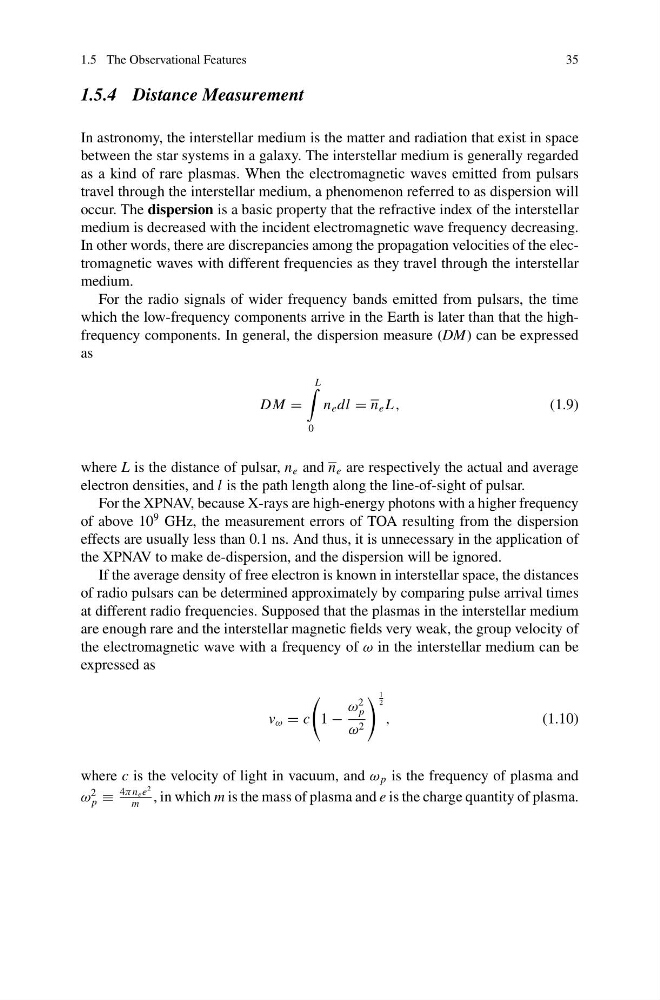
which the low-frequency components arrive in the Earth is later than that the highfrequency components. In general, the dispersion measure (DM) can be expressed
as
DM =
L
0
n e dl = n e L ,
(1.9)
where L is the distance of pulsar, n e and n e are respectively the actual and average
electron densities, and l is the path length along the line-of-sight of pulsar.
For the XPNAV, because X-rays are high-energy photons with a higher frequency
of above 10
9 GHz, the measurement errors of TOA resulting from the dispersion
effects are usually less than 0.1 ns. And thus, it is unnecessary in the application of
the XPNAV to make de-dispersion, and the dispersion will be ignored.
If the average density of free electron is known in interstellar space, the distances
of radio pulsars can be determined approximately by comparing pulse arrival times
at different radio frequencies. Supposed that the plasmas in the interstellar medium
are enough rare and the interstellar magnetic fields very weak, the group velocity of
the electromagnetic wave with a frequency of ω in the interstellar medium can be
expressed as
v ω = c
1 −
ω
2
p
ω 2
1
2
,
(1.10)
where c is the velocity of light in vacuum, and ω p is the frequency of plasma and
ω
2
p ≡
4πn e e
2
m
, in which m is the mass of plasma and e is the charge quantity of plasma.
35
1.5.4 Distance Measurement
In astronomy, the interstellar medium is the matter and radiation that exist in space
between the star systems in a galaxy. The interstellar medium is generally regarded
as a kind of rare plasmas. When the electromagnetic waves emitted from pulsars
travel through the interstellar medium, a phenomenon referred to as dispersion will
occur. The dispersion is a basic property that the refractive index of the interstellar
medium is decreased with the incident electromagnetic wave frequency decreasing.
In other words, there are discrepancies among the propagation velocities of the electromagnetic waves with different frequencies as they travel through the interstellar
medium.
For the radio signals of wider frequency bands emitted from pulsars, the time
which the low-frequency components arrive in the Earth is later than that the highfrequency components. In general, the dispersion measure (DM) can be expressed
as
DM =
L
0
n e dl = n e L ,
(1.9)
where L is the distance of pulsar, n e and n e are respectively the actual and average
electron densities, and l is the path length along the line-of-sight of pulsar.
For the XPNAV, because X-rays are high-energy photons with a higher frequency
of above 10
9 GHz, the measurement errors of TOA resulting from the dispersion
effects are usually less than 0.1 ns. And thus, it is unnecessary in the application of
the XPNAV to make de-dispersion, and the dispersion will be ignored.
If the average density of free electron is known in interstellar space, the distances
of radio pulsars can be determined approximately by comparing pulse arrival times
at different radio frequencies. Supposed that the plasmas in the interstellar medium
are enough rare and the interstellar magnetic fields very weak, the group velocity of
the electromagnetic wave with a frequency of ω in the interstellar medium can be
expressed as
v ω = c
1 −
ω
2
p
ω 2
1
2
,
(1.10)
where c is the velocity of light in vacuum, and ω p is the frequency of plasma and
ω
2
p ≡
4πn e e
2
m
, in which m is the mass of plasma and e is the charge quantity of plasma.