

5.8 The First Space Flight Test and Its Results
383
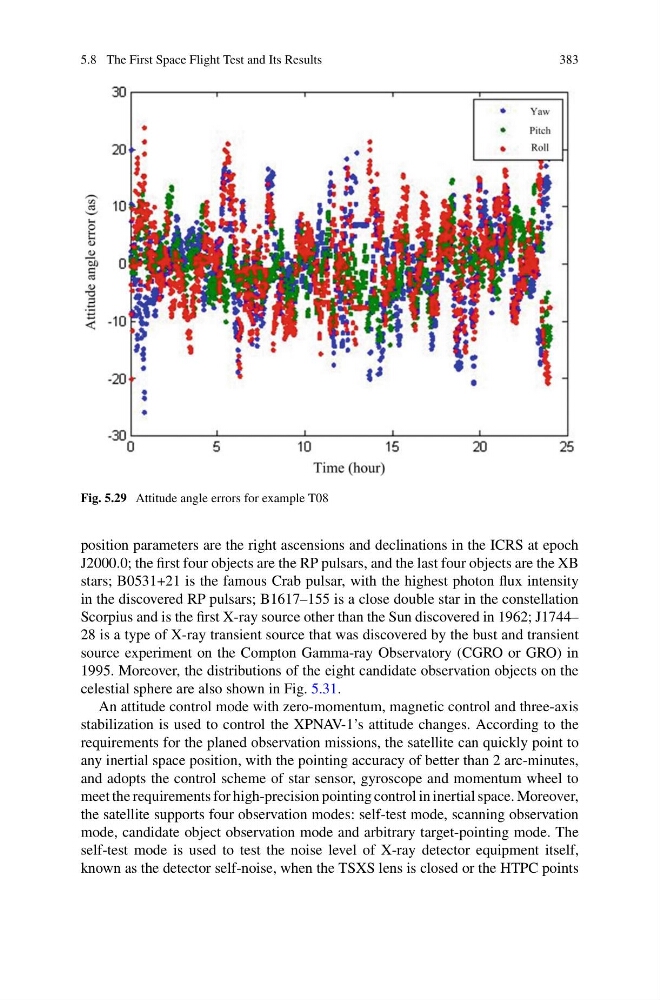
Fig. 5.29 Attitude angle errors for example T08
position parameters are the right ascensions and declinations in the ICRS at epoch
J2000.0; the first four objects are the RP pulsars, and the last four objects are the XB
stars; B0531+21 is the famous Crab pulsar, with the highest photon flux intensity
in the discovered RP pulsars; B1617–155 is a close double star in the constellation
Scorpius and is the first X-ray source other than the Sun discovered in 1962; J1744–
28 is a type of X-ray transient source that was discovered by the bust and transient
source experiment on the Compton Gamma-ray Observatory (CGRO or GRO) in
1995. Moreover, the distributions of the eight candidate observation objects on the
celestial sphere are also shown in Fig. 5.31.
An attitude control mode with zero-momentum, magnetic control and three-axis
stabilization is used to control the XPNAV-1’s attitude changes. According to the
requirements for the planed observation missions, the satellite can quickly point to
any inertial space position, with the pointing accuracy of better than 2 arc-minutes,
and adopts the control scheme of star sensor, gyroscope and momentum wheel to
meet the requirements for high-precision pointing control in inertial space. Moreover,
the satellite supports four observation modes: self-test mode, scanning observation
mode, candidate object observation mode and arbitrary target-pointing mode. The
self-test mode is used to test the noise level of X-ray detector equipment itself,
known as the detector self-noise, when the TSXS lens is closed or the HTPC points
383
Fig. 5.29 Attitude angle errors for example T08
position parameters are the right ascensions and declinations in the ICRS at epoch
J2000.0; the first four objects are the RP pulsars, and the last four objects are the XB
stars; B0531+21 is the famous Crab pulsar, with the highest photon flux intensity
in the discovered RP pulsars; B1617–155 is a close double star in the constellation
Scorpius and is the first X-ray source other than the Sun discovered in 1962; J1744–
28 is a type of X-ray transient source that was discovered by the bust and transient
source experiment on the Compton Gamma-ray Observatory (CGRO or GRO) in
1995. Moreover, the distributions of the eight candidate observation objects on the
celestial sphere are also shown in Fig. 5.31.
An attitude control mode with zero-momentum, magnetic control and three-axis
stabilization is used to control the XPNAV-1’s attitude changes. According to the
requirements for the planed observation missions, the satellite can quickly point to
any inertial space position, with the pointing accuracy of better than 2 arc-minutes,
and adopts the control scheme of star sensor, gyroscope and momentum wheel to
meet the requirements for high-precision pointing control in inertial space. Moreover,
the satellite supports four observation modes: self-test mode, scanning observation
mode, candidate object observation mode and arbitrary target-pointing mode. The
self-test mode is used to test the noise level of X-ray detector equipment itself,
known as the detector self-noise, when the TSXS lens is closed or the HTPC points