

5.7 Design of Ground Test System
373
In the numerical experiments that the orbit and time parameters of navigation
satellites are determined by using the X-ray pulsars, two groups of numerical analysis test schemes are selected, for the application scenarios that only one detector is
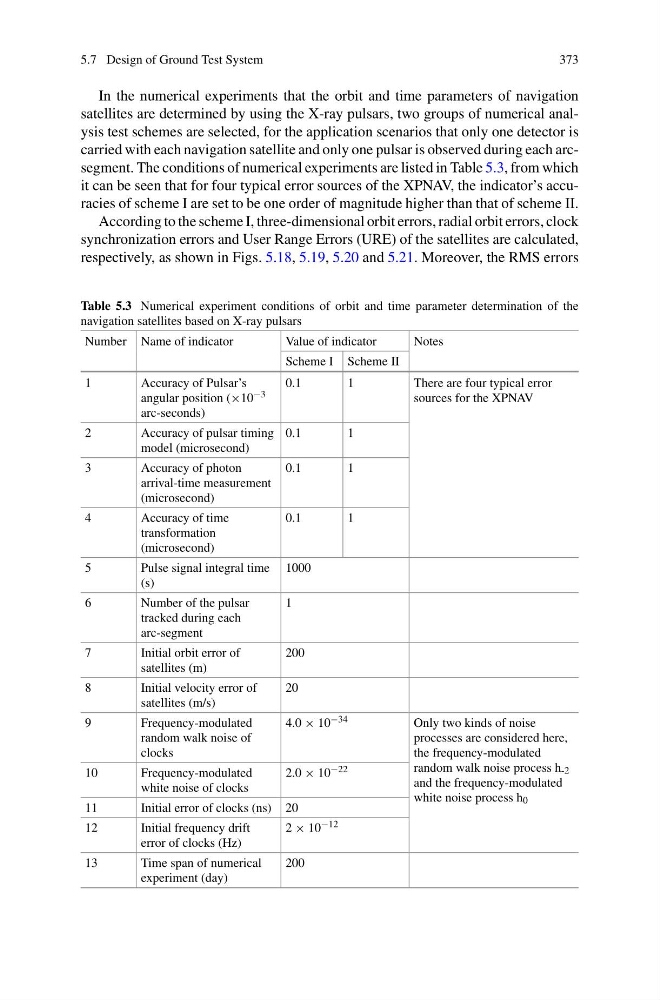
carried with each navigation satellite and only one pulsar is observed during each arcsegment. The conditions of numerical experiments are listed in Table 5.3, from which
it can be seen that for four typical error sources of the XPNAV, the indicator’s accuracies of scheme I are set to be one order of magnitude higher than that of scheme II.
According to the scheme I, three-dimensional orbit errors, radial orbit errors, clock
synchronization errors and User Range Errors (URE) of the satellites are calculated,
respectively, as shown in Figs. 5.18, 5.19, 5.20 and 5.21. Moreover, the RMS errors
Table 5.3 Numerical experiment conditions of orbit and time parameter determination of the
navigation satellites based on X-ray pulsars
Number Name of indicator
Value of indicator
Notes
Scheme I Scheme II
1
Accuracy of Pulsar’s
angular position (×10 −3
arc-seconds)
0.1
1
There are four typical error
sources for the XPNAV
2
Accuracy of pulsar timing
model (microsecond)
0.1
1
3
Accuracy of photon
arrival-time measurement
(microsecond)
0.1
1
4
Accuracy of time
transformation
(microsecond)
0.1
1
5
Pulse signal integral time
(s)
1000
6
Number of the pulsar
tracked during each
arc-segment
1
7
Initial orbit error of
satellites (m)
200
8
Initial velocity error of
satellites (m/s)
20
9
Frequency-modulated
random walk noise of
clocks
4.0 × 10 −34
Only two kinds of noise
processes are considered here,
the frequency-modulated
random walk noise process h -2
and the frequency-modulated
white noise process h 0
10
Frequency-modulated
white noise of clocks
2.0 × 10 −22
11
Initial error of clocks (ns) 20
12
Initial frequency drift
error of clocks (Hz)
2 × 10 −12
13
Time span of numerical
experiment (day)
200
373
In the numerical experiments that the orbit and time parameters of navigation
satellites are determined by using the X-ray pulsars, two groups of numerical analysis test schemes are selected, for the application scenarios that only one detector is
carried with each navigation satellite and only one pulsar is observed during each arcsegment. The conditions of numerical experiments are listed in Table 5.3, from which
it can be seen that for four typical error sources of the XPNAV, the indicator’s accuracies of scheme I are set to be one order of magnitude higher than that of scheme II.
According to the scheme I, three-dimensional orbit errors, radial orbit errors, clock
synchronization errors and User Range Errors (URE) of the satellites are calculated,
respectively, as shown in Figs. 5.18, 5.19, 5.20 and 5.21. Moreover, the RMS errors
Table 5.3 Numerical experiment conditions of orbit and time parameter determination of the
navigation satellites based on X-ray pulsars
Number Name of indicator
Value of indicator
Notes
Scheme I Scheme II
1
Accuracy of Pulsar’s
angular position (×10 −3
arc-seconds)
0.1
1
There are four typical error
sources for the XPNAV
2
Accuracy of pulsar timing
model (microsecond)
0.1
1
3
Accuracy of photon
arrival-time measurement
(microsecond)
0.1
1
4
Accuracy of time
transformation
(microsecond)
0.1
1
5
Pulse signal integral time
(s)
1000
6
Number of the pulsar
tracked during each
arc-segment
1
7
Initial orbit error of
satellites (m)
200
8
Initial velocity error of
satellites (m/s)
20
9
Frequency-modulated
random walk noise of
clocks
4.0 × 10 −34
Only two kinds of noise
processes are considered here,
the frequency-modulated
random walk noise process h -2
and the frequency-modulated
white noise process h 0
10
Frequency-modulated
white noise of clocks
2.0 × 10 −22
11
Initial error of clocks (ns) 20
12
Initial frequency drift
error of clocks (Hz)
2 × 10 −12
13
Time span of numerical
experiment (day)
200