

372
5 X-ray Pulsar-Based Navigation: Theories and Experiments
planes are evenly arranged relative to the reference plane, and the satellites in the
same orbital plane are evenly distributed. The typical Walker constellation is usually
described by three parameters: total of satellites (T), number of orbital planes (P)
and phase angle coefficient (F) of the corresponding satellites between the adjacent
orbits, and then the Walker T/P/F is used to describe the formation of constellation,
where the value range of parameter F is any integer between 0 and (P-1). In addition,
one parameter of inclination (δ) of the orbital plane is added, and thus the constellation configuration can be determined completely. Therefore, sometimes the Walker
constellation is also called Walker-δ constellation. The navigation constellation
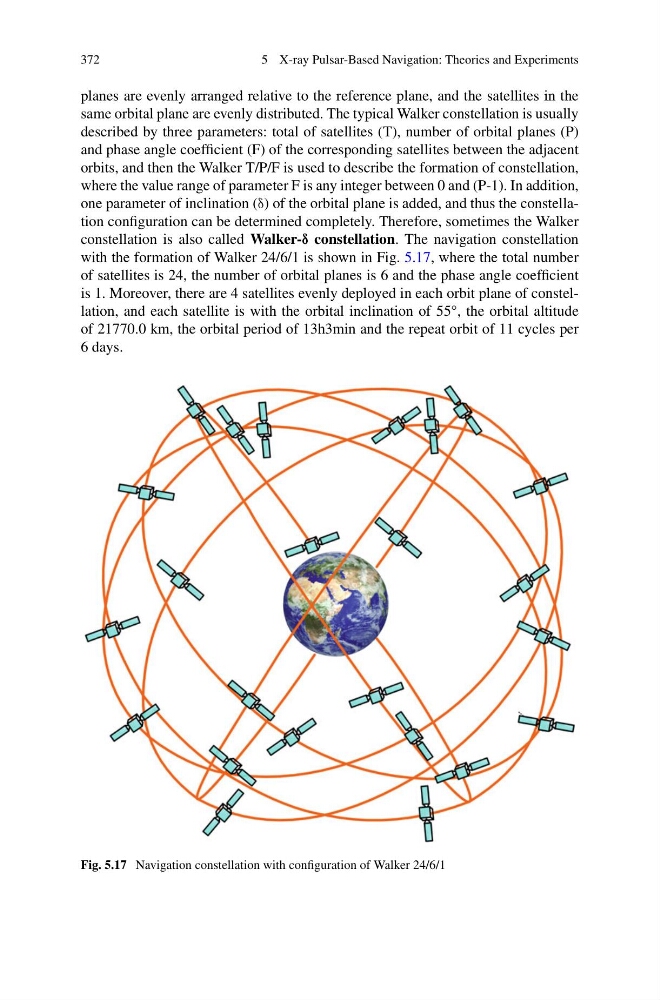
with the formation of Walker 24/6/1 is shown in Fig. 5.17, where the total number
of satellites is 24, the number of orbital planes is 6 and the phase angle coefficient
is 1. Moreover, there are 4 satellites evenly deployed in each orbit plane of constellation, and each satellite is with the orbital inclination of 55°, the orbital altitude
of 21770.0 km, the orbital period of 13h3min and the repeat orbit of 11 cycles per
6 days.
Fig. 5.17 Navigation constellation with configuration of Walker 24/6/1
5 X-ray Pulsar-Based Navigation: Theories and Experiments
planes are evenly arranged relative to the reference plane, and the satellites in the
same orbital plane are evenly distributed. The typical Walker constellation is usually
described by three parameters: total of satellites (T), number of orbital planes (P)
and phase angle coefficient (F) of the corresponding satellites between the adjacent
orbits, and then the Walker T/P/F is used to describe the formation of constellation,
where the value range of parameter F is any integer between 0 and (P-1). In addition,
one parameter of inclination (δ) of the orbital plane is added, and thus the constellation configuration can be determined completely. Therefore, sometimes the Walker
constellation is also called Walker-δ constellation. The navigation constellation
with the formation of Walker 24/6/1 is shown in Fig. 5.17, where the total number
of satellites is 24, the number of orbital planes is 6 and the phase angle coefficient
is 1. Moreover, there are 4 satellites evenly deployed in each orbit plane of constellation, and each satellite is with the orbital inclination of 55°, the orbital altitude
of 21770.0 km, the orbital period of 13h3min and the repeat orbit of 11 cycles per
6 days.
Fig. 5.17 Navigation constellation with configuration of Walker 24/6/1