

5.7 Design of Ground Test System
367
such as the X-ray photon detection, navigation database updating and calling, largescale space-time transformation, time system keeping, autonomous navigation algorithm and fault-tolerant processing, are tested and verified. The ground test system
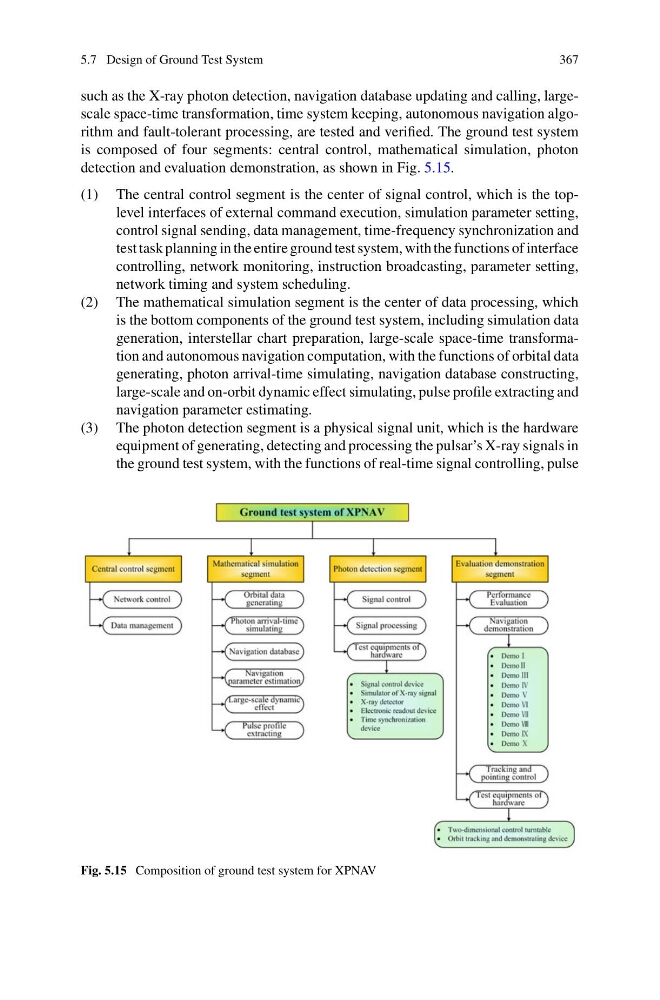
is composed of four segments: central control, mathematical simulation, photon
detection and evaluation demonstration, as shown in Fig. 5.15.
(1) The central control segment is the center of signal control, which is the toplevel interfaces of external command execution, simulation parameter setting,
control signal sending, data management, time-frequency synchronization and
test task planning in the entire ground test system, with the functions of interface
controlling, network monitoring, instruction broadcasting, parameter setting,
network timing and system scheduling.
(2) The mathematical simulation segment is the center of data processing, which
is the bottom components of the ground test system, including simulation data
generation, interstellar chart preparation, large-scale space-time transformation and autonomous navigation computation, with the functions of orbital data
generating, photon arrival-time simulating, navigation database constructing,
large-scale and on-orbit dynamic effect simulating, pulse profile extracting and
navigation parameter estimating.
(3) The photon detection segment is a physical signal unit, which is the hardware
equipment of generating, detecting and processing the pulsar’s X-ray signals in
the ground test system, with the functions of real-time signal controlling, pulse
Fig. 5.15 Composition of ground test system for XPNAV
367
such as the X-ray photon detection, navigation database updating and calling, largescale space-time transformation, time system keeping, autonomous navigation algorithm and fault-tolerant processing, are tested and verified. The ground test system
is composed of four segments: central control, mathematical simulation, photon
detection and evaluation demonstration, as shown in Fig. 5.15.
(1) The central control segment is the center of signal control, which is the toplevel interfaces of external command execution, simulation parameter setting,
control signal sending, data management, time-frequency synchronization and
test task planning in the entire ground test system, with the functions of interface
controlling, network monitoring, instruction broadcasting, parameter setting,
network timing and system scheduling.
(2) The mathematical simulation segment is the center of data processing, which
is the bottom components of the ground test system, including simulation data
generation, interstellar chart preparation, large-scale space-time transformation and autonomous navigation computation, with the functions of orbital data
generating, photon arrival-time simulating, navigation database constructing,
large-scale and on-orbit dynamic effect simulating, pulse profile extracting and
navigation parameter estimating.
(3) The photon detection segment is a physical signal unit, which is the hardware
equipment of generating, detecting and processing the pulsar’s X-ray signals in
the ground test system, with the functions of real-time signal controlling, pulse
Fig. 5.15 Composition of ground test system for XPNAV