

5.6 Methods of Large-Scale Navigation
349
of light in vacuum; n SSB is the direction vector from the SSB to pulsar; n SC is the
direction vector from the spacecraft to pulsar; b, p and D are, respectively, the position
vectors of the SSB, spacecraft and pulsar in the coordinate system at the center of
mass of the Sun, O S − X S Y S Z S , as shown in Fig. 5.1; b = b; p = p; D = D;
p x and D x are, respectively, the components of vectors p and D on the X-axis in the
O S − X S Y S Z S ; D y is the component of vector D on the Y-axis in the O S − X S Y S Z S ;
b k , p k and D k are the vectors from the center of mass of the solar system’s planet
k to the SSB, spacecraft and pulsar, respectively; μ S and μ k are, respectively, the
gravitational constants of the Sun and solar system’s planet k; m P is the total number
of the Sun and the solar system’s planets.
On the right of formula (5.105), the first and second terms denote the time delay
produced by the geometric distance from the pulsar to spacecraft; the third and
fourth terms denote the sum of the Shapiro delay effect resulted from the planets in
the solar system; the fifth, sixth, seventh and eighth terms denote the light deflected
in the gravitation field of the Sun, whose time delay is generally less than 1 ns.
Theoretically, using formula (5.105) under timescale the TCB, the coordinate time
of X-ray photons arriving at the spacecraft is transformed to the SSB, with the transformation accuracy of 0.1 ns level. Although the time delay transformation accuracy
using formula (5.105) is high, the computing process is extremely cumbersome. In
practical application, it is necessary to simplify the processing, and of course, it
will degrade the accuracy of time transformation. If the deflection of light produced
by the gravitational field of the Sun and the gravitational effects produced by the
planets may be ignored, and it is supposed that the velocity of proper motion of the
pulsar is constant, as well as the time differences emitting the photons approximately
equal to those receiving them, and the direction of the line of sight of the pulsar is
approximately a constant vector, then a simplified time delay model can be expressed
as
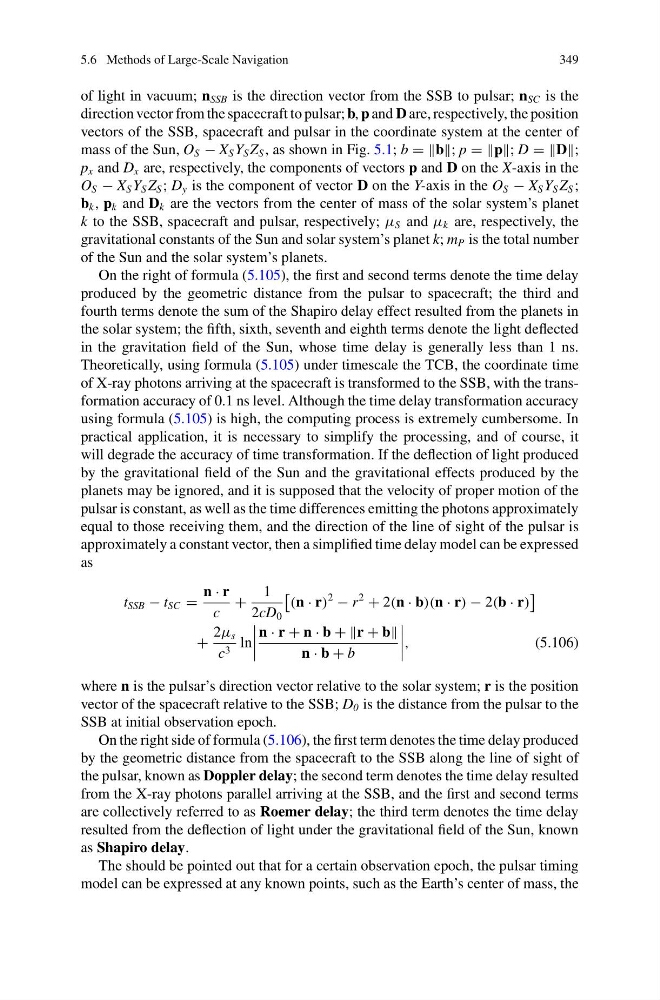
t SSB − t SC =
n · r
c
+
1
2cD 0
(n · r)
2
− r
2
+ 2(n · b)(n · r) − 2(b · r)
+
2μ s
c 3 ln
n · r + n · b + r + b
n · b + b
,
(5.106)
where n is the pulsar’s direction vector relative to the solar system; r is the position
vector of the spacecraft relative to the SSB; D 0 is the distance from the pulsar to the
SSB at initial observation epoch.
On the right side of formula (5.106), the first term denotes the time delay produced
by the geometric distance from the spacecraft to the SSB along the line of sight of
the pulsar, known as Doppler delay; the second term denotes the time delay resulted
from the X-ray photons parallel arriving at the SSB, and the first and second terms
are collectively referred to as Roemer delay; the third term denotes the time delay
resulted from the deflection of light under the gravitational field of the Sun, known
as Shapiro delay.
The should be pointed out that for a certain observation epoch, the pulsar timing
model can be expressed at any known points, such as the Earth’s center of mass, the
349
of light in vacuum; n SSB is the direction vector from the SSB to pulsar; n SC is the
direction vector from the spacecraft to pulsar; b, p and D are, respectively, the position
vectors of the SSB, spacecraft and pulsar in the coordinate system at the center of
mass of the Sun, O S − X S Y S Z S , as shown in Fig. 5.1; b = b; p = p; D = D;
p x and D x are, respectively, the components of vectors p and D on the X-axis in the
O S − X S Y S Z S ; D y is the component of vector D on the Y-axis in the O S − X S Y S Z S ;
b k , p k and D k are the vectors from the center of mass of the solar system’s planet
k to the SSB, spacecraft and pulsar, respectively; μ S and μ k are, respectively, the
gravitational constants of the Sun and solar system’s planet k; m P is the total number
of the Sun and the solar system’s planets.
On the right of formula (5.105), the first and second terms denote the time delay
produced by the geometric distance from the pulsar to spacecraft; the third and
fourth terms denote the sum of the Shapiro delay effect resulted from the planets in
the solar system; the fifth, sixth, seventh and eighth terms denote the light deflected
in the gravitation field of the Sun, whose time delay is generally less than 1 ns.
Theoretically, using formula (5.105) under timescale the TCB, the coordinate time
of X-ray photons arriving at the spacecraft is transformed to the SSB, with the transformation accuracy of 0.1 ns level. Although the time delay transformation accuracy
using formula (5.105) is high, the computing process is extremely cumbersome. In
practical application, it is necessary to simplify the processing, and of course, it
will degrade the accuracy of time transformation. If the deflection of light produced
by the gravitational field of the Sun and the gravitational effects produced by the
planets may be ignored, and it is supposed that the velocity of proper motion of the
pulsar is constant, as well as the time differences emitting the photons approximately
equal to those receiving them, and the direction of the line of sight of the pulsar is
approximately a constant vector, then a simplified time delay model can be expressed
as
t SSB − t SC =
n · r
c
+
1
2cD 0
(n · r)
2
− r
2
+ 2(n · b)(n · r) − 2(b · r)
+
2μ s
c 3 ln
n · r + n · b + r + b
n · b + b
,
(5.106)
where n is the pulsar’s direction vector relative to the solar system; r is the position
vector of the spacecraft relative to the SSB; D 0 is the distance from the pulsar to the
SSB at initial observation epoch.
On the right side of formula (5.106), the first term denotes the time delay produced
by the geometric distance from the spacecraft to the SSB along the line of sight of
the pulsar, known as Doppler delay; the second term denotes the time delay resulted
from the X-ray photons parallel arriving at the SSB, and the first and second terms
are collectively referred to as Roemer delay; the third term denotes the time delay
resulted from the deflection of light under the gravitational field of the Sun, known
as Shapiro delay.
The should be pointed out that for a certain observation epoch, the pulsar timing
model can be expressed at any known points, such as the Earth’s center of mass, the