

348
5 X-ray Pulsar-Based Navigation: Theories and Experiments
process of transforming the photon arrival-time from the spacecraft to the SSB is
called time delay transformation. And further, the pulse profile can be gotten, and
the pulse-arriving time measured. By comparing the measured pulse-arriving time
with the predicted one, the delays from the spacecraft to the SSB along the line
of sight of the pulsar are obtained and then are used to establish the measurement
equations of determining the spacecraft’s orbit and time parameters.
From the point of view of geometric orbit determination, the time transformation model with 1 μs error will result in the orbital error of 300 m for spacecrafts.
According the general relativity, for the X-ray photons radiated from the pulsars with
thousands or even tens of thousands of light-years away from the solar system, their
propagation path is curved, resulting in the delay of arrival-time. For this reason,
the high-precision time delay transformation model needs not only to correct the
spatial geometric distance, but also consider the effect of the relativity. A single
pulse signal is composed of a large number of X-ray photons radiated from the
pulsar, and the trajectory curve of each photon in four-dimensional space-time is a
world-line. For the X-ray photons radiated from the pulsar’s magnetic pole arriving
at the spacecraft’s detection devices, their passed through world-lines are the zerogeodetic lines. That is to say, the light-like space-time interval is equal to zero. So,
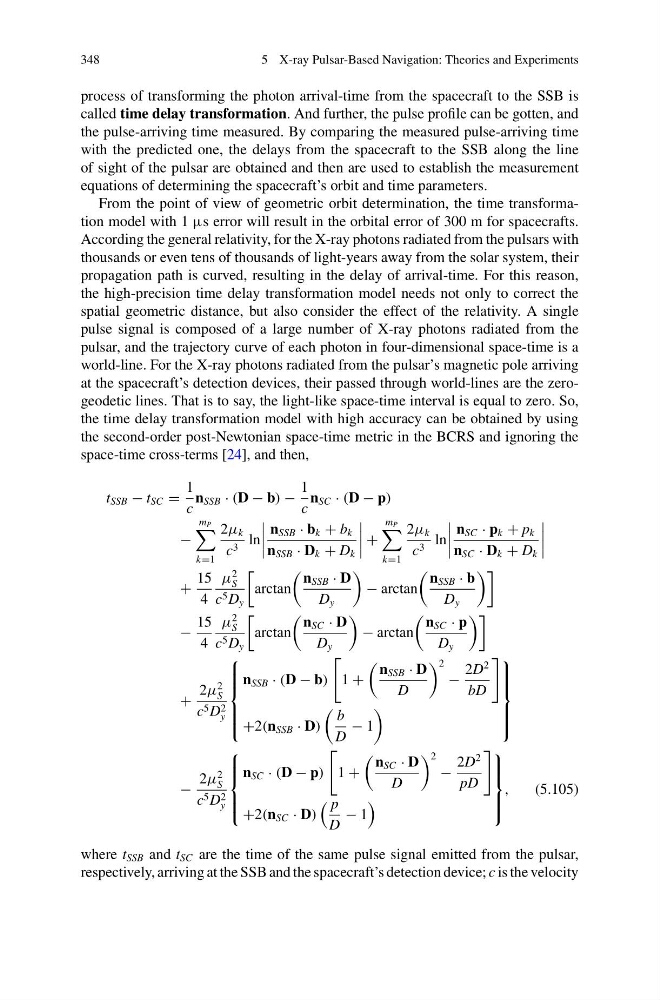
the time delay transformation model with high accuracy can be obtained by using
the second-order post-Newtonian space-time metric in the BCRS and ignoring the
space-time cross-terms [24], and then,
t SSB − t SC =
1
c
n SSB · (D − b) −
1
c
n SC · (D − p)
−
m P
k=1
2μ k
c 3 ln
n SSB · b k + b k
n SSB · D k + D k
+
m P
k=1
2μ k
c 3 ln
n SC · p k + p k
n SC · D k + D k
+
15
4
μ
2
S
c 5 D y
arctan
n SSB · D
D y
− arctan
n SSB · b
D y
−
15
4
μ
2
S
c 5 D y
arctan
n SC · D
D y
− arctan
n SC · p
D y
+
2μ
2
S
c 5 D 2
y
⎧
⎪ ⎪ ⎪ ⎨
⎪ ⎪ ⎪ ⎩
n SSB · (D − b)
1 +
n SSB · D
D
2
−
2D
2
bD
+2(n SSB · D)
b
D
− 1
⎫
⎪ ⎪ ⎪ ⎬
⎪ ⎪ ⎪ ⎭
−
2μ
2
S
c 5 D 2
y
⎧
⎪ ⎪ ⎨
⎪ ⎪ ⎩
n SC · (D − p)
1 +
n SC · D
D
2
−
2D
2
pD
+2(n SC · D)
p
D
− 1
⎫
⎪ ⎪ ⎬
⎪ ⎪ ⎭
,
(5.105)
where t SSB and t SC are the time of the same pulse signal emitted from the pulsar,
respectively, arriving at the SSB and the spacecraft’s detection device; c is the velocity
5 X-ray Pulsar-Based Navigation: Theories and Experiments
process of transforming the photon arrival-time from the spacecraft to the SSB is
called time delay transformation. And further, the pulse profile can be gotten, and
the pulse-arriving time measured. By comparing the measured pulse-arriving time
with the predicted one, the delays from the spacecraft to the SSB along the line
of sight of the pulsar are obtained and then are used to establish the measurement
equations of determining the spacecraft’s orbit and time parameters.
From the point of view of geometric orbit determination, the time transformation model with 1 μs error will result in the orbital error of 300 m for spacecrafts.
According the general relativity, for the X-ray photons radiated from the pulsars with
thousands or even tens of thousands of light-years away from the solar system, their
propagation path is curved, resulting in the delay of arrival-time. For this reason,
the high-precision time delay transformation model needs not only to correct the
spatial geometric distance, but also consider the effect of the relativity. A single
pulse signal is composed of a large number of X-ray photons radiated from the
pulsar, and the trajectory curve of each photon in four-dimensional space-time is a
world-line. For the X-ray photons radiated from the pulsar’s magnetic pole arriving
at the spacecraft’s detection devices, their passed through world-lines are the zerogeodetic lines. That is to say, the light-like space-time interval is equal to zero. So,
the time delay transformation model with high accuracy can be obtained by using
the second-order post-Newtonian space-time metric in the BCRS and ignoring the
space-time cross-terms [24], and then,
t SSB − t SC =
1
c
n SSB · (D − b) −
1
c
n SC · (D − p)
−
m P
k=1
2μ k
c 3 ln
n SSB · b k + b k
n SSB · D k + D k
+
m P
k=1
2μ k
c 3 ln
n SC · p k + p k
n SC · D k + D k
+
15
4
μ
2
S
c 5 D y
arctan
n SSB · D
D y
− arctan
n SSB · b
D y
−
15
4
μ
2
S
c 5 D y
arctan
n SC · D
D y
− arctan
n SC · p
D y
+
2μ
2
S
c 5 D 2
y
⎧
⎪ ⎪ ⎪ ⎨
⎪ ⎪ ⎪ ⎩
n SSB · (D − b)
1 +
n SSB · D
D
2
−
2D
2
bD
+2(n SSB · D)
b
D
− 1
⎫
⎪ ⎪ ⎪ ⎬
⎪ ⎪ ⎪ ⎭
−
2μ
2
S
c 5 D 2
y
⎧
⎪ ⎪ ⎨
⎪ ⎪ ⎩
n SC · (D − p)
1 +
n SC · D
D
2
−
2D
2
pD
+2(n SC · D)
p
D
− 1
⎫
⎪ ⎪ ⎬
⎪ ⎪ ⎭
,
(5.105)
where t SSB and t SC are the time of the same pulse signal emitted from the pulsar,
respectively, arriving at the SSB and the spacecraft’s detection device; c is the velocity