

5.5 Theory of Pulsar Timing System
333
ν =
1
P
˙
ν = −
˙
P
P 2
¨
ν =
2 ˙
P
P 3 −
¨
P
P 2
⎫
⎪ ⎪ ⎬
⎪ ⎪ ⎭
.
(5.85)
Thereby, the pulsar timing model can be also expressed as
(t) = (t 0 ) +
1
P
· (t − t 0 )
2
−
˙
P
2P 2 · (t − t 0 )
2
+
˙
P
2
3P 3 −
¨
P
6P 2
· (t − t 0 )
3
+ · · · ,
(5.86)
where P, ˙
P and ¨
P are the pulse period, and its first-order derivative and second-order
derivative, respectively.
Obviously, the establishment of the pulsar timing model is essentially to determine the periods or frequencies of the pulse signals, as well as their derivatives.
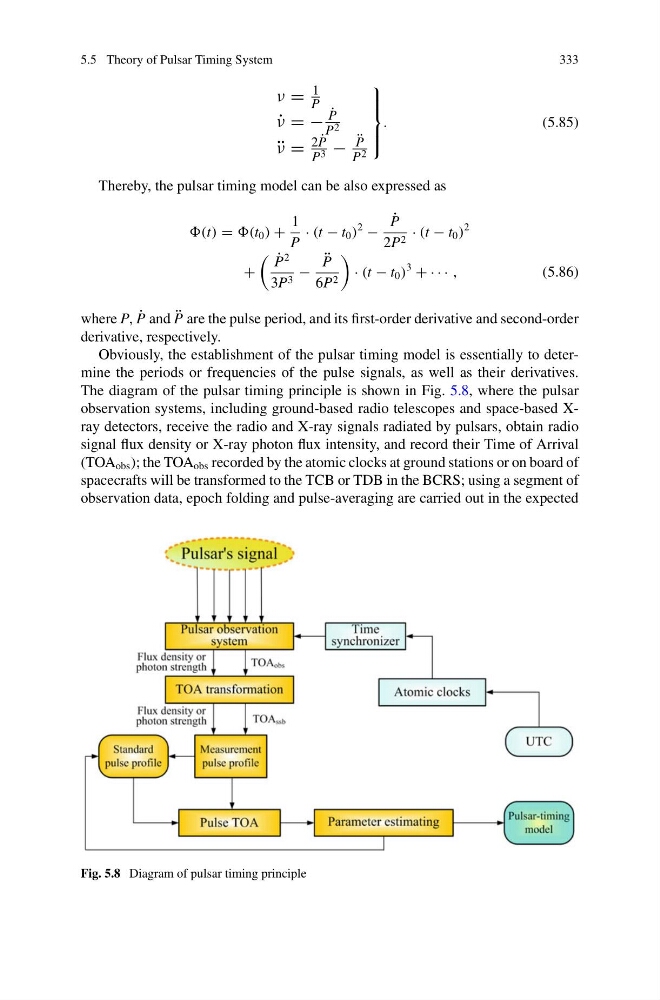
The diagram of the pulsar timing principle is shown in Fig. 5.8, where the pulsar
observation systems, including ground-based radio telescopes and space-based Xray detectors, receive the radio and X-ray signals radiated by pulsars, obtain radio
signal flux density or X-ray photon flux intensity, and record their Time of Arrival
(TOA obs ); the TOA obs recorded by the atomic clocks at ground stations or on board of
spacecrafts will be transformed to the TCB or TDB in the BCRS; using a segment of
observation data, epoch folding and pulse-averaging are carried out in the expected
Fig. 5.8 Diagram of pulsar timing principle
333
ν =
1
P
˙
ν = −
˙
P
P 2
¨
ν =
2 ˙
P
P 3 −
¨
P
P 2
⎫
⎪ ⎪ ⎬
⎪ ⎪ ⎭
.
(5.85)
Thereby, the pulsar timing model can be also expressed as
(t) = (t 0 ) +
1
P
· (t − t 0 )
2
−
˙
P
2P 2 · (t − t 0 )
2
+
˙
P
2
3P 3 −
¨
P
6P 2
· (t − t 0 )
3
+ · · · ,
(5.86)
where P, ˙
P and ¨
P are the pulse period, and its first-order derivative and second-order
derivative, respectively.
Obviously, the establishment of the pulsar timing model is essentially to determine the periods or frequencies of the pulse signals, as well as their derivatives.
The diagram of the pulsar timing principle is shown in Fig. 5.8, where the pulsar
observation systems, including ground-based radio telescopes and space-based Xray detectors, receive the radio and X-ray signals radiated by pulsars, obtain radio
signal flux density or X-ray photon flux intensity, and record their Time of Arrival
(TOA obs ); the TOA obs recorded by the atomic clocks at ground stations or on board of
spacecrafts will be transformed to the TCB or TDB in the BCRS; using a segment of
observation data, epoch folding and pulse-averaging are carried out in the expected
Fig. 5.8 Diagram of pulsar timing principle