

332
5 X-ray Pulsar-Based Navigation: Theories and Experiments
Therefore, in the past thirty years, it has been studied to create a large-scale and
long-term stable time system based on the pulsar’s rotation.
The pulsars are high-speed rotating neutron stars, with extremely stable periodicity, especially the millisecond pulsars, such as PSR B1937+21, B1855+09 and
J1713+074, whose pulse period change rates have reached 10
−19
− 10
−21 s/s. As a
result, the millisecond pulsars are known as the most stable clocks in nature [25].
The time system established by using extremely stable pulsar-rotating period is called
pulsar timing system, and the corresponding timescale is called Pulsar Time (PT).
The pulsar timing system has the following basic characteristics:
(1) The pulse periods of pulsars (also called rotating periods) have extremely good
uniformity, and its measurement accuracy is expected to be better than 10 ns.
(2) The pulsars can rotate and radiate signals for a long time continuously and
naturally. At any time and anywhere in the solar system, stable pulsating signals
can be gotten via processing the observation data from pulsars.
(3) Both the pulse-arriving time and PT can be expressed by using precise mathematical models, with the mathematical description characteristics of general
disciplines.
(4) With the aid of auxiliary devices, the PT has the features of counting and
displaying.
Obviously, the pulsars can satisfy the fundamental conditions for establishing a
time system and are the ideal standard sources metering time and frequency. Since
the first millisecond pulsar, PSR B1937+21 with a period of 1.557 ms, discovered in
1982, studies on using the millisecond pulsars for timing have been developed rapidly.
Currently, the accuracy of measuring the pulse arrival-time based on the pulsar timing
has reached the order of 0.1 μs, and the time stability for the pulsars observed
continually for about one year is better than 10
−14 s/s. Moreover, the instability of
the TAI has been detected by the PT.
The pulsar timing system is to establish a phase function represented by the TDB
or TCB as an independent variable, which is called pulsar timing model. Using
the pulsar timing model, the pulse-arriving time can be predicted accurately. In the
BCRS, the pulsar timing model can be expressed as the Taylor series expansion of
the phase of the pulsating signal, that is,
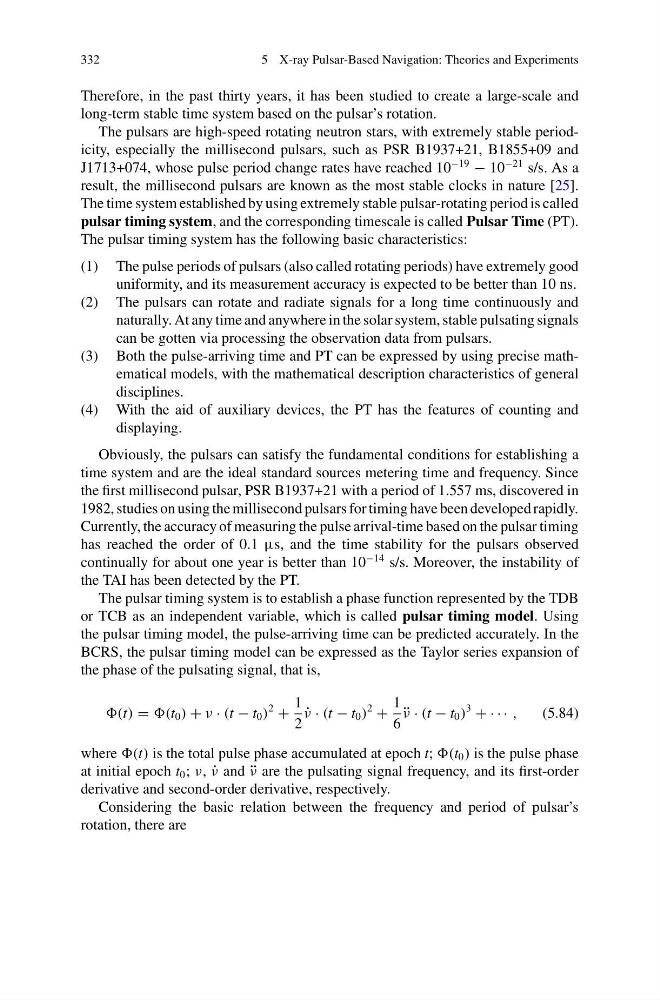
(t) = (t 0 ) + ν · (t − t 0 )
2
+
1
2
˙
ν · (t − t 0 )
2
+
1
6
¨
ν · (t − t 0 )
3
+ · · · ,
(5.84)
where (t) is the total pulse phase accumulated at epoch t; (t 0 ) is the pulse phase
at initial epoch t 0 ; ν, ˙
ν and ¨
ν are the pulsating signal frequency, and its first-order
derivative and second-order derivative, respectively.
Considering the basic relation between the frequency and period of pulsar’s
rotation, there are
5 X-ray Pulsar-Based Navigation: Theories and Experiments
Therefore, in the past thirty years, it has been studied to create a large-scale and
long-term stable time system based on the pulsar’s rotation.
The pulsars are high-speed rotating neutron stars, with extremely stable periodicity, especially the millisecond pulsars, such as PSR B1937+21, B1855+09 and
J1713+074, whose pulse period change rates have reached 10
−19
− 10
−21 s/s. As a
result, the millisecond pulsars are known as the most stable clocks in nature [25].
The time system established by using extremely stable pulsar-rotating period is called
pulsar timing system, and the corresponding timescale is called Pulsar Time (PT).
The pulsar timing system has the following basic characteristics:
(1) The pulse periods of pulsars (also called rotating periods) have extremely good
uniformity, and its measurement accuracy is expected to be better than 10 ns.
(2) The pulsars can rotate and radiate signals for a long time continuously and
naturally. At any time and anywhere in the solar system, stable pulsating signals
can be gotten via processing the observation data from pulsars.
(3) Both the pulse-arriving time and PT can be expressed by using precise mathematical models, with the mathematical description characteristics of general
disciplines.
(4) With the aid of auxiliary devices, the PT has the features of counting and
displaying.
Obviously, the pulsars can satisfy the fundamental conditions for establishing a
time system and are the ideal standard sources metering time and frequency. Since
the first millisecond pulsar, PSR B1937+21 with a period of 1.557 ms, discovered in
1982, studies on using the millisecond pulsars for timing have been developed rapidly.
Currently, the accuracy of measuring the pulse arrival-time based on the pulsar timing
has reached the order of 0.1 μs, and the time stability for the pulsars observed
continually for about one year is better than 10
−14 s/s. Moreover, the instability of
the TAI has been detected by the PT.
The pulsar timing system is to establish a phase function represented by the TDB
or TCB as an independent variable, which is called pulsar timing model. Using
the pulsar timing model, the pulse-arriving time can be predicted accurately. In the
BCRS, the pulsar timing model can be expressed as the Taylor series expansion of
the phase of the pulsating signal, that is,
(t) = (t 0 ) + ν · (t − t 0 )
2
+
1
2
˙
ν · (t − t 0 )
2
+
1
6
¨
ν · (t − t 0 )
3
+ · · · ,
(5.84)
where (t) is the total pulse phase accumulated at epoch t; (t 0 ) is the pulse phase
at initial epoch t 0 ; ν, ˙
ν and ¨
ν are the pulsating signal frequency, and its first-order
derivative and second-order derivative, respectively.
Considering the basic relation between the frequency and period of pulsar’s
rotation, there are