

5.4 Space-Time Reference Based on General Relativity
319
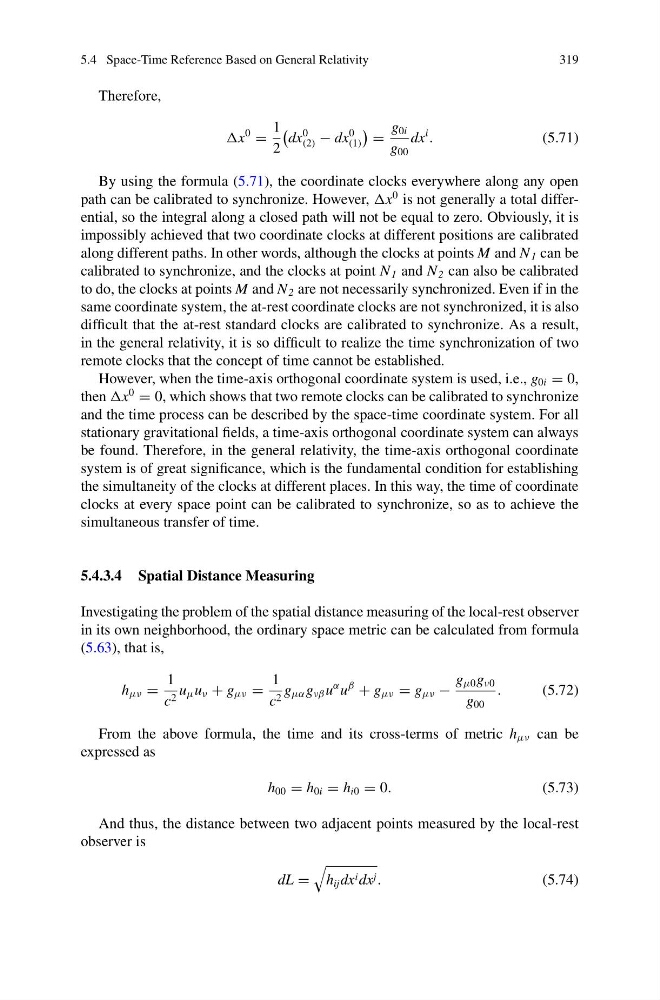
Therefore,
x
0
=
1
2
dx
0
(2) − dx
0
(1)
=
g 0i
g 00
dx
i
.
(5.71)
By using the formula (5.71), the coordinate clocks everywhere along any open
path can be calibrated to synchronize. However, x
0 is not generally a total differential, so the integral along a closed path will not be equal to zero. Obviously, it is
impossibly achieved that two coordinate clocks at different positions are calibrated
along different paths. In other words, although the clocks at points M and N 1 can be
calibrated to synchronize, and the clocks at point N 1 and N 2 can also be calibrated
to do, the clocks at points M and N 2 are not necessarily synchronized. Even if in the
same coordinate system, the at-rest coordinate clocks are not synchronized, it is also
difficult that the at-rest standard clocks are calibrated to synchronize. As a result,
in the general relativity, it is so difficult to realize the time synchronization of two
remote clocks that the concept of time cannot be established.
However, when the time-axis orthogonal coordinate system is used, i.e., g 0i = 0,
then x
0
= 0, which shows that two remote clocks can be calibrated to synchronize
and the time process can be described by the space-time coordinate system. For all
stationary gravitational fields, a time-axis orthogonal coordinate system can always
be found. Therefore, in the general relativity, the time-axis orthogonal coordinate
system is of great significance, which is the fundamental condition for establishing
the simultaneity of the clocks at different places. In this way, the time of coordinate
clocks at every space point can be calibrated to synchronize, so as to achieve the
simultaneous transfer of time.
5.4.3.4 Spatial Distance Measuring
Investigating the problem of the spatial distance measuring of the local-rest observer
in its own neighborhood, the ordinary space metric can be calculated from formula
(5.63), that is,
h μν =
1
c 2 u μ u ν + g μν =
1
c 2 g μα g νβ u
α u
β
+ g μν = g μν −
g μ0 g ν0
g 00
.
(5.72)
From the above formula, the time and its cross-terms of metric h μν can be
expressed as
h 00 = h 0i = h i0 = 0.
(5.73)
And thus, the distance between two adjacent points measured by the local-rest
observer is
dL =
h ij dx i dx j .
(5.74)
319
Therefore,
x
0
=
1
2
dx
0
(2) − dx
0
(1)
=
g 0i
g 00
dx
i
.
(5.71)
By using the formula (5.71), the coordinate clocks everywhere along any open
path can be calibrated to synchronize. However, x
0 is not generally a total differential, so the integral along a closed path will not be equal to zero. Obviously, it is
impossibly achieved that two coordinate clocks at different positions are calibrated
along different paths. In other words, although the clocks at points M and N 1 can be
calibrated to synchronize, and the clocks at point N 1 and N 2 can also be calibrated
to do, the clocks at points M and N 2 are not necessarily synchronized. Even if in the
same coordinate system, the at-rest coordinate clocks are not synchronized, it is also
difficult that the at-rest standard clocks are calibrated to synchronize. As a result,
in the general relativity, it is so difficult to realize the time synchronization of two
remote clocks that the concept of time cannot be established.
However, when the time-axis orthogonal coordinate system is used, i.e., g 0i = 0,
then x
0
= 0, which shows that two remote clocks can be calibrated to synchronize
and the time process can be described by the space-time coordinate system. For all
stationary gravitational fields, a time-axis orthogonal coordinate system can always
be found. Therefore, in the general relativity, the time-axis orthogonal coordinate
system is of great significance, which is the fundamental condition for establishing
the simultaneity of the clocks at different places. In this way, the time of coordinate
clocks at every space point can be calibrated to synchronize, so as to achieve the
simultaneous transfer of time.
5.4.3.4 Spatial Distance Measuring
Investigating the problem of the spatial distance measuring of the local-rest observer
in its own neighborhood, the ordinary space metric can be calculated from formula
(5.63), that is,
h μν =
1
c 2 u μ u ν + g μν =
1
c 2 g μα g νβ u
α u
β
+ g μν = g μν −
g μ0 g ν0
g 00
.
(5.72)
From the above formula, the time and its cross-terms of metric h μν can be
expressed as
h 00 = h 0i = h i0 = 0.
(5.73)
And thus, the distance between two adjacent points measured by the local-rest
observer is
dL =
h ij dx i dx j .
(5.74)