

318
5 X-ray Pulsar-Based Navigation: Theories and Experiments
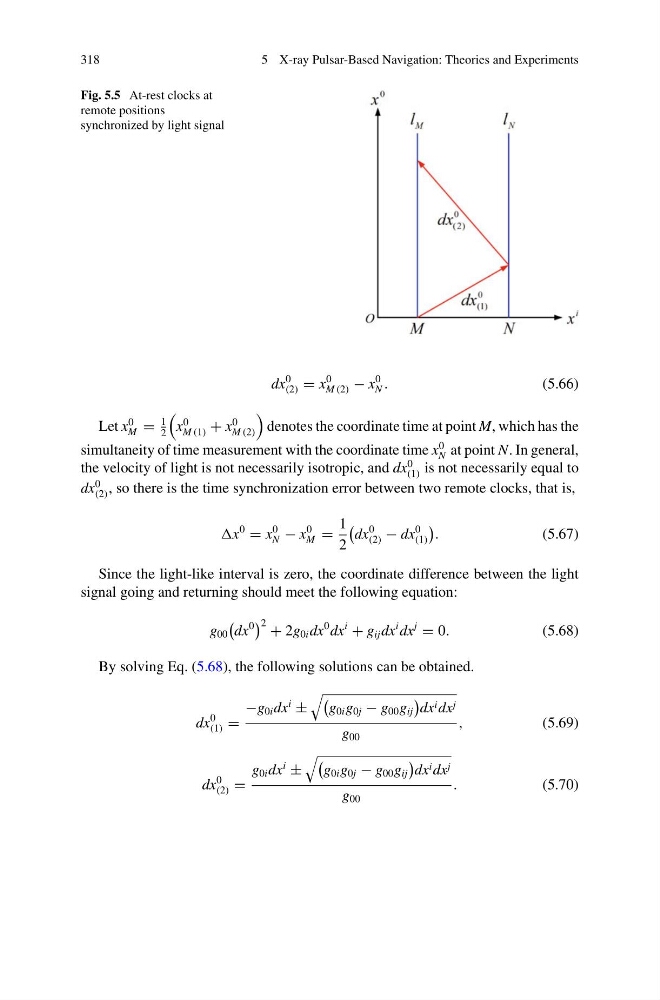
Fig. 5.5 At-rest clocks at
remote positions
synchronized by light signal
dx
0
(2) = x
0
M (2) − x
0
N .
(5.66)
Let x
0
M =
1
2
x
0
M (1) + x
0
M (2)
denotes the coordinate time at point M, which has the
simultaneity of time measurement with the coordinate time x
0
N at point N. In general,
the velocity of light is not necessarily isotropic, and dx
0
(1) is not necessarily equal to
dx
0
(2) , so there is the time synchronization error between two remote clocks, that is,
x
0
= x
0
N − x
0
M =
1
2
dx
0
(2) − dx
0
(1)
.
(5.67)
Since the light-like interval is zero, the coordinate difference between the light
signal going and returning should meet the following equation:
g 00
dx
0
2 + 2g 0i dx
0 dx
i
+ g ij dx
i dx
j
= 0.
(5.68)
By solving Eq. (5.68), the following solutions can be obtained.
dx
0
(1) =
−g 0i dx
i
±
g 0i g 0j − g 00 g ij
dx i dx j
g 00
,
(5.69)
dx
0
(2) =
g 0i dx
i
±
g 0i g 0j − g 00 g ij
dx i dx j
g 00
.
(5.70)
5 X-ray Pulsar-Based Navigation: Theories and Experiments
Fig. 5.5 At-rest clocks at
remote positions
synchronized by light signal
dx
0
(2) = x
0
M (2) − x
0
N .
(5.66)
Let x
0
M =
1
2
x
0
M (1) + x
0
M (2)
denotes the coordinate time at point M, which has the
simultaneity of time measurement with the coordinate time x
0
N at point N. In general,
the velocity of light is not necessarily isotropic, and dx
0
(1) is not necessarily equal to
dx
0
(2) , so there is the time synchronization error between two remote clocks, that is,
x
0
= x
0
N − x
0
M =
1
2
dx
0
(2) − dx
0
(1)
.
(5.67)
Since the light-like interval is zero, the coordinate difference between the light
signal going and returning should meet the following equation:
g 00
dx
0
2 + 2g 0i dx
0 dx
i
+ g ij dx
i dx
j
= 0.
(5.68)
By solving Eq. (5.68), the following solutions can be obtained.
dx
0
(1) =
−g 0i dx
i
±
g 0i g 0j − g 00 g ij
dx i dx j
g 00
,
(5.69)
dx
0
(2) =
g 0i dx
i
±
g 0i g 0j − g 00 g ij
dx i dx j
g 00
.
(5.70)