

304
5 X-ray Pulsar-Based Navigation: Theories and Experiments
where ds is the invariant distance between two adjacent points on the curve; M 0 is a
fixed point on the curve; M is any point on the curve; s is the proper length from M 0
to M, which is a natural scalar argument to mark the point on the curve.
Here, taking s as an affinor, the tangent vector is defined as
a
i
=
dx
i
ds
.
(5.38)
Considering that the tangent vector a is always the unit vector, the geodesic
differential equation with s as the affinor can be derived in the Riemannian space.
da
i
ds
+ Γ
i
jk a
j a
k
= 0.
(5.39)
5.4.2 Gravity and Space-Time Bending
5.4.2.1 Einstein Field Equations
At the end of nineteenth century, James C. Maxwell established the electrodynamics
theory, in which the basic laws of electromagnetism, well known as Maxwell’s equations, was expressed in detail, and predicted the existence of electromagnetic waves.
The velocities of the waves are c, which is the velocity of light, but what is the c
calculated relative to? At first, it was thought that the c was relative to a kind of the
medium propagating electromagnetic waves, called ether, like the sound wave propagated by air. However, it is shown through experiments that there is no the so-called
ether. That is to say, absolute velocity cannot be given by electromagnetism or optics.
In 1905, on the basis of previous studies, Einstein concluded a general principle
that all physical laws should have the same form in any inertial system, which is
known as the special relativity, including two basic principles: one is that any inertial
system is equivalent; another is that the velocity of light is constant. According to
the special relativity, a new space-time transformation between inertial coordinate
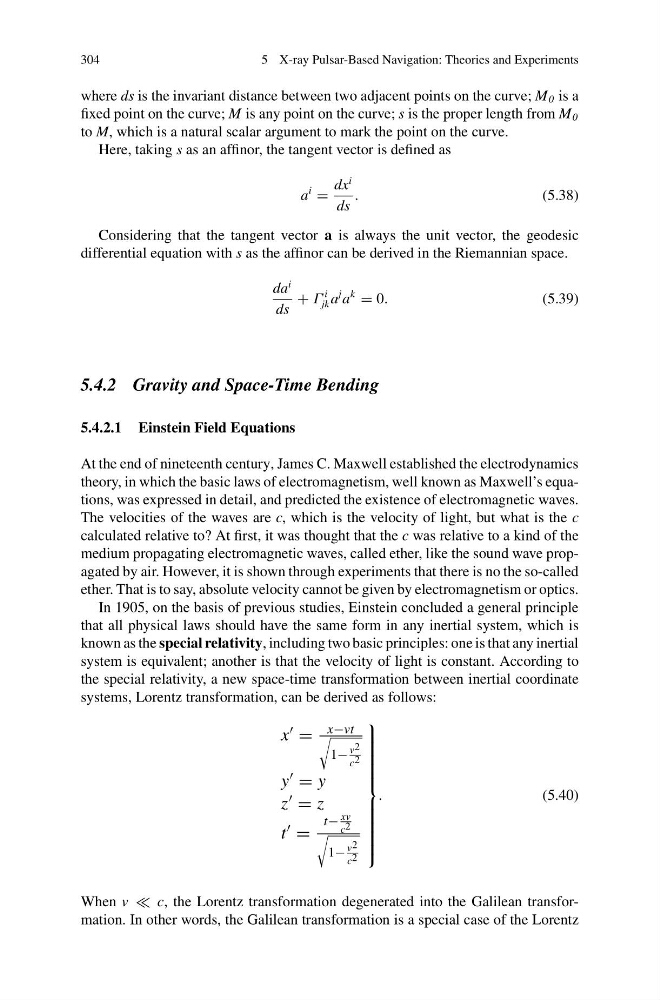
systems, Lorentz transformation, can be derived as follows:
x =
x−vt
1−
v 2
c 2
y = y
z = z
t =
t−
xv
c 2
1−
v 2
c 2
⎫
⎪ ⎪ ⎪ ⎪ ⎪ ⎪ ⎪ ⎪ ⎪ ⎪ ⎬
⎪ ⎪ ⎪ ⎪ ⎪ ⎪ ⎪ ⎪ ⎪ ⎪ ⎭
.
(5.40)
When v c, the Lorentz transformation degenerated into the Galilean transformation. In other words, the Galilean transformation is a special case of the Lorentz
5 X-ray Pulsar-Based Navigation: Theories and Experiments
where ds is the invariant distance between two adjacent points on the curve; M 0 is a
fixed point on the curve; M is any point on the curve; s is the proper length from M 0
to M, which is a natural scalar argument to mark the point on the curve.
Here, taking s as an affinor, the tangent vector is defined as
a
i
=
dx
i
ds
.
(5.38)
Considering that the tangent vector a is always the unit vector, the geodesic
differential equation with s as the affinor can be derived in the Riemannian space.
da
i
ds
+ Γ
i
jk a
j a
k
= 0.
(5.39)
5.4.2 Gravity and Space-Time Bending
5.4.2.1 Einstein Field Equations
At the end of nineteenth century, James C. Maxwell established the electrodynamics
theory, in which the basic laws of electromagnetism, well known as Maxwell’s equations, was expressed in detail, and predicted the existence of electromagnetic waves.
The velocities of the waves are c, which is the velocity of light, but what is the c
calculated relative to? At first, it was thought that the c was relative to a kind of the
medium propagating electromagnetic waves, called ether, like the sound wave propagated by air. However, it is shown through experiments that there is no the so-called
ether. That is to say, absolute velocity cannot be given by electromagnetism or optics.
In 1905, on the basis of previous studies, Einstein concluded a general principle
that all physical laws should have the same form in any inertial system, which is
known as the special relativity, including two basic principles: one is that any inertial
system is equivalent; another is that the velocity of light is constant. According to
the special relativity, a new space-time transformation between inertial coordinate
systems, Lorentz transformation, can be derived as follows:
x =
x−vt
1−
v 2
c 2
y = y
z = z
t =
t−
xv
c 2
1−
v 2
c 2
⎫
⎪ ⎪ ⎪ ⎪ ⎪ ⎪ ⎪ ⎪ ⎪ ⎪ ⎬
⎪ ⎪ ⎪ ⎪ ⎪ ⎪ ⎪ ⎪ ⎪ ⎪ ⎭
.
(5.40)
When v c, the Lorentz transformation degenerated into the Galilean transformation. In other words, the Galilean transformation is a special case of the Lorentz