

5.4 Space-Time Reference Based on General Relativity
301
where T
j 1 ···j l
i 1 ···i m
is the function about x
j , T
j
1 ···j
l
i
1 ···i
m
is the function about x
i
, and N =
l +m.Thereby, the quantity with n
N components is called N-order tensor, and T
j 1 ···j l
i 1 ···i m
(a total of n
N ) is called the mixed-variant component with the m-order covariant
and l-order contravariant for the N-order tensor.
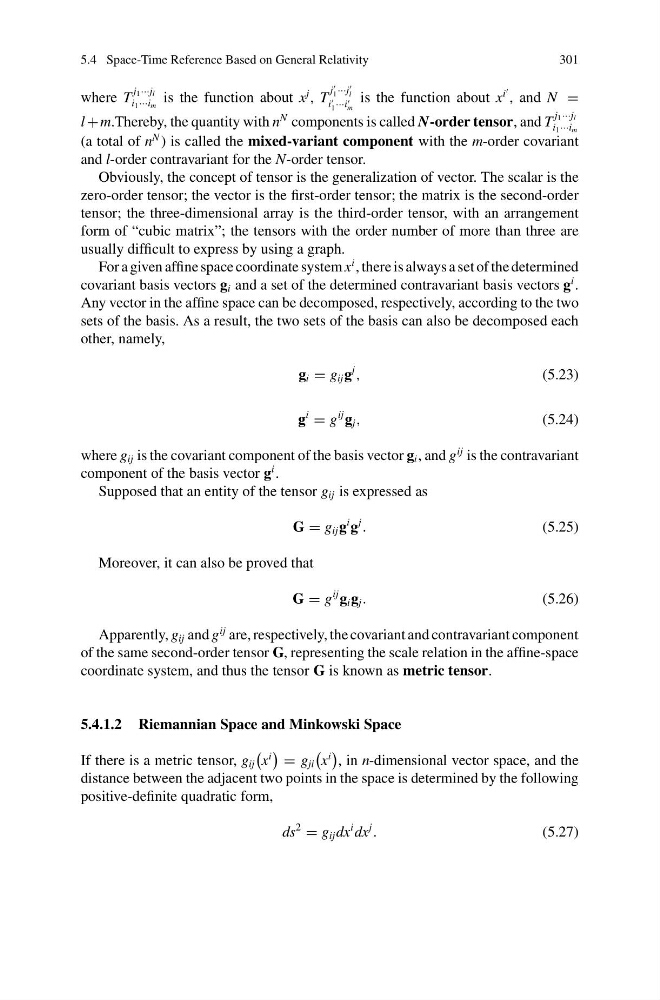
Obviously, the concept of tensor is the generalization of vector. The scalar is the
zero-order tensor; the vector is the first-order tensor; the matrix is the second-order
tensor; the three-dimensional array is the third-order tensor, with an arrangement
form of “cubic matrix”; the tensors with the order number of more than three are
usually difficult to express by using a graph.
For a given affine space coordinate system x
i , there is always a set of the determined
covariant basis vectors g i and a set of the determined contravariant basis vectors g
i .
Any vector in the affine space can be decomposed, respectively, according to the two
sets of the basis. As a result, the two sets of the basis can also be decomposed each
other, namely,
g i = g ij g
j
,
(5.23)
g
i
= g
ij g j ,
(5.24)
where g ij is the covariant component of the basis vector g i , and g
ij is the contravariant
component of the basis vector g
i .
Supposed that an entity of the tensor g ij is expressed as
G = g ij g
i g
j
.
(5.25)
Moreover, it can also be proved that
G = g
ij g i g j .
(5.26)
Apparently, g ij and g
ij are, respectively, the covariant and contravariant component
of the same second-order tensor G, representing the scale relation in the affine-space
coordinate system, and thus the tensor G is known as metric tensor.
5.4.1.2 Riemannian Space and Minkowski Space
If there is a metric tensor, g ij
x
i
= g ji
x
i
, in n-dimensional vector space, and the
distance between the adjacent two points in the space is determined by the following
positive-definite quadratic form,
ds
2
= g ij dx
i dx
j
.
(5.27)
301
where T
j 1 ···j l
i 1 ···i m
is the function about x
j , T
j
1 ···j
l
i
1 ···i
m
is the function about x
i
, and N =
l +m.Thereby, the quantity with n
N components is called N-order tensor, and T
j 1 ···j l
i 1 ···i m
(a total of n
N ) is called the mixed-variant component with the m-order covariant
and l-order contravariant for the N-order tensor.
Obviously, the concept of tensor is the generalization of vector. The scalar is the
zero-order tensor; the vector is the first-order tensor; the matrix is the second-order
tensor; the three-dimensional array is the third-order tensor, with an arrangement
form of “cubic matrix”; the tensors with the order number of more than three are
usually difficult to express by using a graph.
For a given affine space coordinate system x
i , there is always a set of the determined
covariant basis vectors g i and a set of the determined contravariant basis vectors g
i .
Any vector in the affine space can be decomposed, respectively, according to the two
sets of the basis. As a result, the two sets of the basis can also be decomposed each
other, namely,
g i = g ij g
j
,
(5.23)
g
i
= g
ij g j ,
(5.24)
where g ij is the covariant component of the basis vector g i , and g
ij is the contravariant
component of the basis vector g
i .
Supposed that an entity of the tensor g ij is expressed as
G = g ij g
i g
j
.
(5.25)
Moreover, it can also be proved that
G = g
ij g i g j .
(5.26)
Apparently, g ij and g
ij are, respectively, the covariant and contravariant component
of the same second-order tensor G, representing the scale relation in the affine-space
coordinate system, and thus the tensor G is known as metric tensor.
5.4.1.2 Riemannian Space and Minkowski Space
If there is a metric tensor, g ij
x
i
= g ji
x
i
, in n-dimensional vector space, and the
distance between the adjacent two points in the space is determined by the following
positive-definite quadratic form,
ds
2
= g ij dx
i dx
j
.
(5.27)