

298
5 X-ray Pulsar-Based Navigation: Theories and Experiments
but it was lost as discussing the dynamical problem on the gravitational field. It is
the first issue that Newton’s theory of gravitation cannot explain itself.
Secondly, the real difficulty of the Newtonian gravity is that the Mercury’s orbital
precession calculated by Newton’s theory is not consistent with the actual observation
results, and the difference between both is 43 arc-seconds per 100 years.
Thirdly, if it is admitted that the universe is infinite and supposed that the matter
is evenly distributed in universe, then the field strength at any point in the gravitational field will be infinite by using the Newtonian gravity. It is the so-called
Neumann−Seeliger puzzle.
Finally, Newton’s theory of gravitation cannot meet the Lorentz transformation,
and the universal gravitation is a kind of acting force cross over distance, whose
attraction to objects reaches instantaneously. In other words, the propagation of its
field energy is infinite, which does not conform to the idea of the special relativity.
It should be pointed out that Newton’s theory of gravitation is successful in
describing the motion of objects in the solar system and around the Earth, and its
calculation accuracy is also quite high. In particular, the Neptune in the solar system
was successfully predicted and discovered by using Newton’s theory of gravitation.
As the famous physicist Albert Einstein said: a principle with such a wide range of
universality is effective and with such a high precision, for physical phenomena in
one field, but it is ineffective in another field; it is impossible from a priori point of
view.
In fact, Newton’s theory of gravitation is completely applicable to weak gravitational field. The basic criterion for the strength of the gravitational field of a celestial
body is expressed as
α =
2GM
rc 2 =
r g
r
,
(5.14)
where r g =
2GM
c 2 , called the gravitational radius of celestial body; G is the gravitational constant; M is the mass of celestial body; r is the physical radius of celestial
body; c is the velocity of light.
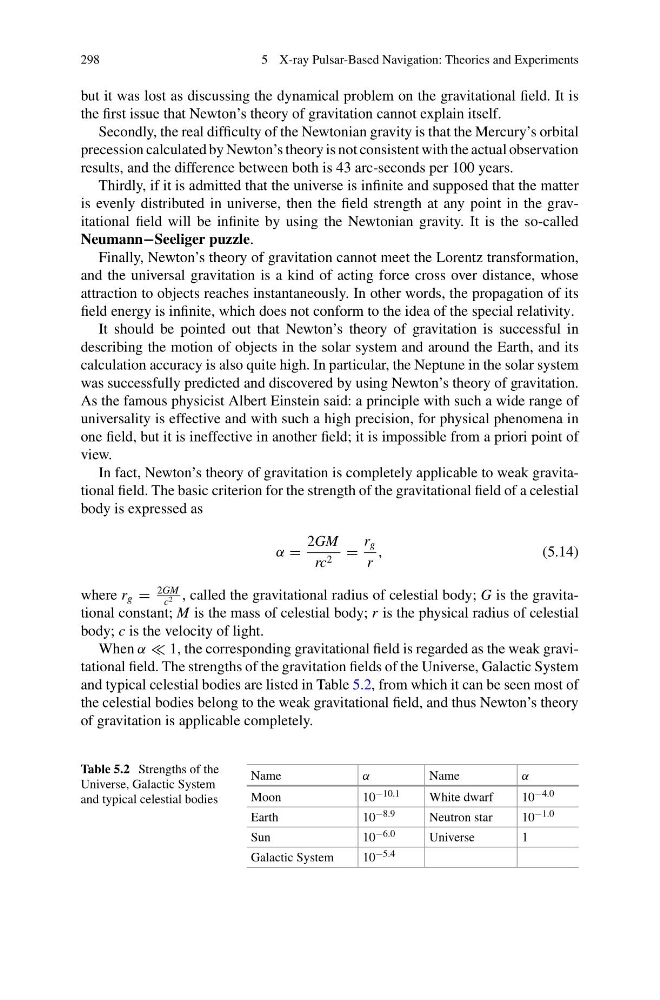
When α 1, the corresponding gravitational field is regarded as the weak gravitational field. The strengths of the gravitation fields of the Universe, Galactic System
and typical celestial bodies are listed in Table 5.2, from which it can be seen most of
the celestial bodies belong to the weak gravitational field, and thus Newton’s theory
of gravitation is applicable completely.
Table 5.2 Strengths of the
Universe, Galactic System
and typical celestial bodies
Name
α
Name
α
Moon
10 −10.1
White dwarf
10 −4.0
Earth
10 −8.9
Neutron star
10 −1.0
Sun
10 −6.0
Universe
1
Galactic System
10 −5.4
5 X-ray Pulsar-Based Navigation: Theories and Experiments
but it was lost as discussing the dynamical problem on the gravitational field. It is
the first issue that Newton’s theory of gravitation cannot explain itself.
Secondly, the real difficulty of the Newtonian gravity is that the Mercury’s orbital
precession calculated by Newton’s theory is not consistent with the actual observation
results, and the difference between both is 43 arc-seconds per 100 years.
Thirdly, if it is admitted that the universe is infinite and supposed that the matter
is evenly distributed in universe, then the field strength at any point in the gravitational field will be infinite by using the Newtonian gravity. It is the so-called
Neumann−Seeliger puzzle.
Finally, Newton’s theory of gravitation cannot meet the Lorentz transformation,
and the universal gravitation is a kind of acting force cross over distance, whose
attraction to objects reaches instantaneously. In other words, the propagation of its
field energy is infinite, which does not conform to the idea of the special relativity.
It should be pointed out that Newton’s theory of gravitation is successful in
describing the motion of objects in the solar system and around the Earth, and its
calculation accuracy is also quite high. In particular, the Neptune in the solar system
was successfully predicted and discovered by using Newton’s theory of gravitation.
As the famous physicist Albert Einstein said: a principle with such a wide range of
universality is effective and with such a high precision, for physical phenomena in
one field, but it is ineffective in another field; it is impossible from a priori point of
view.
In fact, Newton’s theory of gravitation is completely applicable to weak gravitational field. The basic criterion for the strength of the gravitational field of a celestial
body is expressed as
α =
2GM
rc 2 =
r g
r
,
(5.14)
where r g =
2GM
c 2 , called the gravitational radius of celestial body; G is the gravitational constant; M is the mass of celestial body; r is the physical radius of celestial
body; c is the velocity of light.
When α 1, the corresponding gravitational field is regarded as the weak gravitational field. The strengths of the gravitation fields of the Universe, Galactic System
and typical celestial bodies are listed in Table 5.2, from which it can be seen most of
the celestial bodies belong to the weak gravitational field, and thus Newton’s theory
of gravitation is applicable completely.
Table 5.2 Strengths of the
Universe, Galactic System
and typical celestial bodies
Name
α
Name
α
Moon
10 −10.1
White dwarf
10 −4.0
Earth
10 −8.9
Neutron star
10 −1.0
Sun
10 −6.0
Universe
1
Galactic System
10 −5.4