

6.3 Resonant States of 11 Li, Probability Distributions and β-decay of Halo Analog States
85
and the elements of the kernel K i j (
p,
q; E) are explicitly given in Ref. [73].
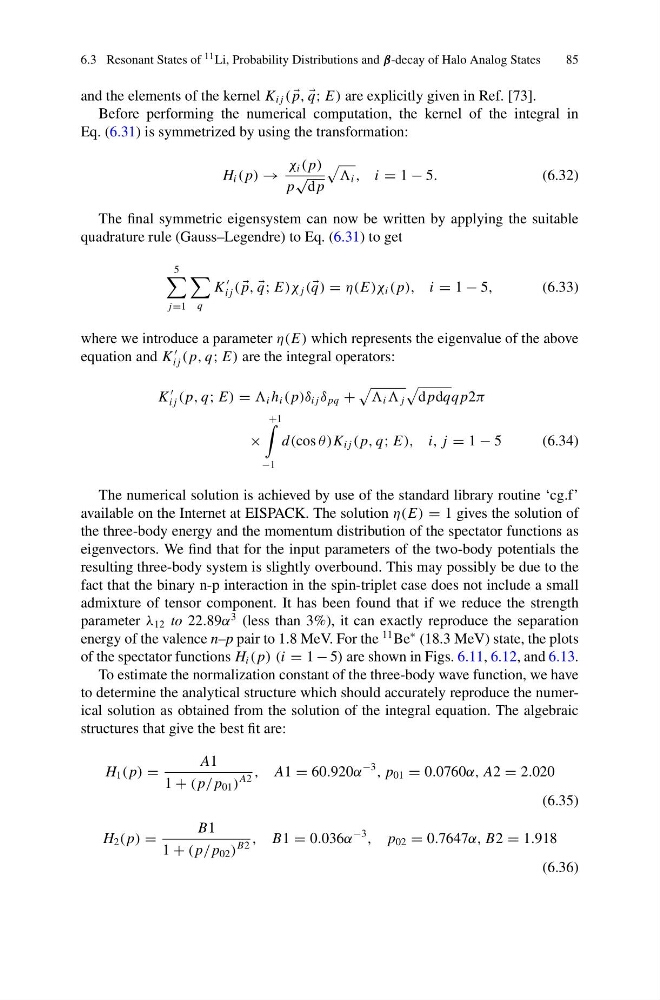
Before performing the numerical computation, the kernel of the integral in
Eq. (6.31) is symmetrized by using the transformation:
H i ( p) →
χ i ( p)
p
√
d p
i , i = 1 − 5.
(6.32)
The final symmetric eigensystem can now be written by applying the suitable
quadrature rule (Gauss–Legendre) to Eq. (6.31) to get
5
j=1
q
K
i j (
p,
q; E)χ j ( q) = η(E)χ i ( p), i = 1 − 5,
(6.33)
where we introduce a parameter η(E) which represents the eigenvalue of the above
equation and K
i j ( p, q; E) are the integral operators:
K
i j ( p, q; E) = i h i ( p)δ i j δ pq +
i j
d pdqqp2π
×
+1
−1
d(cos θ)K i j ( p, q; E), i, j = 1 − 5
(6.34)
The numerical solution is achieved by use of the standard library routine ‘cg.f’
available on the Internet at EISPACK. The solution η(E) = 1 gives the solution of
the three-body energy and the momentum distribution of the spectator functions as
eigenvectors. We find that for the input parameters of the two-body potentials the
resulting three-body system is slightly overbound. This may possibly be due to the
fact that the binary n-p interaction in the spin-triplet case does not include a small
admixture of tensor component. It has been found that if we reduce the strength
parameter λ 12 to 22.89α
3 (less than 3%), it can exactly reproduce the separation
energy of the valence n–p pair to 1.8 MeV. For the
11 Be
∗ (18.3 MeV) state, the plots
of the spectator functions H i ( p) (i = 1 − 5) are shown in Figs. 6.11, 6.12, and 6.13.
To estimate the normalization constant of the three-body wave function, we have
to determine the analytical structure which should accurately reproduce the numerical solution as obtained from the solution of the integral equation. The algebraic
structures that give the best fit are:
H 1 ( p) =
A1
1 + ( p/ p 01 )
A2
, A1 = 60.920α
−3
, p 01 = 0.0760α, A2 = 2.020
(6.35)
H 2 ( p) =
B1
1 + ( p/ p 02 )
B2
, B1 = 0.036α
−3
, p 02 = 0.7647α, B2 = 1.918
(6.36)
85
and the elements of the kernel K i j (
p,
q; E) are explicitly given in Ref. [73].
Before performing the numerical computation, the kernel of the integral in
Eq. (6.31) is symmetrized by using the transformation:
H i ( p) →
χ i ( p)
p
√
d p
i , i = 1 − 5.
(6.32)
The final symmetric eigensystem can now be written by applying the suitable
quadrature rule (Gauss–Legendre) to Eq. (6.31) to get
5
j=1
q
K
i j (
p,
q; E)χ j ( q) = η(E)χ i ( p), i = 1 − 5,
(6.33)
where we introduce a parameter η(E) which represents the eigenvalue of the above
equation and K
i j ( p, q; E) are the integral operators:
K
i j ( p, q; E) = i h i ( p)δ i j δ pq +
i j
d pdqqp2π
×
+1
−1
d(cos θ)K i j ( p, q; E), i, j = 1 − 5
(6.34)
The numerical solution is achieved by use of the standard library routine ‘cg.f’
available on the Internet at EISPACK. The solution η(E) = 1 gives the solution of
the three-body energy and the momentum distribution of the spectator functions as
eigenvectors. We find that for the input parameters of the two-body potentials the
resulting three-body system is slightly overbound. This may possibly be due to the
fact that the binary n-p interaction in the spin-triplet case does not include a small
admixture of tensor component. It has been found that if we reduce the strength
parameter λ 12 to 22.89α
3 (less than 3%), it can exactly reproduce the separation
energy of the valence n–p pair to 1.8 MeV. For the
11 Be
∗ (18.3 MeV) state, the plots
of the spectator functions H i ( p) (i = 1 − 5) are shown in Figs. 6.11, 6.12, and 6.13.
To estimate the normalization constant of the three-body wave function, we have
to determine the analytical structure which should accurately reproduce the numerical solution as obtained from the solution of the integral equation. The algebraic
structures that give the best fit are:
H 1 ( p) =
A1
1 + ( p/ p 01 )
A2
, A1 = 60.920α
−3
, p 01 = 0.0760α, A2 = 2.020
(6.35)
H 2 ( p) =
B1
1 + ( p/ p 02 )
B2
, B1 = 0.036α
−3
, p 02 = 0.7647α, B2 = 1.918
(6.36)