

5.1 Halo Nuclei: A Brief Introduction
59
exotic properties are intimately connected with the advent of RIB facilities. The
pioneering experiment that formally started the field was performed by Isao Tanihata and collaborators who measured the total interaction cross sections in nucleusnucleus collisions using secondary beams of stable and unstable Li and Be isotopes
[15, 41]. They extracted the interaction radii of these isotopes from the total reaction
cross sections. Projectile fragmentation of
11 B and
20 Ne at 790 MeV/nucleon at the
Bevalac facility of Lawrence Berkeley Laboratory produced short-lived nuclei of
6,7,8,9,11 Li and
7,9,10 Be. The secondary beams so produced, were bombarded on Be, C
and Al targets. The total reaction cross sections measured from the depletion of the
projectile beam can be connected with the interaction radii of the target and projectile
through the equations,
I /I o = e
−ρσ t
(5.1a)
σ I = π [R I (P) + R I (T )]
2
(5.2b)
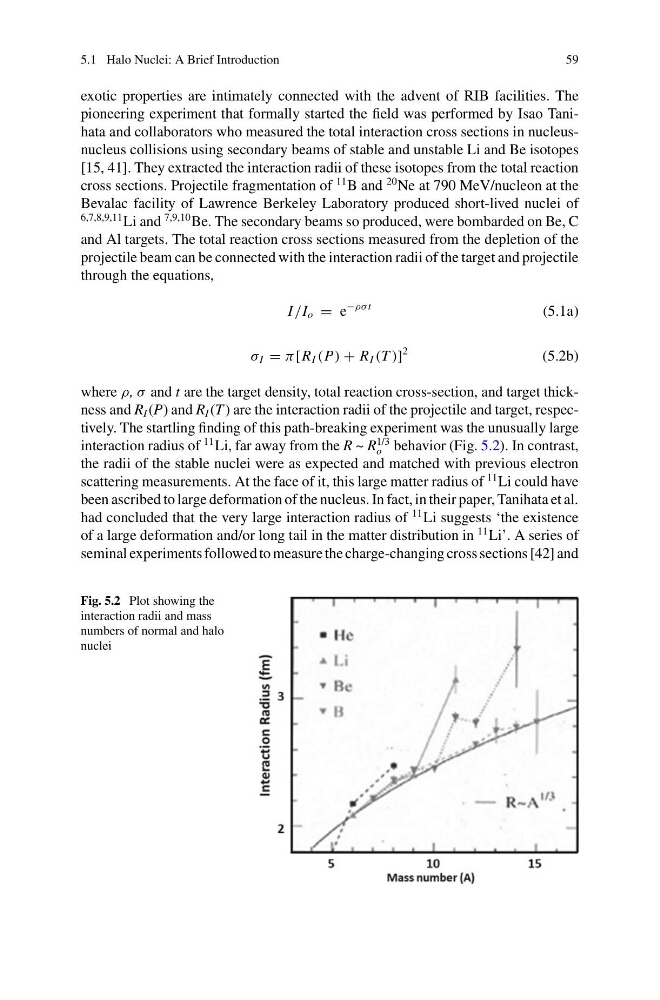
where ρ, σ and t are the target density, total reaction cross-section, and target thickness and R I (P) and R I (T ) are the interaction radii of the projectile and target, respectively. The startling finding of this path-breaking experiment was the unusually large
interaction radius of
11 Li, far away from the R ~ R
1/3
o behavior (Fig. 5.2). In contrast,
the radii of the stable nuclei were as expected and matched with previous electron
scattering measurements. At the face of it, this large matter radius of
11 Li could have
been ascribed to large deformation of the nucleus. In fact, in their paper, Tanihata et al.
had concluded that the very large interaction radius of
11 Li suggests ‘the existence
of a large deformation and/or long tail in the matter distribution in
11 Li’. A series of
seminal experiments followed to measure the charge-changing cross sections [42] and
Fig. 5.2 Plot showing the
interaction radii and mass
numbers of normal and halo
nuclei
59
exotic properties are intimately connected with the advent of RIB facilities. The
pioneering experiment that formally started the field was performed by Isao Tanihata and collaborators who measured the total interaction cross sections in nucleusnucleus collisions using secondary beams of stable and unstable Li and Be isotopes
[15, 41]. They extracted the interaction radii of these isotopes from the total reaction
cross sections. Projectile fragmentation of
11 B and
20 Ne at 790 MeV/nucleon at the
Bevalac facility of Lawrence Berkeley Laboratory produced short-lived nuclei of
6,7,8,9,11 Li and
7,9,10 Be. The secondary beams so produced, were bombarded on Be, C
and Al targets. The total reaction cross sections measured from the depletion of the
projectile beam can be connected with the interaction radii of the target and projectile
through the equations,
I /I o = e
−ρσ t
(5.1a)
σ I = π [R I (P) + R I (T )]
2
(5.2b)
where ρ, σ and t are the target density, total reaction cross-section, and target thickness and R I (P) and R I (T ) are the interaction radii of the projectile and target, respectively. The startling finding of this path-breaking experiment was the unusually large
interaction radius of
11 Li, far away from the R ~ R
1/3
o behavior (Fig. 5.2). In contrast,
the radii of the stable nuclei were as expected and matched with previous electron
scattering measurements. At the face of it, this large matter radius of
11 Li could have
been ascribed to large deformation of the nucleus. In fact, in their paper, Tanihata et al.
had concluded that the very large interaction radius of
11 Li suggests ‘the existence
of a large deformation and/or long tail in the matter distribution in
11 Li’. A series of
seminal experiments followed to measure the charge-changing cross sections [42] and
Fig. 5.2 Plot showing the
interaction radii and mass
numbers of normal and halo
nuclei