

58
5 Halo Nuclei: Properties and Experimental Techniques
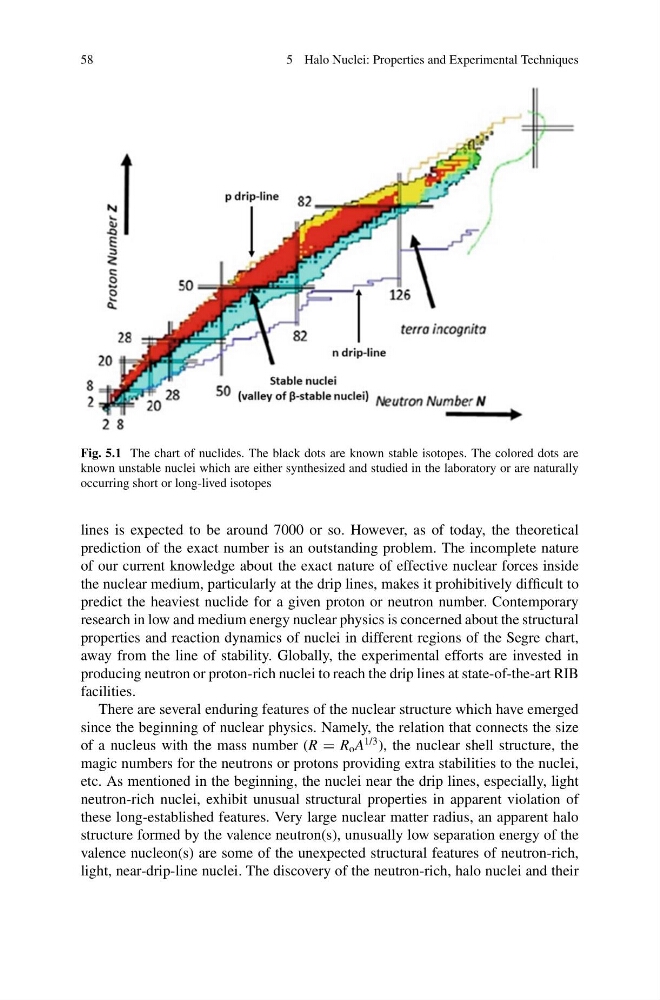
Fig. 5.1 The chart of nuclides. The black dots are known stable isotopes. The colored dots are
known unstable nuclei which are either synthesized and studied in the laboratory or are naturally
occurring short or long-lived isotopes
lines is expected to be around 7000 or so. However, as of today, the theoretical
prediction of the exact number is an outstanding problem. The incomplete nature
of our current knowledge about the exact nature of effective nuclear forces inside
the nuclear medium, particularly at the drip lines, makes it prohibitively difficult to
predict the heaviest nuclide for a given proton or neutron number. Contemporary
research in low and medium energy nuclear physics is concerned about the structural
properties and reaction dynamics of nuclei in different regions of the Segre chart,
away from the line of stability. Globally, the experimental efforts are invested in
producing neutron or proton-rich nuclei to reach the drip lines at state-of-the-art RIB
facilities.
There are several enduring features of the nuclear structure which have emerged
since the beginning of nuclear physics. Namely, the relation that connects the size
of a nucleus with the mass number (R = R o A
1/3 ), the nuclear shell structure, the
magic numbers for the neutrons or protons providing extra stabilities to the nuclei,
etc. As mentioned in the beginning, the nuclei near the drip lines, especially, light
neutron-rich nuclei, exhibit unusual structural properties in apparent violation of
these long-established features. Very large nuclear matter radius, an apparent halo
structure formed by the valence neutron(s), unusually low separation energy of the
valence nucleon(s) are some of the unexpected structural features of neutron-rich,
light, near-drip-line nuclei. The discovery of the neutron-rich, halo nuclei and their
5 Halo Nuclei: Properties and Experimental Techniques
Fig. 5.1 The chart of nuclides. The black dots are known stable isotopes. The colored dots are
known unstable nuclei which are either synthesized and studied in the laboratory or are naturally
occurring short or long-lived isotopes
lines is expected to be around 7000 or so. However, as of today, the theoretical
prediction of the exact number is an outstanding problem. The incomplete nature
of our current knowledge about the exact nature of effective nuclear forces inside
the nuclear medium, particularly at the drip lines, makes it prohibitively difficult to
predict the heaviest nuclide for a given proton or neutron number. Contemporary
research in low and medium energy nuclear physics is concerned about the structural
properties and reaction dynamics of nuclei in different regions of the Segre chart,
away from the line of stability. Globally, the experimental efforts are invested in
producing neutron or proton-rich nuclei to reach the drip lines at state-of-the-art RIB
facilities.
There are several enduring features of the nuclear structure which have emerged
since the beginning of nuclear physics. Namely, the relation that connects the size
of a nucleus with the mass number (R = R o A
1/3 ), the nuclear shell structure, the
magic numbers for the neutrons or protons providing extra stabilities to the nuclei,
etc. As mentioned in the beginning, the nuclei near the drip lines, especially, light
neutron-rich nuclei, exhibit unusual structural properties in apparent violation of
these long-established features. Very large nuclear matter radius, an apparent halo
structure formed by the valence neutron(s), unusually low separation energy of the
valence nucleon(s) are some of the unexpected structural features of neutron-rich,
light, near-drip-line nuclei. The discovery of the neutron-rich, halo nuclei and their