

52
4 Effective Field Theory
[
−1
c − h c ( p)]G(
p) =
d q K 1 (
p,
q; E)G( q) +
d q K 2 (
p,
q; E)F( q)
[
−1
n − h n (
p)]F(
p) = 2
d q K 3 (
p,
q; E)G( q)
(4.33)
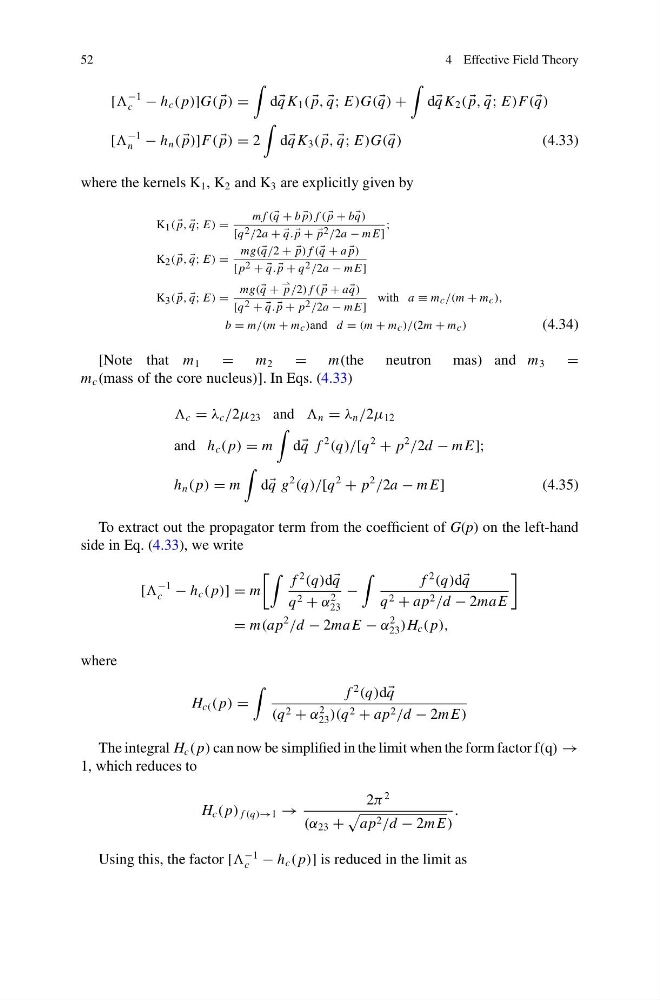
where the kernels K 1 , K 2 and K 3 are explicitly given by
K 1 (
p,
q; E) =
m f ( q + b
p) f (
p + b
q)
[q 2 /2a + +
q.
p + +
p 2 /2a − m E]
;
K 2 (
p,
q; E) =
mg( q/2 + +
p) f ( q + a
p)
[ p 2 + +
q.
p + q 2 /2a − m E]
K 3 (
p,
q; E) =
mg( q +
p/2) f (
p + a
q)
[q 2 + +
q.
p + p 2 /2a − m E]
with a ≡ m c /(m + m c ),
b = m/(m + m c )and d = (m + m c )/(2m + m c )
(4.34)
[Note that m 1
= m 2
= m(the neutron mas) and m 3
=
m c (mass of the core nucleus)]. In Eqs. (4.33)
c = λ c /2μ 23 and n = λ n /2μ 12
and h c ( p) = m
d q f
2
(q)/[q
2
+ p
2
/2d − m E];
h n ( p) = m
d q g
2
(q)/[q
2
+ p
2
/2a − m E]
(4.35)
To extract out the propagator term from the coefficient of G(p) on the left-hand
side in Eq. (4.33), we write
[
−1
c − h c ( p)] = m
f
2
(q)d q
q 2 + α
2
23
−
f
2
(q)d q
q 2 + ap 2 /d − 2ma E
= m(ap
2
/d − 2ma E − α
2
23 )H c ( p),
where
H c( ( p) =
f
2
(q)d q
(q 2 + α
2
23 )(q 2 + ap 2 /d − 2m E)
The integral H c ( p) can now be simplified in the limit when the form factor f(q) →
1, which reduces to
H c ( p) f (q)→1 →
2π
2
(α 23 +
ap 2 /d − 2m E)
.
Using this, the factor [
−1
c − h c ( p)] is reduced in the limit as
4 Effective Field Theory
[
−1
c − h c ( p)]G(
p) =
d q K 1 (
p,
q; E)G( q) +
d q K 2 (
p,
q; E)F( q)
[
−1
n − h n (
p)]F(
p) = 2
d q K 3 (
p,
q; E)G( q)
(4.33)
where the kernels K 1 , K 2 and K 3 are explicitly given by
K 1 (
p,
q; E) =
m f ( q + b
p) f (
p + b
q)
[q 2 /2a + +
q.
p + +
p 2 /2a − m E]
;
K 2 (
p,
q; E) =
mg( q/2 + +
p) f ( q + a
p)
[ p 2 + +
q.
p + q 2 /2a − m E]
K 3 (
p,
q; E) =
mg( q +
p/2) f (
p + a
q)
[q 2 + +
q.
p + p 2 /2a − m E]
with a ≡ m c /(m + m c ),
b = m/(m + m c )and d = (m + m c )/(2m + m c )
(4.34)
[Note that m 1
= m 2
= m(the neutron mas) and m 3
=
m c (mass of the core nucleus)]. In Eqs. (4.33)
c = λ c /2μ 23 and n = λ n /2μ 12
and h c ( p) = m
d q f
2
(q)/[q
2
+ p
2
/2d − m E];
h n ( p) = m
d q g
2
(q)/[q
2
+ p
2
/2a − m E]
(4.35)
To extract out the propagator term from the coefficient of G(p) on the left-hand
side in Eq. (4.33), we write
[
−1
c − h c ( p)] = m
f
2
(q)d q
q 2 + α
2
23
−
f
2
(q)d q
q 2 + ap 2 /d − 2ma E
= m(ap
2
/d − 2ma E − α
2
23 )H c ( p),
where
H c( ( p) =
f
2
(q)d q
(q 2 + α
2
23 )(q 2 + ap 2 /d − 2m E)
The integral H c ( p) can now be simplified in the limit when the form factor f(q) →
1, which reduces to
H c ( p) f (q)→1 →
2π
2
(α 23 +
ap 2 /d − 2m E)
.
Using this, the factor [
−1
c − h c ( p)] is reduced in the limit as