

4.4 Derivation of Three-Body Scattering Amplitude …
51
This similarity in the structure of the integral Eq. (4.21) or (4.28) permits us to
employ similar formalism and proceed exactly in the same way as discussed in ref.
[40], i.e., by imposing an ultraviolet cutoff to ensure that the integral in the kernel
does not diverge and yields results independent of the value of the cutoff used. We
shall also employ the same procedure of using the zero-energy scattering length
for the n-dimer system as a single subtraction constant to study the behavior of the
low-energy scattering amplitude.
We now turn over to set up the formulation for the scattering of n-dimer(ncore(mass,m c )) scattering at low energies using separable interaction, leading to the
coupled one variable integral equations for the scattering amplitude. By allowing the
momentum dependent form factors [g(p)/f (p)] to go to one, we shall finally reduce,
in the limit, these equations to an effective-field theoretic equations—very much
similar to those obtained in ref. [40] for n-d scattering.
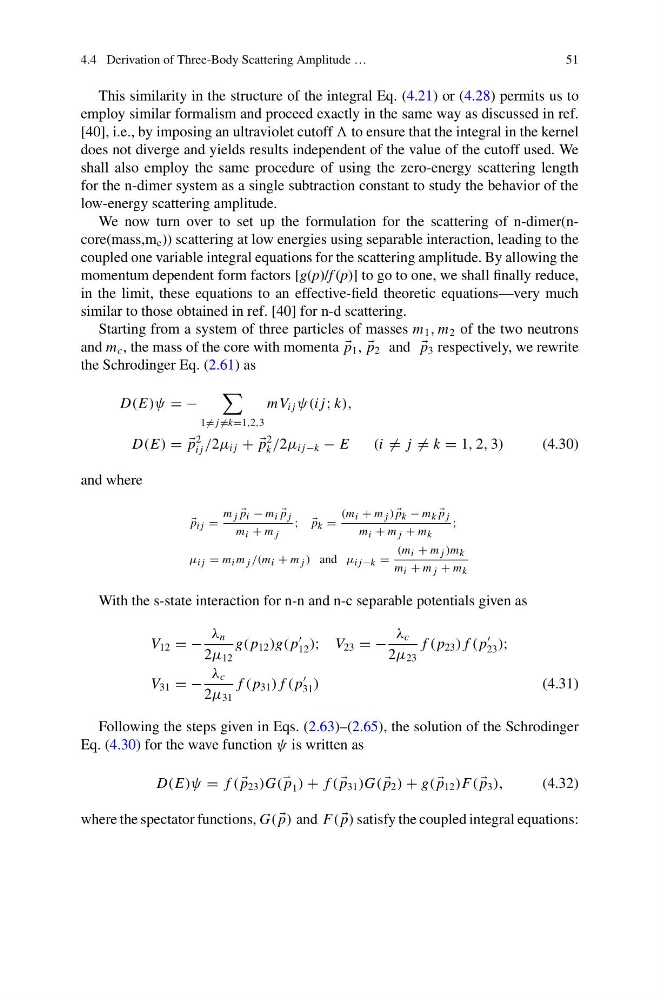
Starting from a system of three particles of masses m 1 , m 2 of the two neutrons
and m c , the mass of the core with momenta
p 1 ,
p 2 and
p 3 respectively, we rewrite
the Schrodinger Eq. (2.61) as
D(E)ψ = −
1 = j =k=1,2,3
mV i j ψ(i j; k),
D(E) = =
p
2
i j /2μ i j + +
p
2
k /2μ i j−k − E
(i = j = k = 1, 2, 3)
(4.30)
and where
p i j =
m j
p i − m i
p j
m i + m j
; ;
p k =
(m i + m j )
p k − m k
p j
m i + m j + m k
;
μ i j = m i m j /(m i + m j ) and μ i j−k =
(m i + m j )m k
m i + m j + m k
With the s-state interaction for n-n and n-c separable potentials given as
V 12 = −
λ n
2μ 12
g( p 12 )g( p
12 ); V 23 = −
λ c
2μ 23
f ( p 23 ) f ( p
23 );
V 31 = −
λ c
2μ 31
f ( p 31 ) f ( p
31 )
(4.31)
Following the steps given in Eqs. (2.63)–(2.65), the solution of the Schrodinger
Eq. (4.30) for the wave function ψ is written as
D(E)ψ = f (
p 23 )G(
p 1 ) + f (
p 31 )G(
p 2 ) + g(
p 12 )F(
p 3 ),
(4.32)
where the spectator functions, G(
p) and F(
p) satisfy the coupled integral equations:
51
This similarity in the structure of the integral Eq. (4.21) or (4.28) permits us to
employ similar formalism and proceed exactly in the same way as discussed in ref.
[40], i.e., by imposing an ultraviolet cutoff to ensure that the integral in the kernel
does not diverge and yields results independent of the value of the cutoff used. We
shall also employ the same procedure of using the zero-energy scattering length
for the n-dimer system as a single subtraction constant to study the behavior of the
low-energy scattering amplitude.
We now turn over to set up the formulation for the scattering of n-dimer(ncore(mass,m c )) scattering at low energies using separable interaction, leading to the
coupled one variable integral equations for the scattering amplitude. By allowing the
momentum dependent form factors [g(p)/f (p)] to go to one, we shall finally reduce,
in the limit, these equations to an effective-field theoretic equations—very much
similar to those obtained in ref. [40] for n-d scattering.
Starting from a system of three particles of masses m 1 , m 2 of the two neutrons
and m c , the mass of the core with momenta
p 1 ,
p 2 and
p 3 respectively, we rewrite
the Schrodinger Eq. (2.61) as
D(E)ψ = −
1 = j =k=1,2,3
mV i j ψ(i j; k),
D(E) = =
p
2
i j /2μ i j + +
p
2
k /2μ i j−k − E
(i = j = k = 1, 2, 3)
(4.30)
and where
p i j =
m j
p i − m i
p j
m i + m j
; ;
p k =
(m i + m j )
p k − m k
p j
m i + m j + m k
;
μ i j = m i m j /(m i + m j ) and μ i j−k =
(m i + m j )m k
m i + m j + m k
With the s-state interaction for n-n and n-c separable potentials given as
V 12 = −
λ n
2μ 12
g( p 12 )g( p
12 ); V 23 = −
λ c
2μ 23
f ( p 23 ) f ( p
23 );
V 31 = −
λ c
2μ 31
f ( p 31 ) f ( p
31 )
(4.31)
Following the steps given in Eqs. (2.63)–(2.65), the solution of the Schrodinger
Eq. (4.30) for the wave function ψ is written as
D(E)ψ = f (
p 23 )G(
p 1 ) + f (
p 31 )G(
p 2 ) + g(
p 12 )F(
p 3 ),
(4.32)
where the spectator functions, G(
p) and F(
p) satisfy the coupled integral equations: