

4.3 Three-Body Scattering Problem in Effective Field Theory
47
basic quantities, viz., n-d scattering length and triton binding energy attracted a great
deal of attention in recent years since the time it was pointed out by Phillips [37(b)].
Within the framework of field theory using Feynman diagrams, STM equations
were first derived by V. Komarov and A. Popova [38], in investigating the breakup
of deuterons by neutrons at low energies. Studying the scattering of a third particle
by the bound state pair, the two-body construct potential leads to a particle exchange
force with a range of the order of two-body scattering length. For instance, in n-d
elastic scattering the lowest order Born term arises from the exchange of proton by
deuteron, which in the language of nuclear physics is known as a pick-up process.
Thus, in nuclear physics, the length scale set by the scattering length is far larger than
any other scale. This makes it worthwhile using this separation of scales to construct
effective field theory for three-body scattering systems.
In the seminal work of Bedaque and collaborators [22], the derivation of STM
equation is found to be particularly simple in the effective field theory, realizing the
fact that STM integral equation is not an equation for the six-point Green’s function
but is an equation for the four-point Green’s function, 0|T (dψd
∗
ψ
∗
)|0, where
the two-particle composite dimer field operator d is annihilating the two particles.
In order to obtain a unique solution, Bedaque et al. [22] also introduced a threebody force in the leading order three-body EFT equation and adjusted this force
to reproduce the experimental 1 + 2 scattering length. Earlier, in 1995, Adhikari,
Frederico and Goldman [39] also pointed out the need of introducing a three-body
observable to account for the divergence appearing in the kernel of the Faddeev
equations for zero range interaction.
In an approach alternative to introducing a three-body force, I Afnan and D Phillips
[40] revisit the Amado model for the case of three spin-less bosons to study the
scattering in which the interaction of an incident particle on a composite system is
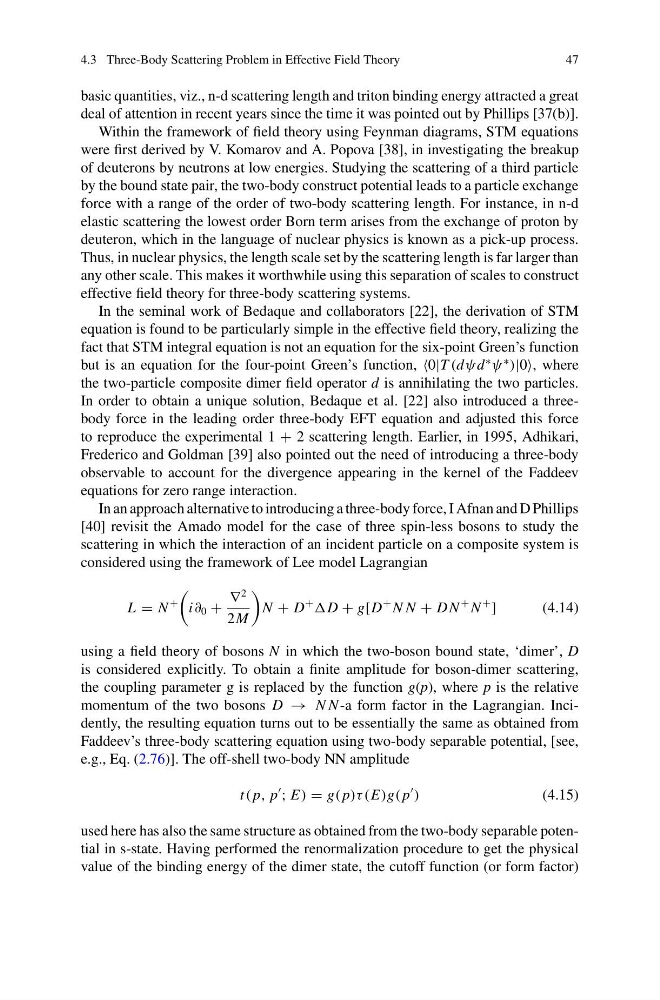
considered using the framework of Lee model Lagrangian
L = N
+
i∂ 0 +
∇
2
2M
N + D
+
D + g[D
+ N N + DN
+ N
+
]
(4.14)
using a field theory of bosons N in which the two-boson bound state, ‘dimer’, D
is considered explicitly. To obtain a finite amplitude for boson-dimer scattering,
the coupling parameter g is replaced by the function g(p), where p is the relative
momentum of the two bosons D → N N-a form factor in the Lagrangian. Incidently, the resulting equation turns out to be essentially the same as obtained from
Faddeev’s three-body scattering equation using two-body separable potential, [see,
e.g., Eq. (2.76)]. The off-shell two-body NN amplitude
t ( p, p
; E) = g( p)τ (E)g( p
)
(4.15)
used here has also the same structure as obtained from the two-body separable potential in s-state. Having performed the renormalization procedure to get the physical
value of the binding energy of the dimer state, the cutoff function (or form factor)
47
basic quantities, viz., n-d scattering length and triton binding energy attracted a great
deal of attention in recent years since the time it was pointed out by Phillips [37(b)].
Within the framework of field theory using Feynman diagrams, STM equations
were first derived by V. Komarov and A. Popova [38], in investigating the breakup
of deuterons by neutrons at low energies. Studying the scattering of a third particle
by the bound state pair, the two-body construct potential leads to a particle exchange
force with a range of the order of two-body scattering length. For instance, in n-d
elastic scattering the lowest order Born term arises from the exchange of proton by
deuteron, which in the language of nuclear physics is known as a pick-up process.
Thus, in nuclear physics, the length scale set by the scattering length is far larger than
any other scale. This makes it worthwhile using this separation of scales to construct
effective field theory for three-body scattering systems.
In the seminal work of Bedaque and collaborators [22], the derivation of STM
equation is found to be particularly simple in the effective field theory, realizing the
fact that STM integral equation is not an equation for the six-point Green’s function
but is an equation for the four-point Green’s function, 0|T (dψd
∗
ψ
∗
)|0, where
the two-particle composite dimer field operator d is annihilating the two particles.
In order to obtain a unique solution, Bedaque et al. [22] also introduced a threebody force in the leading order three-body EFT equation and adjusted this force
to reproduce the experimental 1 + 2 scattering length. Earlier, in 1995, Adhikari,
Frederico and Goldman [39] also pointed out the need of introducing a three-body
observable to account for the divergence appearing in the kernel of the Faddeev
equations for zero range interaction.
In an approach alternative to introducing a three-body force, I Afnan and D Phillips
[40] revisit the Amado model for the case of three spin-less bosons to study the
scattering in which the interaction of an incident particle on a composite system is
considered using the framework of Lee model Lagrangian
L = N
+
i∂ 0 +
∇
2
2M
N + D
+
D + g[D
+ N N + DN
+ N
+
]
(4.14)
using a field theory of bosons N in which the two-boson bound state, ‘dimer’, D
is considered explicitly. To obtain a finite amplitude for boson-dimer scattering,
the coupling parameter g is replaced by the function g(p), where p is the relative
momentum of the two bosons D → N N-a form factor in the Lagrangian. Incidently, the resulting equation turns out to be essentially the same as obtained from
Faddeev’s three-body scattering equation using two-body separable potential, [see,
e.g., Eq. (2.76)]. The off-shell two-body NN amplitude
t ( p, p
; E) = g( p)τ (E)g( p
)
(4.15)
used here has also the same structure as obtained from the two-body separable potential in s-state. Having performed the renormalization procedure to get the physical
value of the binding energy of the dimer state, the cutoff function (or form factor)