

46
4 Effective Field Theory
d
d
C 0s = −
a
a − π/2
+
a
2
2
(a − π/2) 2 = ˆ
C 0s (1 + ˆ
C 0s )
(4.13)
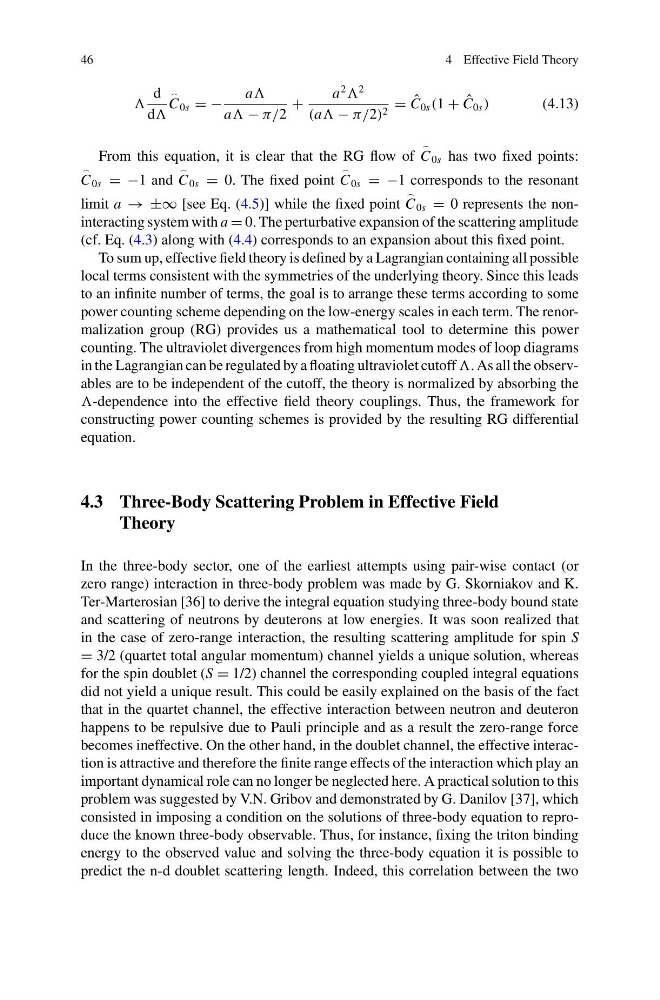
From this equation, it is clear that the RG flow of
C 0s has two fixed points:
C 0s = −1 and
C 0s = 0. The fixed point
C 0s = −1 corresponds to the resonant
limit a → ±∞ [see Eq. (4.5)] while the fixed point
C 0s = 0 represents the noninteracting system with a = 0. The perturbative expansion of the scattering amplitude
(cf. Eq. (4.3) along with (4.4) corresponds to an expansion about this fixed point.
To sum up, effective field theory is defined by a Lagrangian containing all possible
local terms consistent with the symmetries of the underlying theory. Since this leads
to an infinite number of terms, the goal is to arrange these terms according to some
power counting scheme depending on the low-energy scales in each term. The renormalization group (RG) provides us a mathematical tool to determine this power
counting. The ultraviolet divergences from high momentum modes of loop diagrams
in the Lagrangian can be regulated by a floating ultraviolet cutoff . As all the observables are to be independent of the cutoff, the theory is normalized by absorbing the
-dependence into the effective field theory couplings. Thus, the framework for
constructing power counting schemes is provided by the resulting RG differential
equation.
4.3 Three-Body Scattering Problem in Effective Field
Theory
In the three-body sector, one of the earliest attempts using pair-wise contact (or
zero range) interaction in three-body problem was made by G. Skorniakov and K.
Ter-Marterosian [36] to derive the integral equation studying three-body bound state
and scattering of neutrons by deuterons at low energies. It was soon realized that
in the case of zero-range interaction, the resulting scattering amplitude for spin S
= 3/2 (quartet total angular momentum) channel yields a unique solution, whereas
for the spin doublet (S = 1/2) channel the corresponding coupled integral equations
did not yield a unique result. This could be easily explained on the basis of the fact
that in the quartet channel, the effective interaction between neutron and deuteron
happens to be repulsive due to Pauli principle and as a result the zero-range force
becomes ineffective. On the other hand, in the doublet channel, the effective interaction is attractive and therefore the finite range effects of the interaction which play an
important dynamical role can no longer be neglected here. A practical solution to this
problem was suggested by V.N. Gribov and demonstrated by G. Danilov [37], which
consisted in imposing a condition on the solutions of three-body equation to reproduce the known three-body observable. Thus, for instance, fixing the triton binding
energy to the observed value and solving the three-body equation it is possible to
predict the n-d doublet scattering length. Indeed, this correlation between the two
4 Effective Field Theory
d
d
C 0s = −
a
a − π/2
+
a
2
2
(a − π/2) 2 = ˆ
C 0s (1 + ˆ
C 0s )
(4.13)
From this equation, it is clear that the RG flow of
C 0s has two fixed points:
C 0s = −1 and
C 0s = 0. The fixed point
C 0s = −1 corresponds to the resonant
limit a → ±∞ [see Eq. (4.5)] while the fixed point
C 0s = 0 represents the noninteracting system with a = 0. The perturbative expansion of the scattering amplitude
(cf. Eq. (4.3) along with (4.4) corresponds to an expansion about this fixed point.
To sum up, effective field theory is defined by a Lagrangian containing all possible
local terms consistent with the symmetries of the underlying theory. Since this leads
to an infinite number of terms, the goal is to arrange these terms according to some
power counting scheme depending on the low-energy scales in each term. The renormalization group (RG) provides us a mathematical tool to determine this power
counting. The ultraviolet divergences from high momentum modes of loop diagrams
in the Lagrangian can be regulated by a floating ultraviolet cutoff . As all the observables are to be independent of the cutoff, the theory is normalized by absorbing the
-dependence into the effective field theory couplings. Thus, the framework for
constructing power counting schemes is provided by the resulting RG differential
equation.
4.3 Three-Body Scattering Problem in Effective Field
Theory
In the three-body sector, one of the earliest attempts using pair-wise contact (or
zero range) interaction in three-body problem was made by G. Skorniakov and K.
Ter-Marterosian [36] to derive the integral equation studying three-body bound state
and scattering of neutrons by deuterons at low energies. It was soon realized that
in the case of zero-range interaction, the resulting scattering amplitude for spin S
= 3/2 (quartet total angular momentum) channel yields a unique solution, whereas
for the spin doublet (S = 1/2) channel the corresponding coupled integral equations
did not yield a unique result. This could be easily explained on the basis of the fact
that in the quartet channel, the effective interaction between neutron and deuteron
happens to be repulsive due to Pauli principle and as a result the zero-range force
becomes ineffective. On the other hand, in the doublet channel, the effective interaction is attractive and therefore the finite range effects of the interaction which play an
important dynamical role can no longer be neglected here. A practical solution to this
problem was suggested by V.N. Gribov and demonstrated by G. Danilov [37], which
consisted in imposing a condition on the solutions of three-body equation to reproduce the known three-body observable. Thus, for instance, fixing the triton binding
energy to the observed value and solving the three-body equation it is possible to
predict the n-d doublet scattering length. Indeed, this correlation between the two