

44
4 Effective Field Theory
T = T 1c + T 2c = −C 0s +
C
2
0s m
2π 2
−
π
2
√
−m E − iε
(4.3)
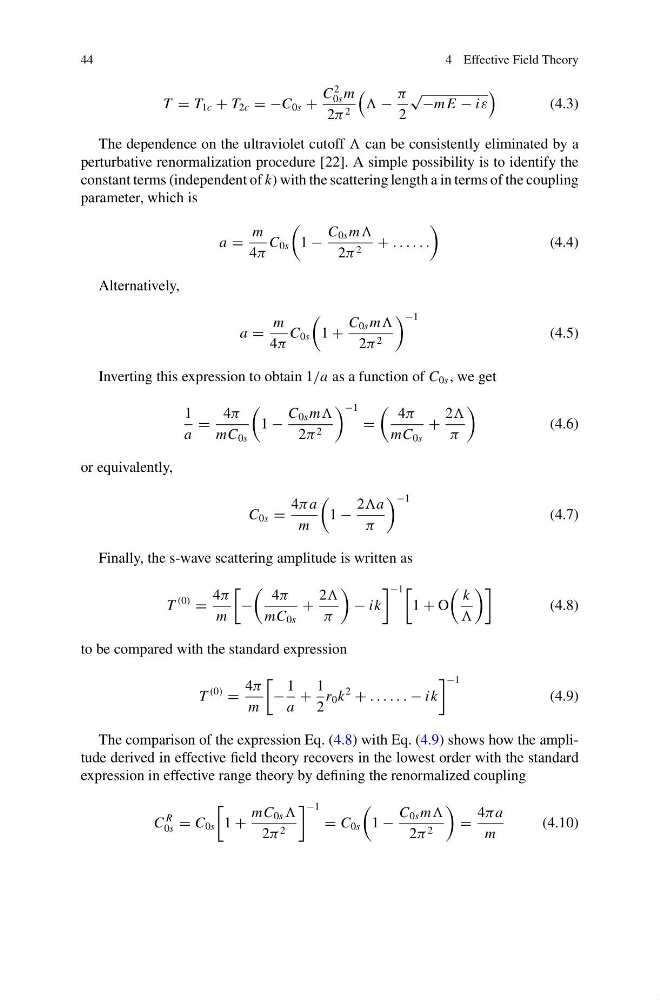
The dependence on the ultraviolet cutoff can be consistently eliminated by a
perturbative renormalization procedure [22]. A simple possibility is to identify the
constant terms (independent of k) with the scattering length a in terms of the coupling
parameter, which is
a =
m
4π
C 0s
1 −
C 0s m
2π 2 + . . . . . .
(4.4)
Alternatively,
a =
m
4π
C 0s
1 +
C 0s m
2π 2
−1
(4.5)
Inverting this expression to obtain 1/a as a function of C 0s , we get
1
a
=
4π
mC 0s
1 −
C 0s m
2π 2
−1
=
4π
mC 0s
+
2
π
(4.6)
or equivalently,
C 0s =
4πa
m
1 −
2a
π
−1
(4.7)
Finally, the s-wave scattering amplitude is written as
T
(0)
=
4π
m
−
4π
mC 0s
+
2
π
− ik
−1
1 + O
k
(4.8)
to be compared with the standard expression
T
(0)
=
4π
m
−
1
a
+
1
2
r 0 k
2
+ . . . . . . − ik
−1
(4.9)
The comparison of the expression Eq. (4.8) with Eq. (4.9) shows how the amplitude derived in effective field theory recovers in the lowest order with the standard
expression in effective range theory by defining the renormalized coupling
C
R
0s = C 0s
1 +
mC 0s
2π 2
−1
= C 0s
1 −
C 0s m
2π 2
=
4πa
m
(4.10)
4 Effective Field Theory
T = T 1c + T 2c = −C 0s +
C
2
0s m
2π 2
−
π
2
√
−m E − iε
(4.3)
The dependence on the ultraviolet cutoff can be consistently eliminated by a
perturbative renormalization procedure [22]. A simple possibility is to identify the
constant terms (independent of k) with the scattering length a in terms of the coupling
parameter, which is
a =
m
4π
C 0s
1 −
C 0s m
2π 2 + . . . . . .
(4.4)
Alternatively,
a =
m
4π
C 0s
1 +
C 0s m
2π 2
−1
(4.5)
Inverting this expression to obtain 1/a as a function of C 0s , we get
1
a
=
4π
mC 0s
1 −
C 0s m
2π 2
−1
=
4π
mC 0s
+
2
π
(4.6)
or equivalently,
C 0s =
4πa
m
1 −
2a
π
−1
(4.7)
Finally, the s-wave scattering amplitude is written as
T
(0)
=
4π
m
−
4π
mC 0s
+
2
π
− ik
−1
1 + O
k
(4.8)
to be compared with the standard expression
T
(0)
=
4π
m
−
1
a
+
1
2
r 0 k
2
+ . . . . . . − ik
−1
(4.9)
The comparison of the expression Eq. (4.8) with Eq. (4.9) shows how the amplitude derived in effective field theory recovers in the lowest order with the standard
expression in effective range theory by defining the renormalized coupling
C
R
0s = C 0s
1 +
mC 0s
2π 2
−1
= C 0s
1 −
C 0s m
2π 2
=
4πa
m
(4.10)