

42
4 Effective Field Theory
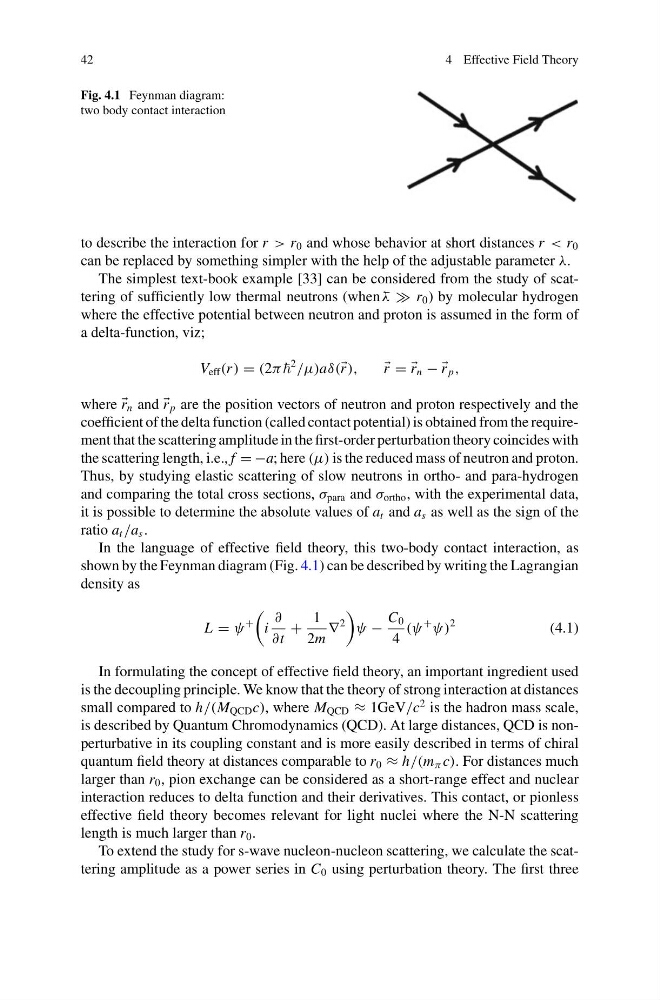
Fig. 4.1 Feynman diagram:
two body contact interaction
to describe the interaction for r > r 0 and whose behavior at short distances r < r 0
can be replaced by something simpler with the help of the adjustable parameter λ.
The simplest text-book example [33] can be considered from the study of scattering of sufficiently low thermal neutrons (when ¯
λ r 0 ) by molecular hydrogen
where the effective potential between neutron and proton is assumed in the form of
a delta-function, viz;
V eff (r ) = (2π
2
/μ)aδ( r ),
r = =
r n − −
r p ,
where
r n and
r p are the position vectors of neutron and proton respectively and the
coefficient of the delta function (called contact potential) is obtained from the requirement that the scattering amplitude in the first-order perturbation theory coincides with
the scattering length, i.e., f = −a; here (μ) is the reduced mass of neutron and proton.
Thus, by studying elastic scattering of slow neutrons in ortho- and para-hydrogen
and comparing the total cross sections, σ para and σ ortho , with the experimental data,
it is possible to determine the absolute values of a t and a s as well as the sign of the
ratio a t /a s .
In the language of effective field theory, this two-body contact interaction, as
shown by the Feynman diagram (Fig. 4.1) can be described by writing the Lagrangian
density as
L = ψ
+
i
∂
∂t
+
1
2m
∇
2
ψ −
C 0
4
(ψ
+
ψ)
2
(4.1)
In formulating the concept of effective field theory, an important ingredient used
is the decoupling principle. We know that the theory of strong interaction at distances
small compared to h/(M QCD c), where M QCD ≈ 1GeV/c
2 is the hadron mass scale,
is described by Quantum Chromodynamics (QCD). At large distances, QCD is nonperturbative in its coupling constant and is more easily described in terms of chiral
quantum field theory at distances comparable to r 0 ≈ h/(m π c). For distances much
larger than r 0 , pion exchange can be considered as a short-range effect and nuclear
interaction reduces to delta function and their derivatives. This contact, or pionless
effective field theory becomes relevant for light nuclei where the N-N scattering
length is much larger than r 0 .
To extend the study for s-wave nucleon-nucleon scattering, we calculate the scattering amplitude as a power series in C 0 using perturbation theory. The first three
4 Effective Field Theory
Fig. 4.1 Feynman diagram:
two body contact interaction
to describe the interaction for r > r 0 and whose behavior at short distances r < r 0
can be replaced by something simpler with the help of the adjustable parameter λ.
The simplest text-book example [33] can be considered from the study of scattering of sufficiently low thermal neutrons (when ¯
λ r 0 ) by molecular hydrogen
where the effective potential between neutron and proton is assumed in the form of
a delta-function, viz;
V eff (r ) = (2π
2
/μ)aδ( r ),
r = =
r n − −
r p ,
where
r n and
r p are the position vectors of neutron and proton respectively and the
coefficient of the delta function (called contact potential) is obtained from the requirement that the scattering amplitude in the first-order perturbation theory coincides with
the scattering length, i.e., f = −a; here (μ) is the reduced mass of neutron and proton.
Thus, by studying elastic scattering of slow neutrons in ortho- and para-hydrogen
and comparing the total cross sections, σ para and σ ortho , with the experimental data,
it is possible to determine the absolute values of a t and a s as well as the sign of the
ratio a t /a s .
In the language of effective field theory, this two-body contact interaction, as
shown by the Feynman diagram (Fig. 4.1) can be described by writing the Lagrangian
density as
L = ψ
+
i
∂
∂t
+
1
2m
∇
2
ψ −
C 0
4
(ψ
+
ψ)
2
(4.1)
In formulating the concept of effective field theory, an important ingredient used
is the decoupling principle. We know that the theory of strong interaction at distances
small compared to h/(M QCD c), where M QCD ≈ 1GeV/c
2 is the hadron mass scale,
is described by Quantum Chromodynamics (QCD). At large distances, QCD is nonperturbative in its coupling constant and is more easily described in terms of chiral
quantum field theory at distances comparable to r 0 ≈ h/(m π c). For distances much
larger than r 0 , pion exchange can be considered as a short-range effect and nuclear
interaction reduces to delta function and their derivatives. This contact, or pionless
effective field theory becomes relevant for light nuclei where the N-N scattering
length is much larger than r 0 .
To extend the study for s-wave nucleon-nucleon scattering, we calculate the scattering amplitude as a power series in C 0 using perturbation theory. The first three