

38
3 Efimov’s Universal Three-Body Effect
the two-body binding energy is zero, but also for realistic values of the parameters
of the nucleon–nucleon amplitude corresponding to the spin-triplet and spin-singlet
s-states.
3.5.1 Studying the Anomalous Behavior Due to Efimov
Effect in Spin-Doublet N-D Scattering Near Threshold
This investigation motivated us [28] to revisit n-d scattering at low energies
employing separable potentials. In order to check whether we are close enough to
the limiting case discussed above, we carried out detailed numerical calculations by
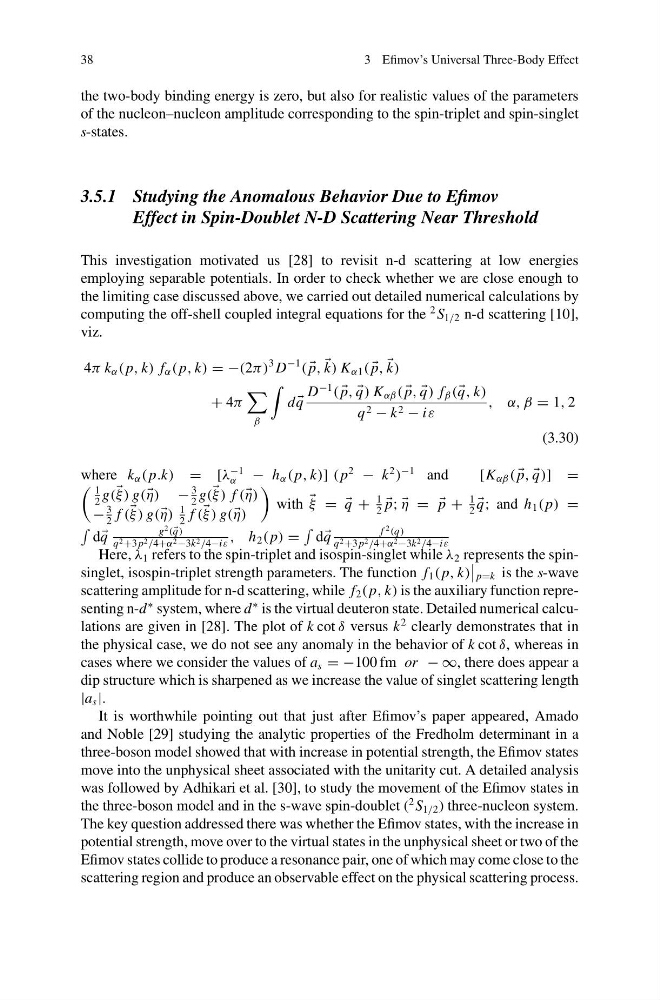
computing the off-shell coupled integral equations for the
2 S 1/2 n-d scattering [10],
viz.
4π k α ( p, k) f α ( p, k) = −(2π)
3 D
−1
(
p,
k) K α1 (
p,
k)
+ 4π
β
d
q
D
−1
(
p,
q) K αβ (
p,
q) f β ( q, k)
q 2 − k 2 − iε
, α,β = 1, 2
(3.30)
where k α ( p.k) = [λ
−1
α
− h α ( p, k)] ( p
2
− k
2
)
−1 and
[K αβ (
p,
q)] =
1
2
g(
ξ) g( η) −
3
2
g(
ξ) f ( η)
−
3
2
f (
ξ) g( η)
1
2
f (
ξ) g( η)
with
ξ = =
q +
1
2
p; ;
η = =
p +
1
2
q; and h 1 ( p) =
d q
g
2 ( q)
q 2 +3 p 2 /4+α 2 −3k 2 /4−iε
, h 2 ( p) =
d q
f
2 (q)
q 2 +3 p 2 /4+α 2 −3k 2 /4−iε
Here, λ 1 refers to the spin-triplet and isospin-singlet while λ 2 represents the spinsinglet, isospin-triplet strength parameters. The function f 1 ( p, k)
p=k is the s-wave
scattering amplitude for n-d scattering, while f 2 ( p, k) is the auxiliary function representing n-d
∗ system, where d
∗ is the virtual deuteron state. Detailed numerical calculations are given in [28]. The plot of k cot δ versus k
2 clearly demonstrates that in
the physical case, we do not see any anomaly in the behavior of k cot δ, whereas in
cases where we consider the values of a s = −100 fm or − ∞, there does appear a
dip structure which is sharpened as we increase the value of singlet scattering length
|a s |.
It is worthwhile pointing out that just after Efimov’s paper appeared, Amado
and Noble [29] studying the analytic properties of the Fredholm determinant in a
three-boson model showed that with increase in potential strength, the Efimov states
move into the unphysical sheet associated with the unitarity cut. A detailed analysis
was followed by Adhikari et al. [30], to study the movement of the Efimov states in
the three-boson model and in the s-wave spin-doublet (
2 S 1/2 ) three-nucleon system.
The key question addressed there was whether the Efimov states, with the increase in
potential strength, move over to the virtual states in the unphysical sheet or two of the
Efimov states collide to produce a resonance pair, one of which may come close to the
scattering region and produce an observable effect on the physical scattering process.
3 Efimov’s Universal Three-Body Effect
the two-body binding energy is zero, but also for realistic values of the parameters
of the nucleon–nucleon amplitude corresponding to the spin-triplet and spin-singlet
s-states.
3.5.1 Studying the Anomalous Behavior Due to Efimov
Effect in Spin-Doublet N-D Scattering Near Threshold
This investigation motivated us [28] to revisit n-d scattering at low energies
employing separable potentials. In order to check whether we are close enough to
the limiting case discussed above, we carried out detailed numerical calculations by
computing the off-shell coupled integral equations for the
2 S 1/2 n-d scattering [10],
viz.
4π k α ( p, k) f α ( p, k) = −(2π)
3 D
−1
(
p,
k) K α1 (
p,
k)
+ 4π
β
d
q
D
−1
(
p,
q) K αβ (
p,
q) f β ( q, k)
q 2 − k 2 − iε
, α,β = 1, 2
(3.30)
where k α ( p.k) = [λ
−1
α
− h α ( p, k)] ( p
2
− k
2
)
−1 and
[K αβ (
p,
q)] =
1
2
g(
ξ) g( η) −
3
2
g(
ξ) f ( η)
−
3
2
f (
ξ) g( η)
1
2
f (
ξ) g( η)
with
ξ = =
q +
1
2
p; ;
η = =
p +
1
2
q; and h 1 ( p) =
d q
g
2 ( q)
q 2 +3 p 2 /4+α 2 −3k 2 /4−iε
, h 2 ( p) =
d q
f
2 (q)
q 2 +3 p 2 /4+α 2 −3k 2 /4−iε
Here, λ 1 refers to the spin-triplet and isospin-singlet while λ 2 represents the spinsinglet, isospin-triplet strength parameters. The function f 1 ( p, k)
p=k is the s-wave
scattering amplitude for n-d scattering, while f 2 ( p, k) is the auxiliary function representing n-d
∗ system, where d
∗ is the virtual deuteron state. Detailed numerical calculations are given in [28]. The plot of k cot δ versus k
2 clearly demonstrates that in
the physical case, we do not see any anomaly in the behavior of k cot δ, whereas in
cases where we consider the values of a s = −100 fm or − ∞, there does appear a
dip structure which is sharpened as we increase the value of singlet scattering length
|a s |.
It is worthwhile pointing out that just after Efimov’s paper appeared, Amado
and Noble [29] studying the analytic properties of the Fredholm determinant in a
three-boson model showed that with increase in potential strength, the Efimov states
move into the unphysical sheet associated with the unitarity cut. A detailed analysis
was followed by Adhikari et al. [30], to study the movement of the Efimov states in
the three-boson model and in the s-wave spin-doublet (
2 S 1/2 ) three-nucleon system.
The key question addressed there was whether the Efimov states, with the increase in
potential strength, move over to the virtual states in the unphysical sheet or two of the
Efimov states collide to produce a resonance pair, one of which may come close to the
scattering region and produce an observable effect on the physical scattering process.