

3.4 Salient Feature of Efimov Effect
37
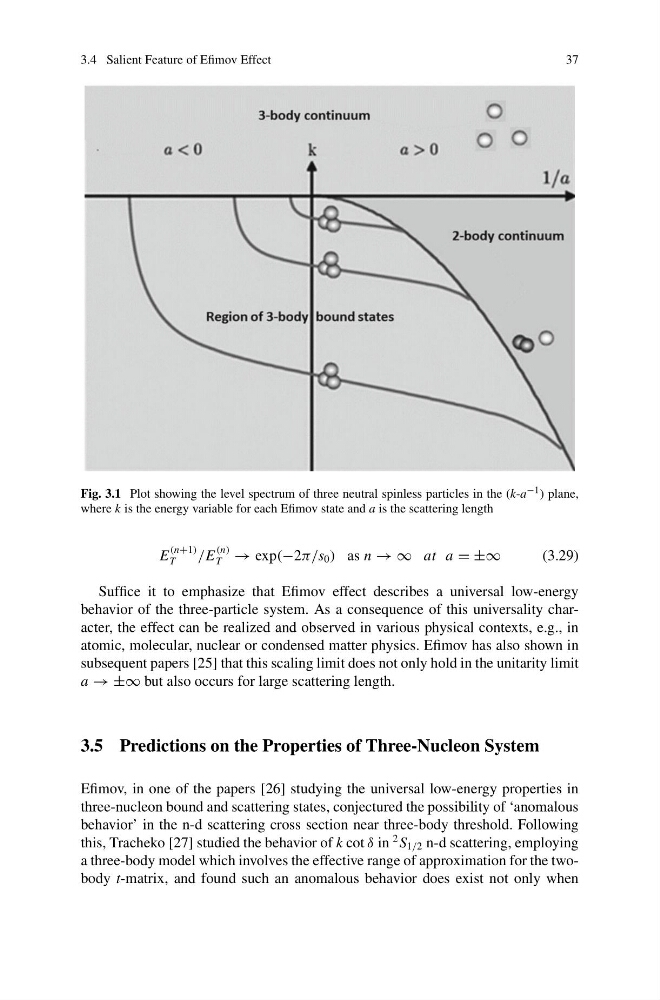
Fig. 3.1 Plot showing the level spectrum of three neutral spinless particles in the (k-a −1 ) plane,
where k is the energy variable for each Efimov state and a is the scattering length
E
(n+1)
T
/E
(n)
T → exp(−2π/s 0 ) as n → ∞ at a = ±∞
(3.29)
Suffice it to emphasize that Efimov effect describes a universal low-energy
behavior of the three-particle system. As a consequence of this universality character, the effect can be realized and observed in various physical contexts, e.g., in
atomic, molecular, nuclear or condensed matter physics. Efimov has also shown in
subsequent papers [25] that this scaling limit does not only hold in the unitarity limit
a → ±∞ but also occurs for large scattering length.
3.5 Predictions on the Properties of Three-Nucleon System
Efimov, in one of the papers [26] studying the universal low-energy properties in
three-nucleon bound and scattering states, conjectured the possibility of ‘anomalous
behavior’ in the n-d scattering cross section near three-body threshold. Following
this, Tracheko [27] studied the behavior of k cot δ in
2 S 1/2 n-d scattering, employing
a three-body model which involves the effective range of approximation for the twobody t-matrix, and found such an anomalous behavior does exist not only when
37
Fig. 3.1 Plot showing the level spectrum of three neutral spinless particles in the (k-a −1 ) plane,
where k is the energy variable for each Efimov state and a is the scattering length
E
(n+1)
T
/E
(n)
T → exp(−2π/s 0 ) as n → ∞ at a = ±∞
(3.29)
Suffice it to emphasize that Efimov effect describes a universal low-energy
behavior of the three-particle system. As a consequence of this universality character, the effect can be realized and observed in various physical contexts, e.g., in
atomic, molecular, nuclear or condensed matter physics. Efimov has also shown in
subsequent papers [25] that this scaling limit does not only hold in the unitarity limit
a → ±∞ but also occurs for large scattering length.
3.5 Predictions on the Properties of Three-Nucleon System
Efimov, in one of the papers [26] studying the universal low-energy properties in
three-nucleon bound and scattering states, conjectured the possibility of ‘anomalous
behavior’ in the n-d scattering cross section near three-body threshold. Following
this, Tracheko [27] studied the behavior of k cot δ in
2 S 1/2 n-d scattering, employing
a three-body model which involves the effective range of approximation for the twobody t-matrix, and found such an anomalous behavior does exist not only when