

18
2 Scattering Theory of Three-Particle System
has solution for energies in the scattering region.
Consider, for example, another channel state
φ j n
for j = i
For such a state
lim
ε→0
±iε G
(±)
i (E ± iε)
φ j n
= 0
(2.24)
because the state
φ j n
f or j = i is not an eigen-state of H i . Therefore, we get
ψ
(±
jn
= G i (E + i0) ¯
V i
ψ
(±)
jn
(2.25)
This homogeneous equation which belongs to the inhomogeneous L–S equation
has non-trivial solutions of the scattering states in channels, j = i.
2.4.2 Disconnectedness of the Kernel
Another difficulty one encounters is that the kernel of L–S Eq. (2.22) does not have
a finite Schmidt norm. The kernels are also not compact and therefore standard
methods of the theory of integral equations can not be applied. Written explicitly in
momentum space
p 1
p 2
p 3 |G 0 (z)
V i
p
1
p
2
p
3
= (z −
3
i=1
p
2
i /2m i )
−1
j =i
δ(
k j −
k
j )
q j
¯
V j
q
j
(2.26)
In Eq. (2.26), the δ-function belonging to the total CM motion is omitted on
the right-hand side. However, δ-functions associated with the two-body potentials
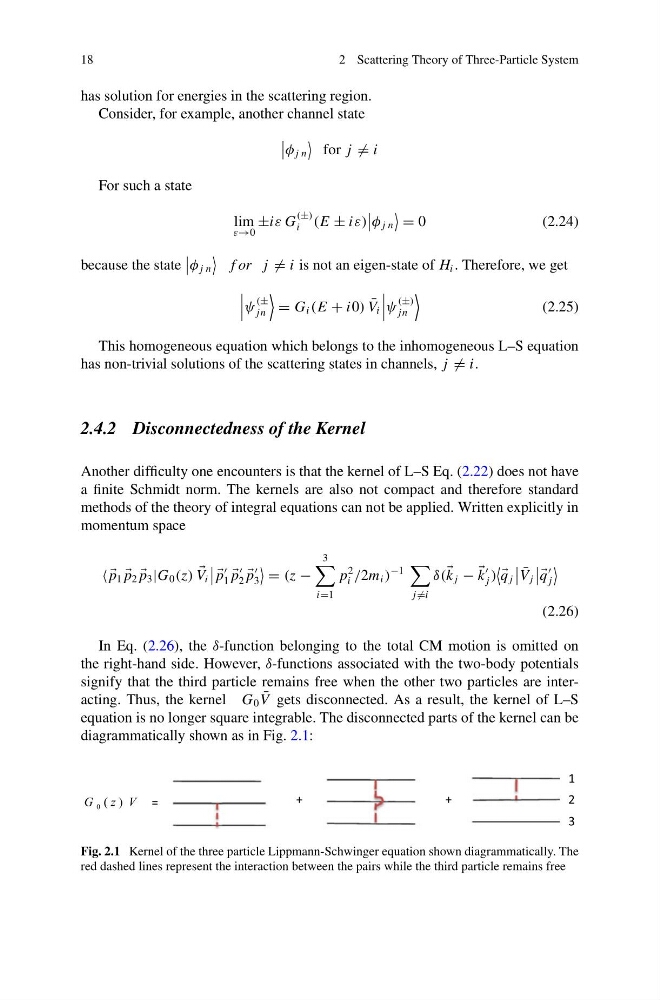
signify that the third particle remains free when the other two particles are interacting. Thus, the kernel G 0 ¯
V gets disconnected. As a result, the kernel of L–S
equation is no longer square integrable. The disconnected parts of the kernel can be
diagrammatically shown as in Fig. 2.1:
Fig. 2.1 Kernel of the three particle Lippmann-Schwinger equation shown diagrammatically. The
red dashed lines represent the interaction between the pairs while the third particle remains free
2 Scattering Theory of Three-Particle System
has solution for energies in the scattering region.
Consider, for example, another channel state
φ j n
for j = i
For such a state
lim
ε→0
±iε G
(±)
i (E ± iε)
φ j n
= 0
(2.24)
because the state
φ j n
f or j = i is not an eigen-state of H i . Therefore, we get
ψ
(±
jn
= G i (E + i0) ¯
V i
ψ
(±)
jn
(2.25)
This homogeneous equation which belongs to the inhomogeneous L–S equation
has non-trivial solutions of the scattering states in channels, j = i.
2.4.2 Disconnectedness of the Kernel
Another difficulty one encounters is that the kernel of L–S Eq. (2.22) does not have
a finite Schmidt norm. The kernels are also not compact and therefore standard
methods of the theory of integral equations can not be applied. Written explicitly in
momentum space
p 1
p 2
p 3 |G 0 (z)
V i
p
1
p
2
p
3
= (z −
3
i=1
p
2
i /2m i )
−1
j =i
δ(
k j −
k
j )
q j
¯
V j
q
j
(2.26)
In Eq. (2.26), the δ-function belonging to the total CM motion is omitted on
the right-hand side. However, δ-functions associated with the two-body potentials
signify that the third particle remains free when the other two particles are interacting. Thus, the kernel G 0 ¯
V gets disconnected. As a result, the kernel of L–S
equation is no longer square integrable. The disconnected parts of the kernel can be
diagrammatically shown as in Fig. 2.1:
Fig. 2.1 Kernel of the three particle Lippmann-Schwinger equation shown diagrammatically. The
red dashed lines represent the interaction between the pairs while the third particle remains free