

2.3 Boundary Conditions and Moller Operators
17
ψ
(±)
i j
=
i (±)
i j
φ i j
(2.17)
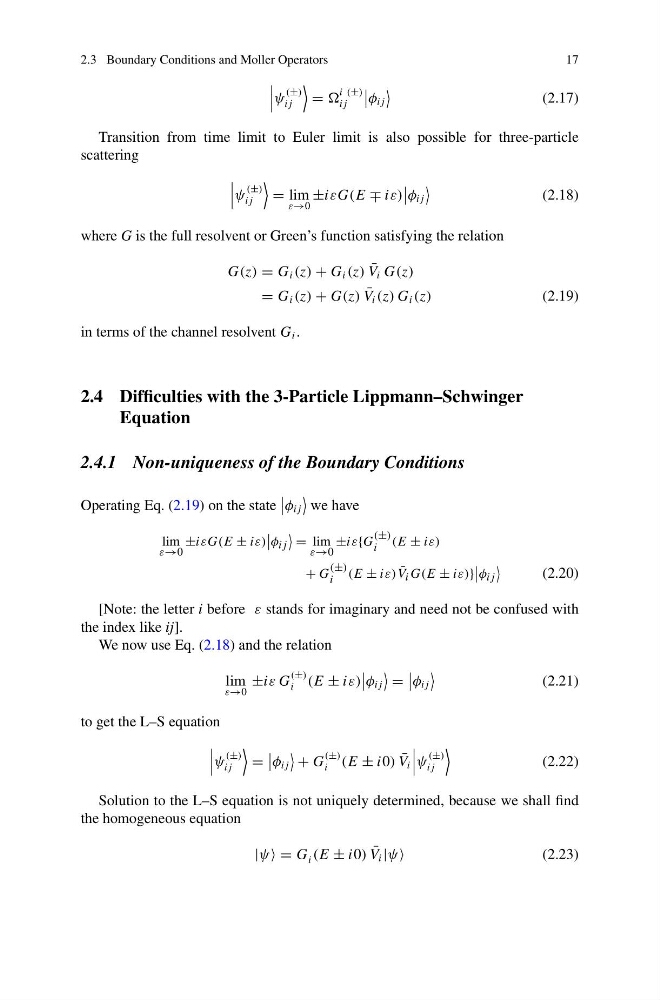
Transition from time limit to Euler limit is also possible for three-particle
scattering
ψ
(±)
i j
= lim
ε→0
±iεG(E ∓ iε)
φ i j
(2.18)
where G is the full resolvent or Green’s function satisfying the relation
G(z) = G i (z) + G i (z) ¯
V i G(z)
= G i (z) + G(z) ¯
V i (z) G i (z)
(2.19)
in terms of the channel resolvent G i .
2.4 Difficulties with the 3-Particle Lippmann–Schwinger
Equation
2.4.1 Non-uniqueness of the Boundary Conditions
Operating Eq. (2.19) on the state
φ i j
we have
lim
ε→0
±iεG(E ± iε)
φ i j
= lim
ε→0
±iε{G
(±)
i (E ± iε)
+ G
(±)
i (E ± iε) ¯
V i G(E ± iε)}
φ i j
(2.20)
[Note: the letter i before ε stands for imaginary and need not be confused with
the index like ij].
We now use Eq. (2.18) and the relation
lim
ε→0
±iε G
(±)
i (E ± iε)
φ i j
=
φ i j
(2.21)
to get the L–S equation
ψ
(±)
i j
=
φ i j
+ G
(±)
i (E ± i0) ¯
V i
ψ
(±)
i j
(2.22)
Solution to the L–S equation is not uniquely determined, because we shall find
the homogeneous equation
|ψ = G i (E ± i0) ¯
V i |ψ
(2.23)
17
ψ
(±)
i j
=
i (±)
i j
φ i j
(2.17)
Transition from time limit to Euler limit is also possible for three-particle
scattering
ψ
(±)
i j
= lim
ε→0
±iεG(E ∓ iε)
φ i j
(2.18)
where G is the full resolvent or Green’s function satisfying the relation
G(z) = G i (z) + G i (z) ¯
V i G(z)
= G i (z) + G(z) ¯
V i (z) G i (z)
(2.19)
in terms of the channel resolvent G i .
2.4 Difficulties with the 3-Particle Lippmann–Schwinger
Equation
2.4.1 Non-uniqueness of the Boundary Conditions
Operating Eq. (2.19) on the state
φ i j
we have
lim
ε→0
±iεG(E ± iε)
φ i j
= lim
ε→0
±iε{G
(±)
i (E ± iε)
+ G
(±)
i (E ± iε) ¯
V i G(E ± iε)}
φ i j
(2.20)
[Note: the letter i before ε stands for imaginary and need not be confused with
the index like ij].
We now use Eq. (2.18) and the relation
lim
ε→0
±iε G
(±)
i (E ± iε)
φ i j
=
φ i j
(2.21)
to get the L–S equation
ψ
(±)
i j
=
φ i j
+ G
(±)
i (E ± i0) ¯
V i
ψ
(±)
i j
(2.22)
Solution to the L–S equation is not uniquely determined, because we shall find
the homogeneous equation
|ψ = G i (E ± i0) ¯
V i |ψ
(2.23)