

6.6 Occurrence of Efimov States in 20 C
9 7
of
20 C increasing from 3.1 to 3.5 MeV in close agreement with the experimental
data [91]. In addition, we get excited states as shown in Table 6.8. The first excited
states (ε 1 ) shown in column 5 of the table have binding energies below the n–(nc)
scattering threshold (ε 1 − ε n−core ) which can vary from 2 to 19 keV depending on the
n−
18 C input binding energy. In order to analyze these states further, we present the
number of bound states (N) for the respective two-body interactions as per Efimov’s
relations for these quantities [93]. The value of N ≈ 1 in column 7 is indicative of
the occurrence of not more than one Efimov state. We also estimate the size [75] of
the first excited state for the different two-body interactions to vary between 50 and
55 fm. The rather large size is also in conformity with expectations for the sizes of
Efimov states.
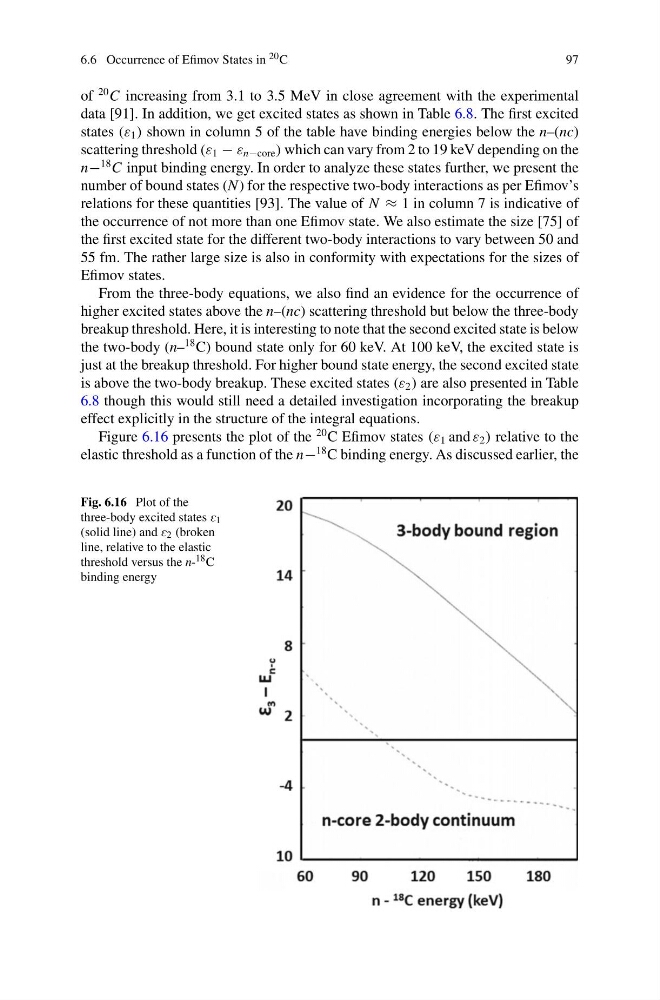
From the three-body equations, we also find an evidence for the occurrence of
higher excited states above the n–(nc) scattering threshold but below the three-body
breakup threshold. Here, it is interesting to note that the second excited state is below
the two-body (n–
18 C) bound state only for 60 keV. At 100 keV, the excited state is
just at the breakup threshold. For higher bound state energy, the second excited state
is above the two-body breakup. These excited states (ε 2 ) are also presented in Table
6.8 though this would still need a detailed investigation incorporating the breakup
effect explicitly in the structure of the integral equations.
Figure 6.16 presents the plot of the
20 C Efimov states (ε 1 and ε 2 ) relative to the
elastic threshold as a function of the n−
18 C binding energy. As discussed earlier, the
Fig. 6.16 Plot of the
three-body excited states E 1
(solid line) and E 2 (broken
line, relative to the elastic
threshold versus the n- 18 C
binding energy
9 7
of
20 C increasing from 3.1 to 3.5 MeV in close agreement with the experimental
data [91]. In addition, we get excited states as shown in Table 6.8. The first excited
states (ε 1 ) shown in column 5 of the table have binding energies below the n–(nc)
scattering threshold (ε 1 − ε n−core ) which can vary from 2 to 19 keV depending on the
n−
18 C input binding energy. In order to analyze these states further, we present the
number of bound states (N) for the respective two-body interactions as per Efimov’s
relations for these quantities [93]. The value of N ≈ 1 in column 7 is indicative of
the occurrence of not more than one Efimov state. We also estimate the size [75] of
the first excited state for the different two-body interactions to vary between 50 and
55 fm. The rather large size is also in conformity with expectations for the sizes of
Efimov states.
From the three-body equations, we also find an evidence for the occurrence of
higher excited states above the n–(nc) scattering threshold but below the three-body
breakup threshold. Here, it is interesting to note that the second excited state is below
the two-body (n–
18 C) bound state only for 60 keV. At 100 keV, the excited state is
just at the breakup threshold. For higher bound state energy, the second excited state
is above the two-body breakup. These excited states (ε 2 ) are also presented in Table
6.8 though this would still need a detailed investigation incorporating the breakup
effect explicitly in the structure of the integral equations.
Figure 6.16 presents the plot of the
20 C Efimov states (ε 1 and ε 2 ) relative to the
elastic threshold as a function of the n−
18 C binding energy. As discussed earlier, the
Fig. 6.16 Plot of the
three-body excited states E 1
(solid line) and E 2 (broken
line, relative to the elastic
threshold versus the n- 18 C
binding energy