

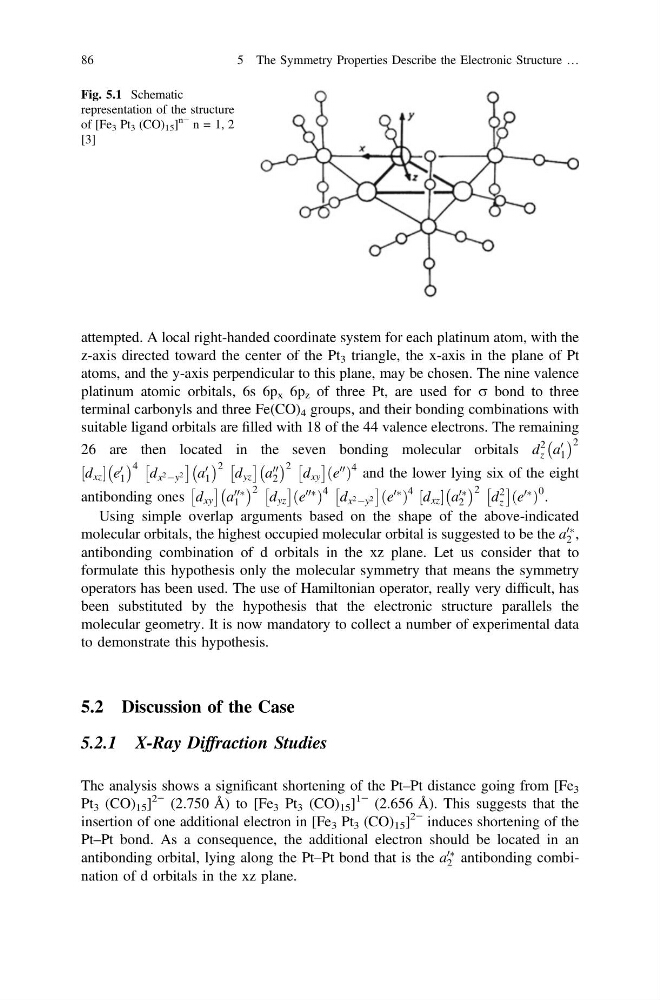
attempted. A local right-handed coordinate system for each platinum atom, with the
z-axis directed toward the center of the Pt 3 triangle, the x-axis in the plane of Pt
atoms, and the y-axis perpendicular to this plane, may be chosen. The nine valence
platinum atomic orbitals, 6s 6p x 6p z of three Pt, are used for r bond to three
terminal carbonyls and three Fe(CO) 4 groups, and their bonding combinations with
suitable ligand orbitals are filled with 18 of the 44 valence electrons. The remaining
26 are then located in the seven bonding molecular orbitals d
2
z a
0
1
À Á 2
d xz
½ e
0
1
À Á 4 d x 2 Ày 2
Â
Ã
a
0
1
À Á 2 d yz
 Ã
a
00
2
À Á 2 d xy
 Ã
e
00
ð Þ
4 and the lower lying six of the eight
antibonding ones d xy
 Ã
a
00Ã
1
À Á 2 d yz
 Ã
e
00Ã
ð Þ
4 d x 2 Ày 2
Â
Ã
e
0Ã
ð Þ
4 d xz
½ a
0Ã
2
À Á 2 d
2
z
 Ã
e
0Ã
ð Þ
0 .
Using simple overlap arguments based on the shape of the above-indicated
molecular orbitals, the highest occupied molecular orbital is suggested to be the a
0Ã
2 ,
antibonding combination of d orbitals in the xz plane. Let us consider that to
formulate this hypothesis only the molecular symmetry that means the symmetry
operators has been used. The use of Hamiltonian operator, really very difficult, has
been substituted by the hypothesis that the electronic structure parallels the
molecular geometry. It is now mandatory to collect a number of experimental data
to demonstrate this hypothesis.
5.2 Discussion of the Case
5.2.1 X-Ray Diffraction Studies
The analysis shows a significant shortening of the Pt–Pt distance going from [Fe 3
Pt 3 (CO) 15 ]
2− (2.750 Å) to [Fe 3 Pt 3 (CO) 15 ]
1− (2.656 Å). This suggests that the
insertion of one additional electron in [Fe 3 Pt 3 (CO) 15 ]
2− induces shortening of the
Pt–Pt bond. As a consequence, the additional electron should be located in an
antibonding orbital, lying along the Pt–Pt bond that is the a
0Ã
2 antibonding combination of d orbitals in the xz plane.
Fig. 5.1 Schematic
representation of the structure
of [Fe 3 Pt 3 (CO) 15 ]
n− n = 1, 2
[3]
86
5 The Symmetry Properties Describe the Electronic Structure …
z-axis directed toward the center of the Pt 3 triangle, the x-axis in the plane of Pt
atoms, and the y-axis perpendicular to this plane, may be chosen. The nine valence
platinum atomic orbitals, 6s 6p x 6p z of three Pt, are used for r bond to three
terminal carbonyls and three Fe(CO) 4 groups, and their bonding combinations with
suitable ligand orbitals are filled with 18 of the 44 valence electrons. The remaining
26 are then located in the seven bonding molecular orbitals d
2
z a
0
1
À Á 2
d xz
½ e
0
1
À Á 4 d x 2 Ày 2
Â
Ã
a
0
1
À Á 2 d yz
 Ã
a
00
2
À Á 2 d xy
 Ã
e
00
ð Þ
4 and the lower lying six of the eight
antibonding ones d xy
 Ã
a
00Ã
1
À Á 2 d yz
 Ã
e
00Ã
ð Þ
4 d x 2 Ày 2
Â
Ã
e
0Ã
ð Þ
4 d xz
½ a
0Ã
2
À Á 2 d
2
z
 Ã
e
0Ã
ð Þ
0 .
Using simple overlap arguments based on the shape of the above-indicated
molecular orbitals, the highest occupied molecular orbital is suggested to be the a
0Ã
2 ,
antibonding combination of d orbitals in the xz plane. Let us consider that to
formulate this hypothesis only the molecular symmetry that means the symmetry
operators has been used. The use of Hamiltonian operator, really very difficult, has
been substituted by the hypothesis that the electronic structure parallels the
molecular geometry. It is now mandatory to collect a number of experimental data
to demonstrate this hypothesis.
5.2 Discussion of the Case
5.2.1 X-Ray Diffraction Studies
The analysis shows a significant shortening of the Pt–Pt distance going from [Fe 3
Pt 3 (CO) 15 ]
2− (2.750 Å) to [Fe 3 Pt 3 (CO) 15 ]
1− (2.656 Å). This suggests that the
insertion of one additional electron in [Fe 3 Pt 3 (CO) 15 ]
2− induces shortening of the
Pt–Pt bond. As a consequence, the additional electron should be located in an
antibonding orbital, lying along the Pt–Pt bond that is the a
0Ã
2 antibonding combination of d orbitals in the xz plane.
Fig. 5.1 Schematic
representation of the structure
of [Fe 3 Pt 3 (CO) 15 ]
n− n = 1, 2
[3]
86
5 The Symmetry Properties Describe the Electronic Structure …