

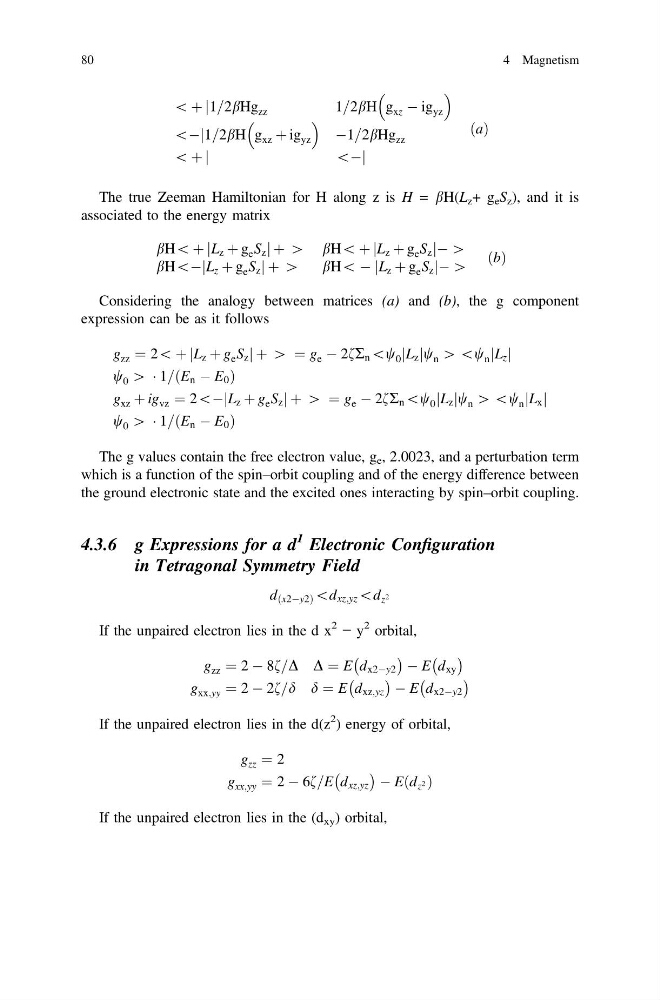
\ þ j1=2bHg zz
1=2bH g xz À ig yz
\Àj1=2bH g xz þ ig yz
À1=2bHg zz
\ þ j
\Àj
ðaÞ
The true Zeeman Hamiltonian for H along z is H = bH(L z + g e S z ), and it is
associated to the energy matrix
bH\ þ L z þ g e S z
j
jþ[ bH\ þ L z þ g e S z
j
j À[
bH\À L z þ g e S z
j
jþ [
bH\ À L z þ g e S z
j
j À[
ðbÞ
Considering the analogy between matrices (a) and (b), the g component
expression can be as it follows
g zz ¼ 2\ þ L z þ g e S z
j
jþ [ ¼ g e À 2fR n \w 0 L z
j jw n [ \w n L z
j j
w 0 [ Á 1= E n À E 0
ð
Þ
g xz þ ig vz ¼ 2\À L z þ g e S z
j
jþ [ ¼ g e À 2fR n \w 0 L z
j jw n [ \w n L x
j j
w 0 [ Á 1= E n À E 0
ð
Þ
The g values contain the free electron value, g e , 2.0023, and a perturbation term
which is a function of the spin–orbit coupling and of the energy difference between
the ground electronic state and the excited ones interacting by spin–orbit coupling.
4.3.6 g Expressions for a d
1 Electronic Configuration
in Tetragonal Symmetry Field
d ðx2Ày2Þ \d xz;yz \d z 2
If the unpaired electron lies in the d x
2
− y
2 orbital,
g zz ¼ 2 À 8f=D D ¼ E d x2Ày2
À
Á À E d xy
À Á
g xx;yy ¼ 2 À 2f=d d ¼ E d xz;yz
À
Á À E d x2Ày2
À
Á
If the unpaired electron lies in the d(z
2 ) energy of orbital,
g zz ¼ 2
g xx;yy ¼ 2 À 6f=E d xz;yz
À
Á À E d z 2
ð Þ
If the unpaired electron lies in the (d xy ) orbital,
80
4 Magnetism
1=2bH g xz À ig yz
\Àj1=2bH g xz þ ig yz
À1=2bHg zz
\ þ j
\Àj
ðaÞ
The true Zeeman Hamiltonian for H along z is H = bH(L z + g e S z ), and it is
associated to the energy matrix
bH\ þ L z þ g e S z
j
jþ[ bH\ þ L z þ g e S z
j
j À[
bH\À L z þ g e S z
j
jþ [
bH\ À L z þ g e S z
j
j À[
ðbÞ
Considering the analogy between matrices (a) and (b), the g component
expression can be as it follows
g zz ¼ 2\ þ L z þ g e S z
j
jþ [ ¼ g e À 2fR n \w 0 L z
j jw n [ \w n L z
j j
w 0 [ Á 1= E n À E 0
ð
Þ
g xz þ ig vz ¼ 2\À L z þ g e S z
j
jþ [ ¼ g e À 2fR n \w 0 L z
j jw n [ \w n L x
j j
w 0 [ Á 1= E n À E 0
ð
Þ
The g values contain the free electron value, g e , 2.0023, and a perturbation term
which is a function of the spin–orbit coupling and of the energy difference between
the ground electronic state and the excited ones interacting by spin–orbit coupling.
4.3.6 g Expressions for a d
1 Electronic Configuration
in Tetragonal Symmetry Field
d ðx2Ày2Þ \d xz;yz \d z 2
If the unpaired electron lies in the d x
2
− y
2 orbital,
g zz ¼ 2 À 8f=D D ¼ E d x2Ày2
À
Á À E d xy
À Á
g xx;yy ¼ 2 À 2f=d d ¼ E d xz;yz
À
Á À E d x2Ày2
À
Á
If the unpaired electron lies in the d(z
2 ) energy of orbital,
g zz ¼ 2
g xx;yy ¼ 2 À 6f=E d xz;yz
À
Á À E d z 2
ð Þ
If the unpaired electron lies in the (d xy ) orbital,
80
4 Magnetism