

g
2
eff ¼ l x l y l z
Â
Ã
g
2
xx 0
0
½l x
0
g
2
yy
0
l y
0
0
g
2
yy
l z
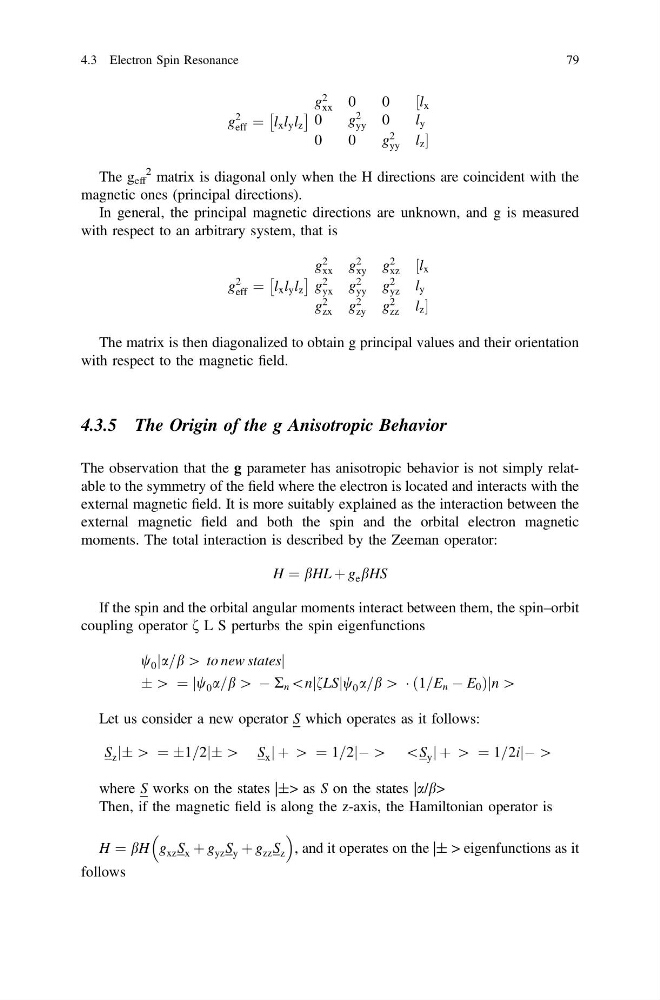
The g eff
2 matrix is diagonal only when the H directions are coincident with the
magnetic ones (principal directions).
In general, the principal magnetic directions are unknown, and g is measured
with respect to an arbitrary system, that is
g
2
eff ¼ l x l y l z
Â
Ã
g
2
xx
g
2
xy
g
2
xz
½l x
g
2
yx
g
2
yy
g
2
yz
l y
g
2
zx
g
2
zy
g
2
zz
l z
The matrix is then diagonalized to obtain g principal values and their orientation
with respect to the magnetic field.
4.3.5 The Origin of the g Anisotropic Behavior
The observation that the g parameter has anisotropic behavior is not simply relatable to the symmetry of the field where the electron is located and interacts with the
external magnetic field. It is more suitably explained as the interaction between the
external magnetic field and both the spin and the orbital electron magnetic
moments. The total interaction is described by the Zeeman operator:
H ¼ bHL þ g e bHS
If the spin and the orbital angular moments interact between them, the spin–orbit
coupling operator f L S perturbs the spin eigenfunctions
w 0 a=b [ to new states
j
j
Æ [ ¼ w 0 a=b [ À R n \n
j
j fLS w 0 a=b [ Á 1=E n À E 0
ð
Þ
j
j n [
Let us consider a new operator S which operates as it follows:
S z jÆ [ ¼ Æ1=2jÆ [ S x j þ [ ¼ 1=2jÀ [ \S y j þ [ ¼ 1=2ijÀ [
where S works on the states |±> as S on the states |a/b>
Then, if the magnetic field is along the z-axis, the Hamiltonian operator is
H ¼ bH g xz S x þ g yz S y þ g zz S z
, and it operates on the |± > eigenfunctions as it
follows
4.3 Electron Spin Resonance
79
2
eff ¼ l x l y l z
Â
Ã
g
2
xx 0
0
½l x
0
g
2
yy
0
l y
0
0
g
2
yy
l z
The g eff
2 matrix is diagonal only when the H directions are coincident with the
magnetic ones (principal directions).
In general, the principal magnetic directions are unknown, and g is measured
with respect to an arbitrary system, that is
g
2
eff ¼ l x l y l z
Â
Ã
g
2
xx
g
2
xy
g
2
xz
½l x
g
2
yx
g
2
yy
g
2
yz
l y
g
2
zx
g
2
zy
g
2
zz
l z
The matrix is then diagonalized to obtain g principal values and their orientation
with respect to the magnetic field.
4.3.5 The Origin of the g Anisotropic Behavior
The observation that the g parameter has anisotropic behavior is not simply relatable to the symmetry of the field where the electron is located and interacts with the
external magnetic field. It is more suitably explained as the interaction between the
external magnetic field and both the spin and the orbital electron magnetic
moments. The total interaction is described by the Zeeman operator:
H ¼ bHL þ g e bHS
If the spin and the orbital angular moments interact between them, the spin–orbit
coupling operator f L S perturbs the spin eigenfunctions
w 0 a=b [ to new states
j
j
Æ [ ¼ w 0 a=b [ À R n \n
j
j fLS w 0 a=b [ Á 1=E n À E 0
ð
Þ
j
j n [
Let us consider a new operator S which operates as it follows:
S z jÆ [ ¼ Æ1=2jÆ [ S x j þ [ ¼ 1=2jÀ [ \S y j þ [ ¼ 1=2ijÀ [
where S works on the states |±> as S on the states |a/b>
Then, if the magnetic field is along the z-axis, the Hamiltonian operator is
H ¼ bH g xz S x þ g yz S y þ g zz S z
, and it operates on the |± > eigenfunctions as it
follows
4.3 Electron Spin Resonance
79