

allowed. Thus, the quenching of the orbital momentum is fully justified. Instead in
tetrahedral symmetry field, there is one electron in t 2g orbitals, and the orbital
circulation is active.
4.3 Electron Spin Resonance
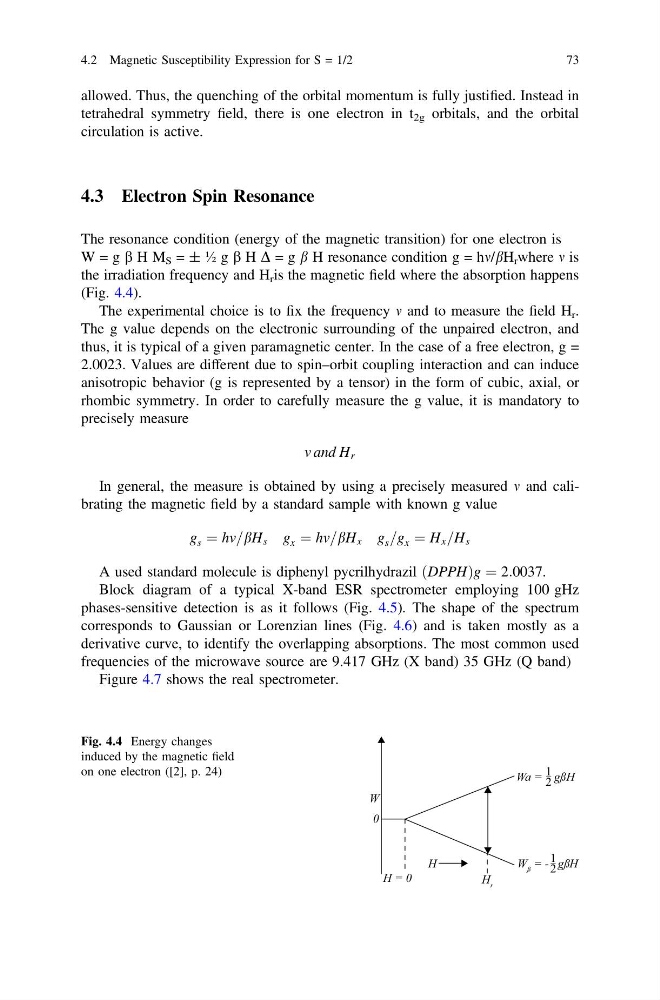
The resonance condition (energy of the magnetic transition) for one electron is
W = g b H M S = ± ½ g b H D = g b H resonance condition g = hm/bH r where m is
the irradiation frequency and H r is the magnetic field where the absorption happens
(Fig. 4.4).
The experimental choice is to fix the frequency m and to measure the field H r .
The g value depends on the electronic surrounding of the unpaired electron, and
thus, it is typical of a given paramagnetic center. In the case of a free electron, g =
2.0023. Values are different due to spin–orbit coupling interaction and can induce
anisotropic behavior (g is represented by a tensor) in the form of cubic, axial, or
rhombic symmetry. In order to carefully measure the g value, it is mandatory to
precisely measure
v and H r
In general, the measure is obtained by using a precisely measured m and calibrating the magnetic field by a standard sample with known g value
g s ¼ hv=bH s g x ¼ hv=bH x g s =g x ¼ H x =H s
A used standard molecule is diphenyl pycrilhydrazil ðDPPHÞg ¼ 2:0037.
Block diagram of a typical X-band ESR spectrometer employing 100 gHz
phases-sensitive detection is as it follows (Fig. 4.5). The shape of the spectrum
corresponds to Gaussian or Lorenzian lines (Fig. 4.6) and is taken mostly as a
derivative curve, to identify the overlapping absorptions. The most common used
frequencies of the microwave source are 9.417 GHz (X band) 35 GHz (Q band)
Figure 4.7 shows the real spectrometer.
Wa = gßH
1
2
W ß = - gßH
1
2
W
H
H r
0
H = 0
Fig. 4.4 Energy changes
induced by the magnetic field
on one electron ([2], p. 24)
4.2 Magnetic Susceptibility Expression for S = 1/2
73
tetrahedral symmetry field, there is one electron in t 2g orbitals, and the orbital
circulation is active.
4.3 Electron Spin Resonance
The resonance condition (energy of the magnetic transition) for one electron is
W = g b H M S = ± ½ g b H D = g b H resonance condition g = hm/bH r where m is
the irradiation frequency and H r is the magnetic field where the absorption happens
(Fig. 4.4).
The experimental choice is to fix the frequency m and to measure the field H r .
The g value depends on the electronic surrounding of the unpaired electron, and
thus, it is typical of a given paramagnetic center. In the case of a free electron, g =
2.0023. Values are different due to spin–orbit coupling interaction and can induce
anisotropic behavior (g is represented by a tensor) in the form of cubic, axial, or
rhombic symmetry. In order to carefully measure the g value, it is mandatory to
precisely measure
v and H r
In general, the measure is obtained by using a precisely measured m and calibrating the magnetic field by a standard sample with known g value
g s ¼ hv=bH s g x ¼ hv=bH x g s =g x ¼ H x =H s
A used standard molecule is diphenyl pycrilhydrazil ðDPPHÞg ¼ 2:0037.
Block diagram of a typical X-band ESR spectrometer employing 100 gHz
phases-sensitive detection is as it follows (Fig. 4.5). The shape of the spectrum
corresponds to Gaussian or Lorenzian lines (Fig. 4.6) and is taken mostly as a
derivative curve, to identify the overlapping absorptions. The most common used
frequencies of the microwave source are 9.417 GHz (X band) 35 GHz (Q band)
Figure 4.7 shows the real spectrometer.
Wa = gßH
1
2
W ß = - gßH
1
2
W
H
H r
0
H = 0
Fig. 4.4 Energy changes
induced by the magnetic field
on one electron ([2], p. 24)
4.2 Magnetic Susceptibility Expression for S = 1/2
73