

The method of descending symmetry thus consists in rewriting the electronic
configuration in a symmetry where all the orbital degeneracies disappear. By this
way, the spin state can be definitely associated to the orbital. It results in a complete
correlation diagram between the mono electronic configurations that correspond to
very strong crystal field perturbation and the terms, where the electronic repulsion is
stronger than the crystal field one (weak field).
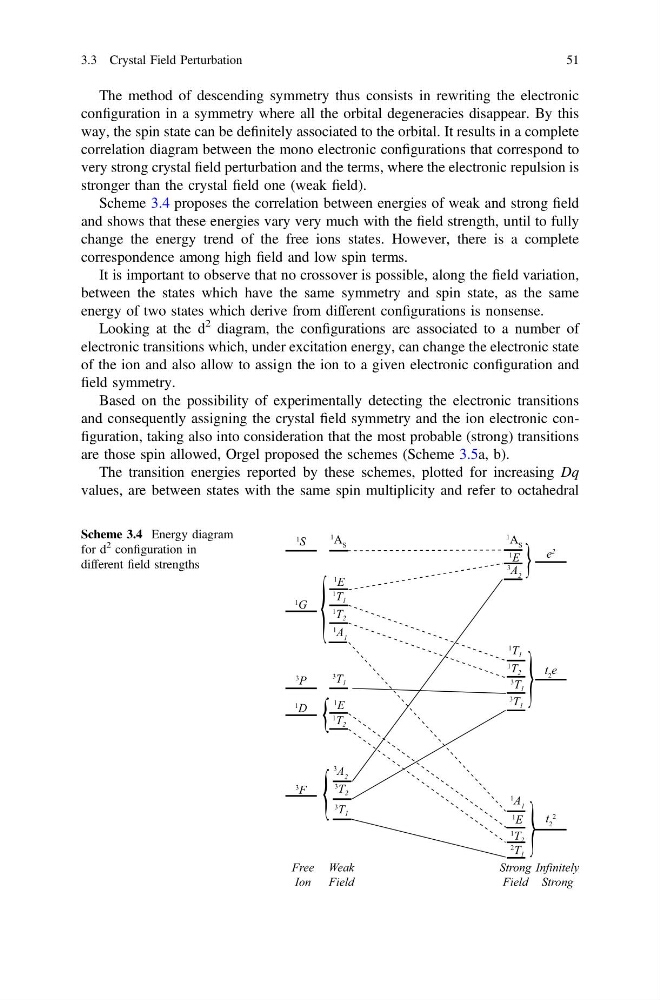
Scheme 3.4 proposes the correlation between energies of weak and strong field
and shows that these energies vary very much with the field strength, until to fully
change the energy trend of the free ions states. However, there is a complete
correspondence among high field and low spin terms.
It is important to observe that no crossover is possible, along the field variation,
between the states which have the same symmetry and spin state, as the same
energy of two states which derive from different configurations is nonsense.
Looking at the d
2 diagram, the configurations are associated to a number of
electronic transitions which, under excitation energy, can change the electronic state
of the ion and also allow to assign the ion to a given electronic configuration and
field symmetry.
Based on the possibility of experimentally detecting the electronic transitions
and consequently assigning the crystal field symmetry and the ion electronic configuration, taking also into consideration that the most probable (strong) transitions
are those spin allowed, Orgel proposed the schemes (Scheme 3.5a, b).
The transition energies reported by these schemes, plotted for increasing Dq
values, are between states with the same spin multiplicity and refer to octahedral
1 G
1 S
3 P
1 D
3 F
Free
Ion
Weak
Field
Strong
Field
Infinitely
Strong
1 A S
1
A S
e
2
t 2 e
t 2
2
1 E
1 E
1 T 1
1
T 1
3 T 1
3
T 1
1 T 2
2
T 1
1 T 2
3 T 2
3 T 1
3
T 1
1 E
1 E
1 T 2
1
T 2
1 A 1
1
A 1
3
A 2
3 A 2
Scheme 3.4 Energy diagram
for d
2 configuration in
different field strengths
3.3 Crystal Field Perturbation
51
configuration in a symmetry where all the orbital degeneracies disappear. By this
way, the spin state can be definitely associated to the orbital. It results in a complete
correlation diagram between the mono electronic configurations that correspond to
very strong crystal field perturbation and the terms, where the electronic repulsion is
stronger than the crystal field one (weak field).
Scheme 3.4 proposes the correlation between energies of weak and strong field
and shows that these energies vary very much with the field strength, until to fully
change the energy trend of the free ions states. However, there is a complete
correspondence among high field and low spin terms.
It is important to observe that no crossover is possible, along the field variation,
between the states which have the same symmetry and spin state, as the same
energy of two states which derive from different configurations is nonsense.
Looking at the d
2 diagram, the configurations are associated to a number of
electronic transitions which, under excitation energy, can change the electronic state
of the ion and also allow to assign the ion to a given electronic configuration and
field symmetry.
Based on the possibility of experimentally detecting the electronic transitions
and consequently assigning the crystal field symmetry and the ion electronic configuration, taking also into consideration that the most probable (strong) transitions
are those spin allowed, Orgel proposed the schemes (Scheme 3.5a, b).
The transition energies reported by these schemes, plotted for increasing Dq
values, are between states with the same spin multiplicity and refer to octahedral
1 G
1 S
3 P
1 D
3 F
Free
Ion
Weak
Field
Strong
Field
Infinitely
Strong
1 A S
1
A S
e
2
t 2 e
t 2
2
1 E
1 E
1 T 1
1
T 1
3 T 1
3
T 1
1 T 2
2
T 1
1 T 2
3 T 2
3 T 1
3
T 1
1 E
1 E
1 T 2
1
T 2
1 A 1
1
A 1
3
A 2
3 A 2
Scheme 3.4 Energy diagram
for d
2 configuration in
different field strengths
3.3 Crystal Field Perturbation
51