

Chapter 2
Symmetry Orbitals for Different Bis
and Polyatomic Molecules
The description will involve the examples of H 2 and the linear diatomic
homonuclear molecules of the periodic table first row, of H 2 O, NH 3 , CO, CH 4
molecules. This is to demonstrate the power of group theory in predicting the
chemical bond structure.
H 2 The molecule belongs to the D ∞h symmetry group, as well as all the diatomic
homonuclear molecules of the periodic table first row, reported below. Assuming as
atomic base function that constituted by two s orbitals, u 1 and u 2 , the character
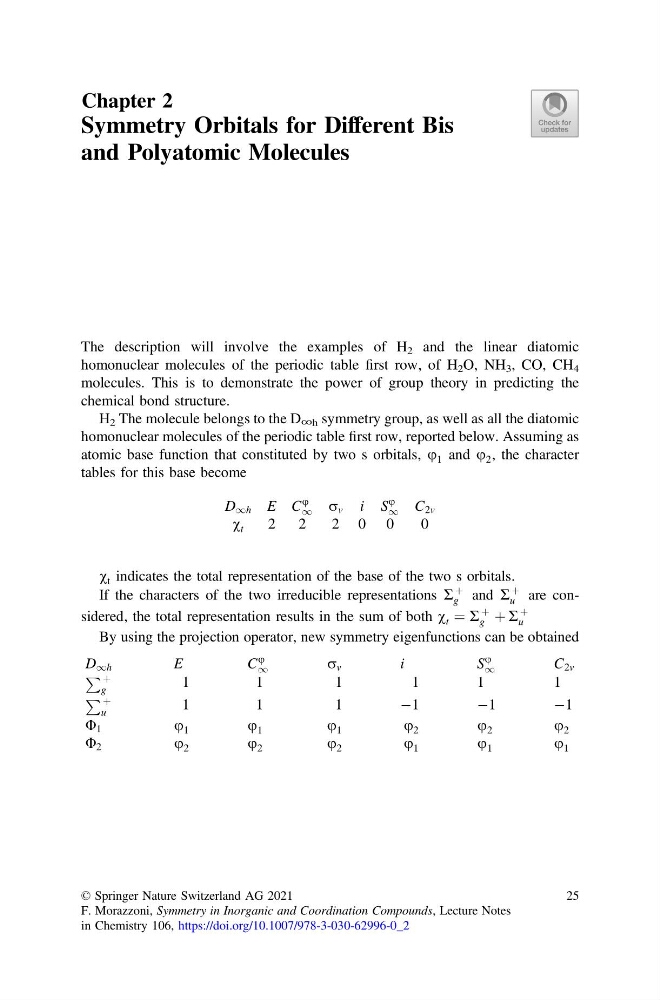
tables for this base become
D 1h E C
u
1
r v i S
u
1
C 2v
v t
2
2
2 0 0
0
v t indicates the total representation of the base of the two s orbitals.
If the characters of the two irreducible representations R
þ
g and R
þ
u are considered, the total representation results in the sum of both v t ¼ R
þ
g þ R
þ
u
By using the projection operator, new symmetry eigenfunctions can be obtained
D 1h
E
C
u
1
r v
i
S
u
1
C 2v
P þ
g
1
1
1
1
1
1
P þ
u
1
1
1
À1
À1
À1
U 1
u 1
u 1
u 1
u 2
u 2
u 2
U 2
u 2
u 2
u 2
u 1
u 1
u 1
© Springer Nature Switzerland AG 2021
F. Morazzoni, Symmetry in Inorganic and Coordination Compounds, Lecture Notes
in Chemistry 106, https://doi.org/10.1007/978-3-030-62996-0_2
25
Symmetry Orbitals for Different Bis
and Polyatomic Molecules
The description will involve the examples of H 2 and the linear diatomic
homonuclear molecules of the periodic table first row, of H 2 O, NH 3 , CO, CH 4
molecules. This is to demonstrate the power of group theory in predicting the
chemical bond structure.
H 2 The molecule belongs to the D ∞h symmetry group, as well as all the diatomic
homonuclear molecules of the periodic table first row, reported below. Assuming as
atomic base function that constituted by two s orbitals, u 1 and u 2 , the character
tables for this base become
D 1h E C
u
1
r v i S
u
1
C 2v
v t
2
2
2 0 0
0
v t indicates the total representation of the base of the two s orbitals.
If the characters of the two irreducible representations R
þ
g and R
þ
u are considered, the total representation results in the sum of both v t ¼ R
þ
g þ R
þ
u
By using the projection operator, new symmetry eigenfunctions can be obtained
D 1h
E
C
u
1
r v
i
S
u
1
C 2v
P þ
g
1
1
1
1
1
1
P þ
u
1
1
1
À1
À1
À1
U 1
u 1
u 1
u 1
u 2
u 2
u 2
U 2
u 2
u 2
u 2
u 1
u 1
u 1
© Springer Nature Switzerland AG 2021
F. Morazzoni, Symmetry in Inorganic and Coordination Compounds, Lecture Notes
in Chemistry 106, https://doi.org/10.1007/978-3-030-62996-0_2
25