

Since the molecular energy is time invariant and independent of the position of
the molecule, the Hamiltonian must be invariant under a symmetry operation. Thus,
any symmetry operation is associated with a symmetry operator which commutes
with the Hamiltonian, i.e., HR = RH (R is the symmetry operator associated to the
symmetry operation). If we take the wave equation HW n = EW n and multiply each
side by the symmetry operator R, we get
HRW n = ERW n ; thus, RW n is a eigenfunction
Being W n normalized, it is normalized also RW n ; that is,
R
RW n RW n ds ¼ 1
(ds is the infinitesimal coordinate space) and
RW n ¼ Æ1W n
The molecular eigenfunction does not vary under the symmetry operators of the
molecular point symmetry group, as well as the base functions of an irreducible
representation base function (see further details in the next group theory chapter).
1.5 Group Theory
The point groups collect all the possible symmetry operations for a given molecule.
Each symmetry element reported in Table 1.4 can be associated to the symmetry
operations.
The following flowchart (Scheme 1.3) provides a systematic way to classify the
molecules in their proper point groups, through the identification of the symmetry
elements.
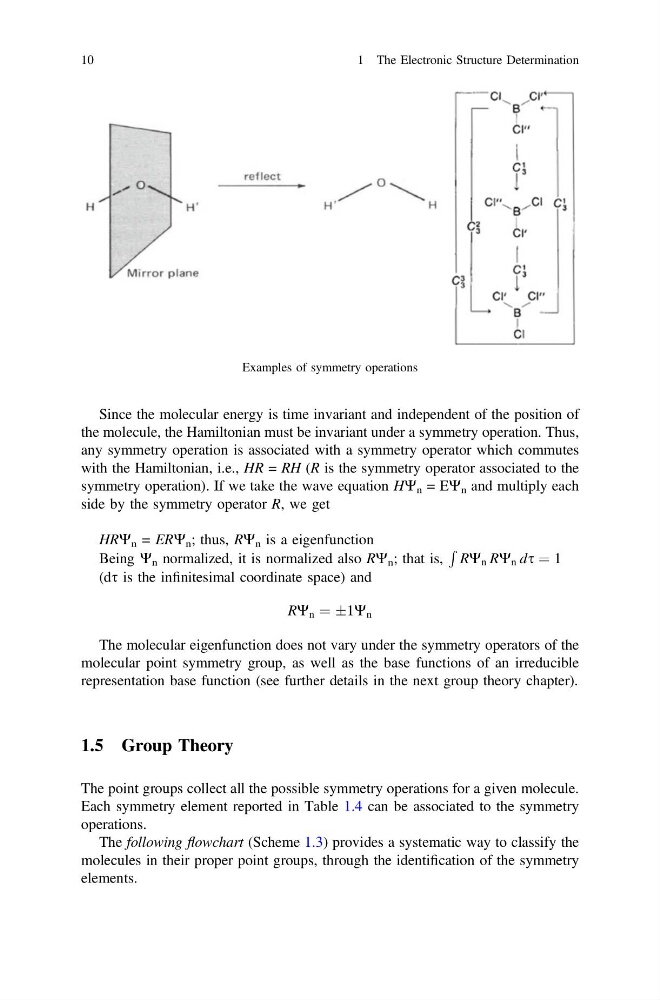
Examples of symmetry operations
10
1 The Electronic Structure Determination
the molecule, the Hamiltonian must be invariant under a symmetry operation. Thus,
any symmetry operation is associated with a symmetry operator which commutes
with the Hamiltonian, i.e., HR = RH (R is the symmetry operator associated to the
symmetry operation). If we take the wave equation HW n = EW n and multiply each
side by the symmetry operator R, we get
HRW n = ERW n ; thus, RW n is a eigenfunction
Being W n normalized, it is normalized also RW n ; that is,
R
RW n RW n ds ¼ 1
(ds is the infinitesimal coordinate space) and
RW n ¼ Æ1W n
The molecular eigenfunction does not vary under the symmetry operators of the
molecular point symmetry group, as well as the base functions of an irreducible
representation base function (see further details in the next group theory chapter).
1.5 Group Theory
The point groups collect all the possible symmetry operations for a given molecule.
Each symmetry element reported in Table 1.4 can be associated to the symmetry
operations.
The following flowchart (Scheme 1.3) provides a systematic way to classify the
molecules in their proper point groups, through the identification of the symmetry
elements.
Examples of symmetry operations
10
1 The Electronic Structure Determination