

In all cases until now considered, it is mandatory to select the atomic orbitals
which have to be used in the linear combination and give the MO. As the maximum
limit, all AOs can be employed. However, it is not convenient to consider all the
orbitals because some of them give no relevant contribution to MO (see allyl anion
Table 1.1 of M.O and A.O.)
How to select those which give the maximum contribution?
Let us consider that the MO shape should necessarily reflect the symmetry of the
molecule and the AO has to be combined in agreement with this symmetry. In order
to select the symmetry of MO and to satisfy the symmetry imposal, we have to use
the group theory.
WHAT DOES IT MEAN?
Let us consider firstly the details of symmetry elements and of the related symmetry
operations in a molecule (Table 1.3), which are the molecule motions reproducing it
unchanged.
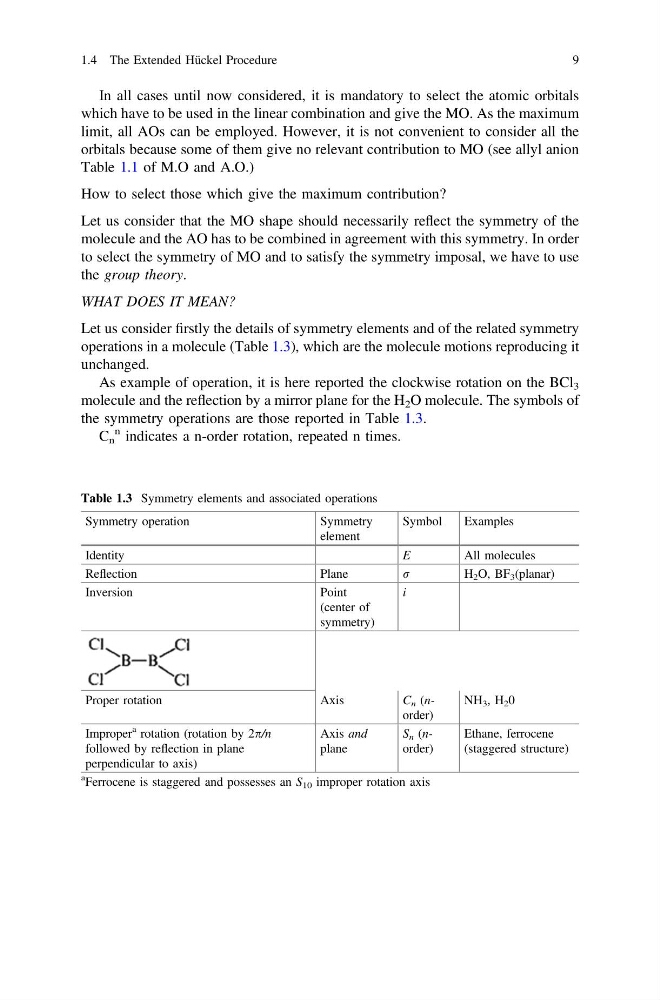
As example of operation, it is here reported the clockwise rotation on the BCl 3
molecule and the reflection by a mirror plane for the H 2 O molecule. The symbols of
the symmetry operations are those reported in Table 1.3.
C n
n indicates a n-order rotation, repeated n times.
Table 1.3 Symmetry elements and associated operations
Symmetry operation
Symmetry
element
Symbol
Examples
Identity
E
All molecules
Reflection
Plane
r
H 2 O, BF 3 (planar)
Inversion
Point
(center of
symmetry)
i
Proper rotation
Axis
C n (norder)
NH 3 , H 2 0
Improper
a rotation (rotation by 2p/n
followed by reflection in plane
perpendicular to axis)
Axis and
plane
S n (norder)
Ethane, ferrocene
(staggered structure)
a Ferrocene is staggered and possesses an S 10 improper rotation axis
1.4 The Extended Hückel Procedure
9
which have to be used in the linear combination and give the MO. As the maximum
limit, all AOs can be employed. However, it is not convenient to consider all the
orbitals because some of them give no relevant contribution to MO (see allyl anion
Table 1.1 of M.O and A.O.)
How to select those which give the maximum contribution?
Let us consider that the MO shape should necessarily reflect the symmetry of the
molecule and the AO has to be combined in agreement with this symmetry. In order
to select the symmetry of MO and to satisfy the symmetry imposal, we have to use
the group theory.
WHAT DOES IT MEAN?
Let us consider firstly the details of symmetry elements and of the related symmetry
operations in a molecule (Table 1.3), which are the molecule motions reproducing it
unchanged.
As example of operation, it is here reported the clockwise rotation on the BCl 3
molecule and the reflection by a mirror plane for the H 2 O molecule. The symbols of
the symmetry operations are those reported in Table 1.3.
C n
n indicates a n-order rotation, repeated n times.
Table 1.3 Symmetry elements and associated operations
Symmetry operation
Symmetry
element
Symbol
Examples
Identity
E
All molecules
Reflection
Plane
r
H 2 O, BF 3 (planar)
Inversion
Point
(center of
symmetry)
i
Proper rotation
Axis
C n (norder)
NH 3 , H 2 0
Improper
a rotation (rotation by 2p/n
followed by reflection in plane
perpendicular to axis)
Axis and
plane
S n (norder)
Ethane, ferrocene
(staggered structure)
a Ferrocene is staggered and possesses an S 10 improper rotation axis
1.4 The Extended Hückel Procedure
9