

1.3 The Hückel Approximation
The most simple approximation in the frame of MO-LCAO is the Hückel
approximation, essentially based on molecular symmetry properties, and most
frequently used for organic molecules.
The secular equations, written directly by generalizing the variational case
described above for a two atomic orbital system, become
C 11 H 11 À E S 11
ð
Þ þ Á Á Á C 1n H 1n À E S 1n
ð
Þ¼0
C n1 H n1 À E S n1
ð
Þ þ Á Á Á C nn H nn À E S nn
ð
Þ¼0
Given the requirements for the approximation:
(1) Resonance integrals = 0 for unconnected atoms, instead
= b (scalar value) for connected ones
(2) Coulomb integrals = a (scalar value)
(3) Overlap integrals = 1 for connected atoms, instead
= 0 for unconnected ones
The secular equations become
C 11 ða À EÞ þ C 12 b 12 . . .C 1n b 1n ¼ 0
C n1 b. . .C n n ða À EÞ ¼ 0
The results of calculation, obtained by solving the above linear system, allow to
express the energies as a function of a and b that in turn can be determined by using
the experimental absorption energy values.
The simple example is reported in the following.
1.3.1 The Case of the Allyl Anion (MO-LCAO by p Orbitals)
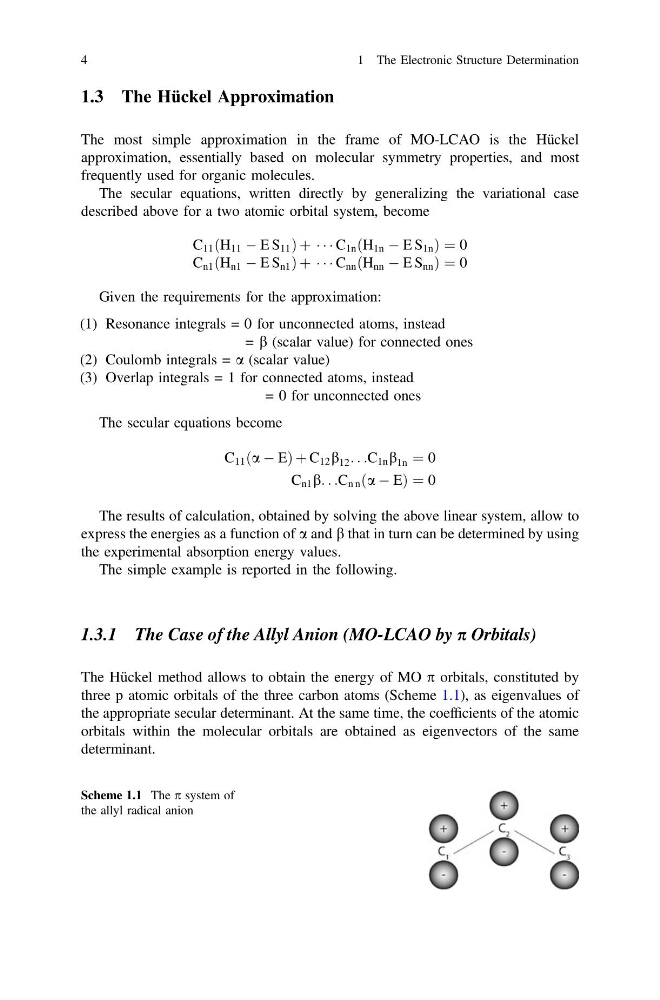
The Hückel method allows to obtain the energy of MO p orbitals, constituted by
three p atomic orbitals of the three carbon atoms (Scheme 1.1), as eigenvalues of
the appropriate secular determinant. At the same time, the coefficients of the atomic
orbitals within the molecular orbitals are obtained as eigenvectors of the same
determinant.
Scheme 1.1 The p system of
the allyl radical anion
4
1 The Electronic Structure Determination
The most simple approximation in the frame of MO-LCAO is the Hückel
approximation, essentially based on molecular symmetry properties, and most
frequently used for organic molecules.
The secular equations, written directly by generalizing the variational case
described above for a two atomic orbital system, become
C 11 H 11 À E S 11
ð
Þ þ Á Á Á C 1n H 1n À E S 1n
ð
Þ¼0
C n1 H n1 À E S n1
ð
Þ þ Á Á Á C nn H nn À E S nn
ð
Þ¼0
Given the requirements for the approximation:
(1) Resonance integrals = 0 for unconnected atoms, instead
= b (scalar value) for connected ones
(2) Coulomb integrals = a (scalar value)
(3) Overlap integrals = 1 for connected atoms, instead
= 0 for unconnected ones
The secular equations become
C 11 ða À EÞ þ C 12 b 12 . . .C 1n b 1n ¼ 0
C n1 b. . .C n n ða À EÞ ¼ 0
The results of calculation, obtained by solving the above linear system, allow to
express the energies as a function of a and b that in turn can be determined by using
the experimental absorption energy values.
The simple example is reported in the following.
1.3.1 The Case of the Allyl Anion (MO-LCAO by p Orbitals)
The Hückel method allows to obtain the energy of MO p orbitals, constituted by
three p atomic orbitals of the three carbon atoms (Scheme 1.1), as eigenvalues of
the appropriate secular determinant. At the same time, the coefficients of the atomic
orbitals within the molecular orbitals are obtained as eigenvectors of the same
determinant.
Scheme 1.1 The p system of
the allyl radical anion
4
1 The Electronic Structure Determination