

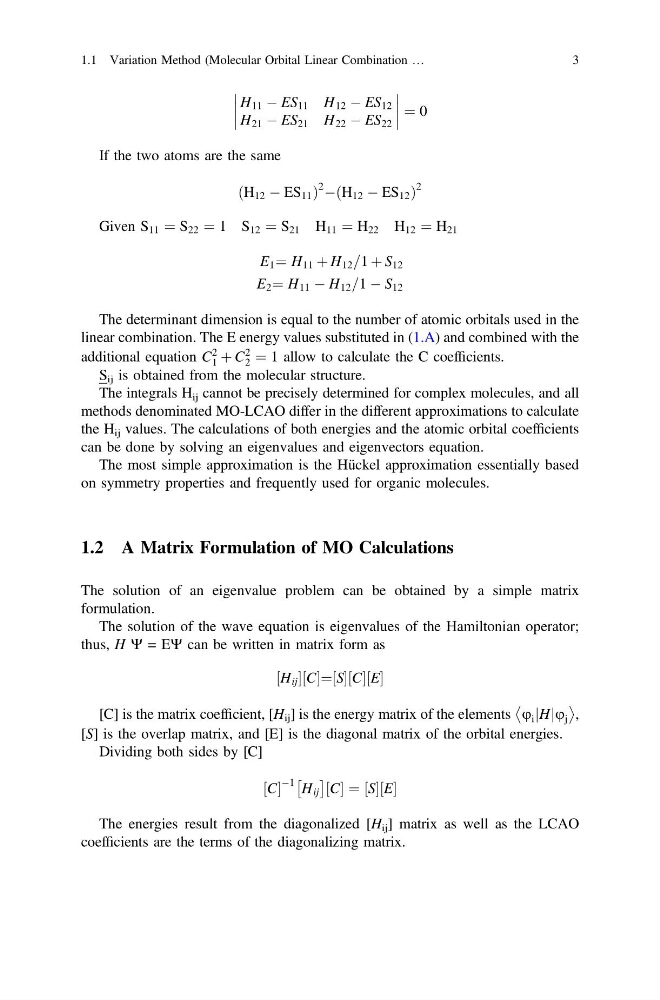
H 11 À ES 11 H 12 À ES 12
H 21 À ES 21 H 22 À ES 22
¼ 0
If the two atoms are the same
H 12 À ES 11
ð
Þ
2 À H 12 À ES 12
ð
Þ
2
Given S 11 ¼ S 22 ¼ 1 S 12 ¼ S 21 H 11 ¼ H 22 H 12 ¼ H 21
E 1 ¼ H 11 þ H 12 =1 þ S 12
E 2 ¼ H 11 À H 12 =1 À S 12
The determinant dimension is equal to the number of atomic orbitals used in the
linear combination. The E energy values substituted in (1.A) and combined with the
additional equation C
2
1 þ C
2
2 ¼ 1 allow to calculate the C coefficients.
S ij is obtained from the molecular structure.
The integrals H ij cannot be precisely determined for complex molecules, and all
methods denominated MO-LCAO differ in the different approximations to calculate
the H ij values. The calculations of both energies and the atomic orbital coefficients
can be done by solving an eigenvalues and eigenvectors equation.
The most simple approximation is the Hückel approximation essentially based
on symmetry properties and frequently used for organic molecules.
1.2 A Matrix Formulation of MO Calculations
The solution of an eigenvalue problem can be obtained by a simple matrix
formulation.
The solution of the wave equation is eigenvalues of the Hamiltonian operator;
thus, H W = EW can be written in matrix form as
½H ij ½C¼½S½C½E
[C] is the matrix coefficient, [H ij ] is the energy matrix of the elements u i jHju j
,
[S] is the overlap matrix, and [E] is the diagonal matrix of the orbital energies.
Dividing both sides by [C]
½C
À1 H ij
 à ½C ¼ ½S½E
The energies result from the diagonalized [H ij ] matrix as well as the LCAO
coefficients are the terms of the diagonalizing matrix.
1.1 Variation Method (Molecular Orbital Linear Combination …
3
H 21 À ES 21 H 22 À ES 22
¼ 0
If the two atoms are the same
H 12 À ES 11
ð
Þ
2 À H 12 À ES 12
ð
Þ
2
Given S 11 ¼ S 22 ¼ 1 S 12 ¼ S 21 H 11 ¼ H 22 H 12 ¼ H 21
E 1 ¼ H 11 þ H 12 =1 þ S 12
E 2 ¼ H 11 À H 12 =1 À S 12
The determinant dimension is equal to the number of atomic orbitals used in the
linear combination. The E energy values substituted in (1.A) and combined with the
additional equation C
2
1 þ C
2
2 ¼ 1 allow to calculate the C coefficients.
S ij is obtained from the molecular structure.
The integrals H ij cannot be precisely determined for complex molecules, and all
methods denominated MO-LCAO differ in the different approximations to calculate
the H ij values. The calculations of both energies and the atomic orbital coefficients
can be done by solving an eigenvalues and eigenvectors equation.
The most simple approximation is the Hückel approximation essentially based
on symmetry properties and frequently used for organic molecules.
1.2 A Matrix Formulation of MO Calculations
The solution of an eigenvalue problem can be obtained by a simple matrix
formulation.
The solution of the wave equation is eigenvalues of the Hamiltonian operator;
thus, H W = EW can be written in matrix form as
½H ij ½C¼½S½C½E
[C] is the matrix coefficient, [H ij ] is the energy matrix of the elements u i jHju j
,
[S] is the overlap matrix, and [E] is the diagonal matrix of the orbital energies.
Dividing both sides by [C]
½C
À1 H ij
 à ½C ¼ ½S½E
The energies result from the diagonalized [H ij ] matrix as well as the LCAO
coefficients are the terms of the diagonalizing matrix.
1.1 Variation Method (Molecular Orbital Linear Combination …
3