

5.61 Chemical Message
The presence of organic or inorganic catalysts on the surface of PM is not necessary
to produce ROS. They derive from the defects located at the graphite surface; thus
in a number of cases, also unexpected, the reduction of oxygen to radical is active.
The toxicity over long-term exposure remains a question to be investigated; however, it has to be considered that ROS production may occur over a long time, with
heavy consequences by toxicity.
5.62 The Interaction of Graphite Defects with Oxygen
Treated by Structural Studies
In the previous paragraph, it has been shown that the reduction of oxygen is
promoted by graphite and specifically the graphite surface defects are responsible
for activating the process [31]. In general, the study of a catalytic process implies
both the evaluation of the products and the detection of the catalytic intermediates.
This is the most difficult goal, as the structure of defects has to be investigated as
well as their attitude to transfer electrons. It is well known that the structure of
nanosized graphite particles is rather defective as the milling procedure introduces
different types of defects. It reduces the size of the graphite sheet from 160 to 9 nm
(Fig. 5.63), partly destroying the electronic delocalization, and changes the C
hybridization from sp
2 to sp
3 . Moreover, the milling promotes the formation of
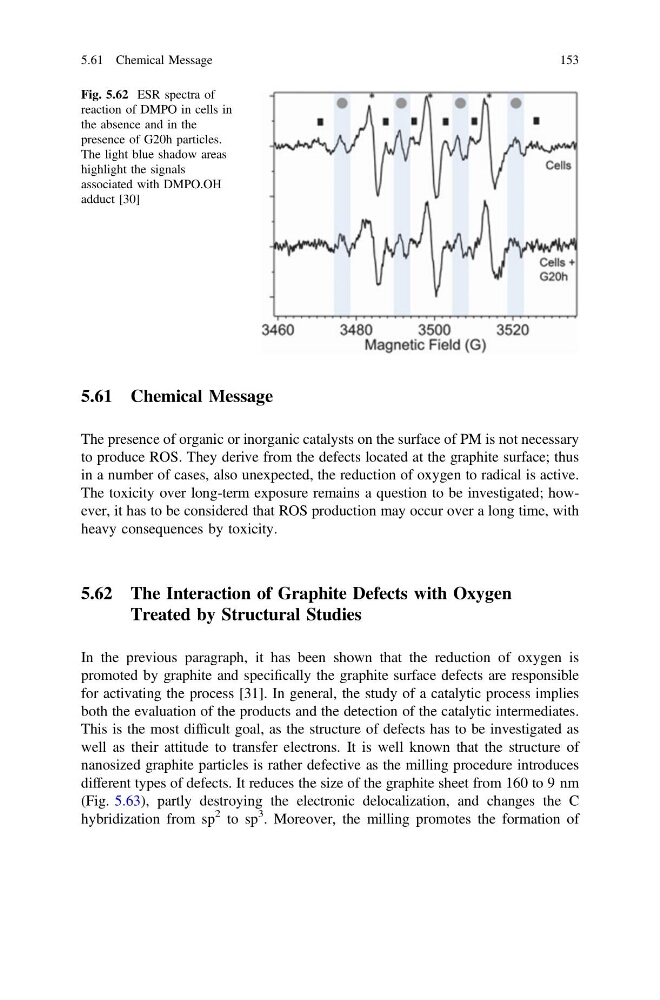
Fig. 5.62 ESR spectra of
reaction of DMPO in cells in
the absence and in the
presence of G20h particles.
The light blue shadow areas
highlight the signals
associated with DMPO.OH
adduct [30]
5.61 Chemical Message
153
The presence of organic or inorganic catalysts on the surface of PM is not necessary
to produce ROS. They derive from the defects located at the graphite surface; thus
in a number of cases, also unexpected, the reduction of oxygen to radical is active.
The toxicity over long-term exposure remains a question to be investigated; however, it has to be considered that ROS production may occur over a long time, with
heavy consequences by toxicity.
5.62 The Interaction of Graphite Defects with Oxygen
Treated by Structural Studies
In the previous paragraph, it has been shown that the reduction of oxygen is
promoted by graphite and specifically the graphite surface defects are responsible
for activating the process [31]. In general, the study of a catalytic process implies
both the evaluation of the products and the detection of the catalytic intermediates.
This is the most difficult goal, as the structure of defects has to be investigated as
well as their attitude to transfer electrons. It is well known that the structure of
nanosized graphite particles is rather defective as the milling procedure introduces
different types of defects. It reduces the size of the graphite sheet from 160 to 9 nm
(Fig. 5.63), partly destroying the electronic delocalization, and changes the C
hybridization from sp
2 to sp
3 . Moreover, the milling promotes the formation of
Fig. 5.62 ESR spectra of
reaction of DMPO in cells in
the absence and in the
presence of G20h particles.
The light blue shadow areas
highlight the signals
associated with DMPO.OH
adduct [30]
5.61 Chemical Message
153