

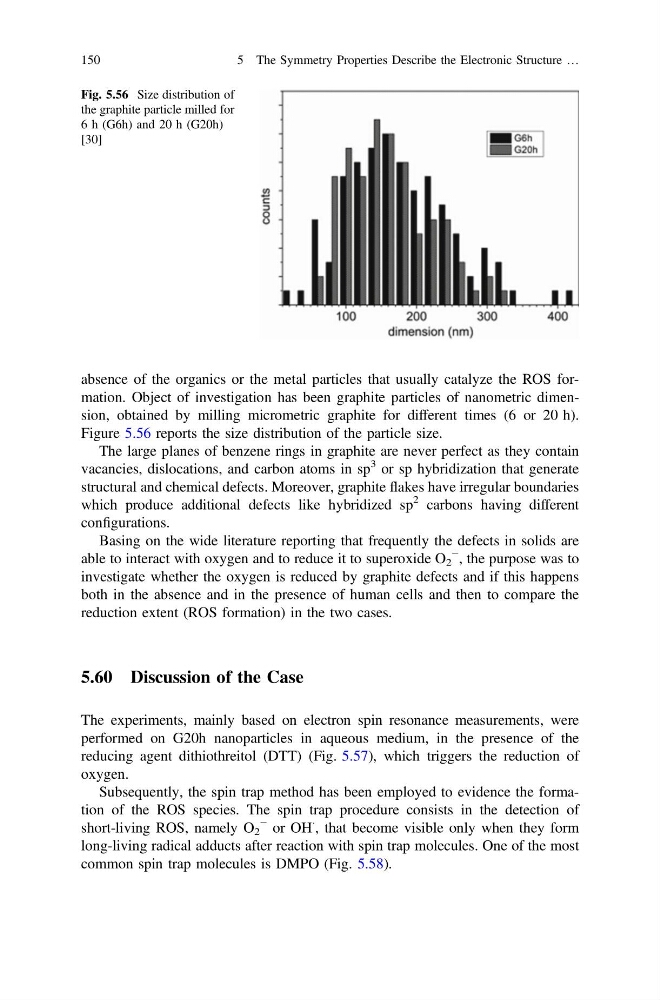
absence of the organics or the metal particles that usually catalyze the ROS formation. Object of investigation has been graphite particles of nanometric dimension, obtained by milling micrometric graphite for different times (6 or 20 h).
Figure 5.56 reports the size distribution of the particle size.
The large planes of benzene rings in graphite are never perfect as they contain
vacancies, dislocations, and carbon atoms in sp
3 or sp hybridization that generate
structural and chemical defects. Moreover, graphite flakes have irregular boundaries
which produce additional defects like hybridized sp
2 carbons having different
configurations.
Basing on the wide literature reporting that frequently the defects in solids are
able to interact with oxygen and to reduce it to superoxide O 2
− , the purpose was to
investigate whether the oxygen is reduced by graphite defects and if this happens
both in the absence and in the presence of human cells and then to compare the
reduction extent (ROS formation) in the two cases.
5.60 Discussion of the Case
The experiments, mainly based on electron spin resonance measurements, were
performed on G20h nanoparticles in aqueous medium, in the presence of the
reducing agent dithiothreitol (DTT) (Fig. 5.57), which triggers the reduction of
oxygen.
Subsequently, the spin trap method has been employed to evidence the formation of the ROS species. The spin trap procedure consists in the detection of
short-living ROS, namely O 2
− or OH
Á
, that become visible only when they form
long-living radical adducts after reaction with spin trap molecules. One of the most
common spin trap molecules is DMPO (Fig. 5.58).
Fig. 5.56 Size distribution of
the graphite particle milled for
6 h (G6h) and 20 h (G20h)
[30]
150
5 The Symmetry Properties Describe the Electronic Structure …
Figure 5.56 reports the size distribution of the particle size.
The large planes of benzene rings in graphite are never perfect as they contain
vacancies, dislocations, and carbon atoms in sp
3 or sp hybridization that generate
structural and chemical defects. Moreover, graphite flakes have irregular boundaries
which produce additional defects like hybridized sp
2 carbons having different
configurations.
Basing on the wide literature reporting that frequently the defects in solids are
able to interact with oxygen and to reduce it to superoxide O 2
− , the purpose was to
investigate whether the oxygen is reduced by graphite defects and if this happens
both in the absence and in the presence of human cells and then to compare the
reduction extent (ROS formation) in the two cases.
5.60 Discussion of the Case
The experiments, mainly based on electron spin resonance measurements, were
performed on G20h nanoparticles in aqueous medium, in the presence of the
reducing agent dithiothreitol (DTT) (Fig. 5.57), which triggers the reduction of
oxygen.
Subsequently, the spin trap method has been employed to evidence the formation of the ROS species. The spin trap procedure consists in the detection of
short-living ROS, namely O 2
− or OH
Á
, that become visible only when they form
long-living radical adducts after reaction with spin trap molecules. One of the most
common spin trap molecules is DMPO (Fig. 5.58).
Fig. 5.56 Size distribution of
the graphite particle milled for
6 h (G6h) and 20 h (G20h)
[30]
150
5 The Symmetry Properties Describe the Electronic Structure …