

5.58 Chemical Message
The radicals of CDDP generated by interaction of the electrons with the drug trigger
the damage to DNA, when CDDP is delivered in association with radiotherapy. It
seems to us that the mechanism is related to change of molecular structure of
CDDP, well evident from the electronic analysis, consequent to the change of
oxidation state of platinum center.
Given the structural proposal for the Pt/DNA adducts, responsible for the permanent damage to the biomacromolecule, it is expected that the Pt(I) center, inside
Pt(NH 3 ) 2 Cl
Á and Pt(NH 3 ) 2 l
Á , is reoxidized to Pt(II) after the interaction with DNA
and it releases one electron. This electron can further interact with CDDP molecules
as in a true catalytic process (Fig. 5.54).
The crucial event seems the formation of radicals triggered by Pt reduction; this
process is expected to be favored by the attitude of P(II) to accept electrons. The
proposal of an eventual CDDP analogue could be based on the coordination of Pt
(II) with electron accepting ligands. One example is the (R,R)1,2-diaminocicloesano(etandioato-O,O)platino, known as oxaliplatin (Scheme in
Fig. 5.55).
CDDP and its homologues have severe side effect during the therapy, when used
as drug alone. In the case of combined chemo-radiotherapy, the dose of Pt drug
could be decreased as the radicalic and catalytic mechanism implies chain reactions
with the DNA.
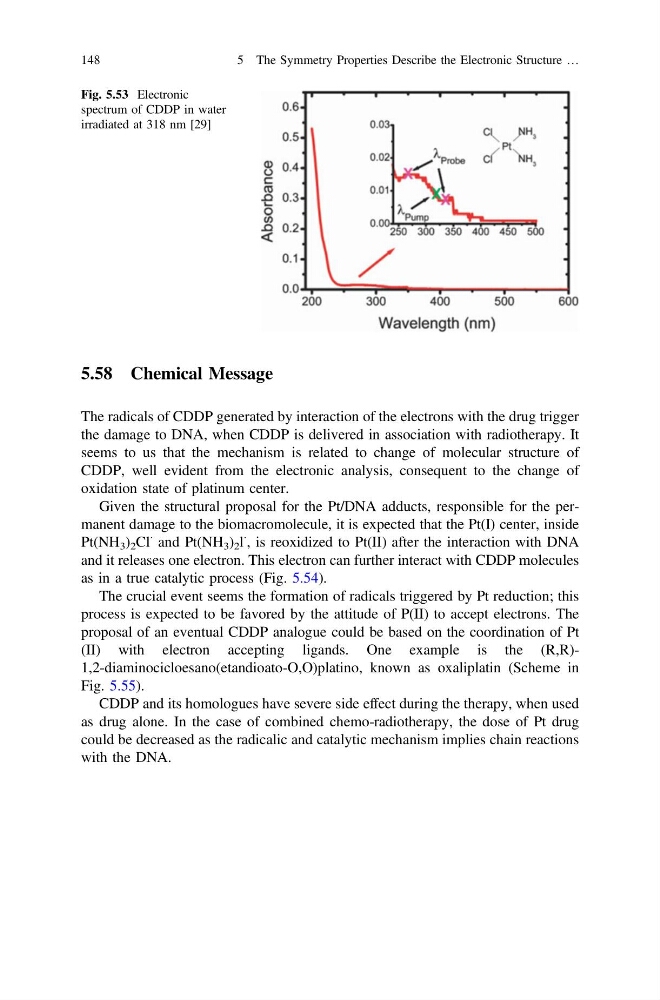
Fig. 5.53 Electronic
spectrum of CDDP in water
irradiated at 318 nm [29]
148
5 The Symmetry Properties Describe the Electronic Structure …
The radicals of CDDP generated by interaction of the electrons with the drug trigger
the damage to DNA, when CDDP is delivered in association with radiotherapy. It
seems to us that the mechanism is related to change of molecular structure of
CDDP, well evident from the electronic analysis, consequent to the change of
oxidation state of platinum center.
Given the structural proposal for the Pt/DNA adducts, responsible for the permanent damage to the biomacromolecule, it is expected that the Pt(I) center, inside
Pt(NH 3 ) 2 Cl
Á and Pt(NH 3 ) 2 l
Á , is reoxidized to Pt(II) after the interaction with DNA
and it releases one electron. This electron can further interact with CDDP molecules
as in a true catalytic process (Fig. 5.54).
The crucial event seems the formation of radicals triggered by Pt reduction; this
process is expected to be favored by the attitude of P(II) to accept electrons. The
proposal of an eventual CDDP analogue could be based on the coordination of Pt
(II) with electron accepting ligands. One example is the (R,R)1,2-diaminocicloesano(etandioato-O,O)platino, known as oxaliplatin (Scheme in
Fig. 5.55).
CDDP and its homologues have severe side effect during the therapy, when used
as drug alone. In the case of combined chemo-radiotherapy, the dose of Pt drug
could be decreased as the radicalic and catalytic mechanism implies chain reactions
with the DNA.
Fig. 5.53 Electronic
spectrum of CDDP in water
irradiated at 318 nm [29]
148
5 The Symmetry Properties Describe the Electronic Structure …