

It is expected that any distortion from the planar symmetry D 4h or change in the
Pt electronic configuration can be revealed by the spectral analysis. In the literature,
it has been reported that excitation of CDDP by 318 nm irradiation induces variations in the absorption electronic spectrum, specifically the bands at about 300 nm
loss intensity (Fig. 5.53).
A possible interpretation is that the excitation at 318 nm reduces Pt(II) centers to
Pt(I) consequently destroying the complex symmetry. A possible reaction pathway
could be
e
À
þ Pt NH 3
ð
Þ 2 Cl 2 ! Pt NH 3
ð
Þ 2 Cl 2
Â
à À ! Pt NH 3
ð
Þ 2 Cl
Á
þ Cl
À
e
À
þ Pt NH 3
ð
Þ 2 Cl ! Pt NH 3
ð
Þ 2 Cl
Â
à À ! Pt NH 3
ð
Þ 2 I
Á
þ Cl
À
where the formation of the Pt radical, with less steric hindrance than CDDP, is
triggered by the Pt reduction. The radicals, well penetrating, are responsible for the
damage to DNA of human cells. It could be argued that higher the acidity of Pt(II)
centers, modulated by the ligands, higher the attitude of Pt to be reduced.
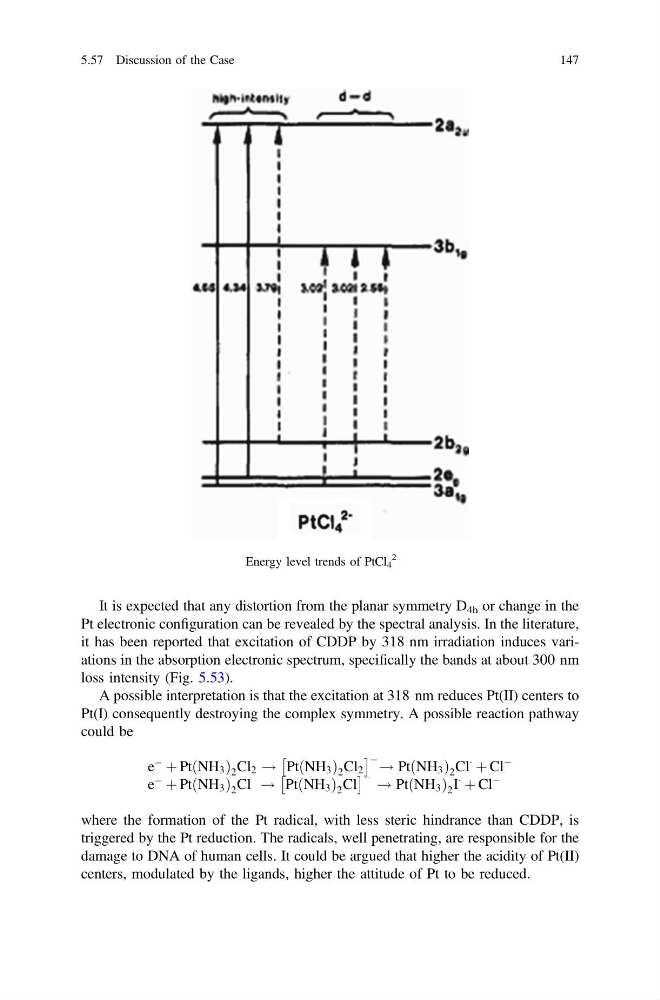
Energy level trends of PtCl 4
25.57 Discussion of the Case
147
Pt electronic configuration can be revealed by the spectral analysis. In the literature,
it has been reported that excitation of CDDP by 318 nm irradiation induces variations in the absorption electronic spectrum, specifically the bands at about 300 nm
loss intensity (Fig. 5.53).
A possible interpretation is that the excitation at 318 nm reduces Pt(II) centers to
Pt(I) consequently destroying the complex symmetry. A possible reaction pathway
could be
e
À
þ Pt NH 3
ð
Þ 2 Cl 2 ! Pt NH 3
ð
Þ 2 Cl 2
Â
à À ! Pt NH 3
ð
Þ 2 Cl
Á
þ Cl
À
e
À
þ Pt NH 3
ð
Þ 2 Cl ! Pt NH 3
ð
Þ 2 Cl
Â
à À ! Pt NH 3
ð
Þ 2 I
Á
þ Cl
À
where the formation of the Pt radical, with less steric hindrance than CDDP, is
triggered by the Pt reduction. The radicals, well penetrating, are responsible for the
damage to DNA of human cells. It could be argued that higher the acidity of Pt(II)
centers, modulated by the ligands, higher the attitude of Pt to be reduced.
Energy level trends of PtCl 4
25.57 Discussion of the Case
147