

Different ways of administration? Administration combined with radiation therapy?
In order to validate a therapeutic protocol, the study of the action mechanism is
mandatory, in particular when using combined radiation therapy. The commonly
proposed CDDP mechanism suggests that the major damage to DNA is induced
after the hydrolysis of the CDDP to cis-Pt(NH) 3 and further attaches to DNA bases,
without any electron exchange process. In the case of chemo-radio combination
therapy, electron transfer processes should be implied and an additional pathway is
expected to be active and responsible for the enhanced effects.
Assuming that the radiation source generates electrons, it may be expected that
they go to the metal center, which originally has the Pt(II) d
8 electronic configuration. This can have influence on the coordination geometry of the platinum
complex. Electronic spectroscopy can help in detecting the metal center modifications and suggesting an activated form of the drug.
5.57 Discussion of the Case
Figure 5.51 reports the electronic spectrum of cisplatinum and the intensities of the
bands, varying the drug amount in solution. Considering the electronic spectra of a
simple tetracoordinated planar Pt(II) compounds (Fig. 5.52), the planar geometry
can be spectroscopically assigned to cisplatinum. Three absorption bands are
attributable to d-d transition 3a 1g ! 3b 1g 2e g ! 3b 1g 2b 2g ! 3b 1g that means
d
2
z ! d x 2 Ày 2 d xz, yz ! d x 2 Ày 2 d xy ! d x 2 Ày 2 , with two transitions very similar in
energy (see the energy trend of PtCl 4
2− ).
Cl
Cl
NH 3
NH 3
Pt
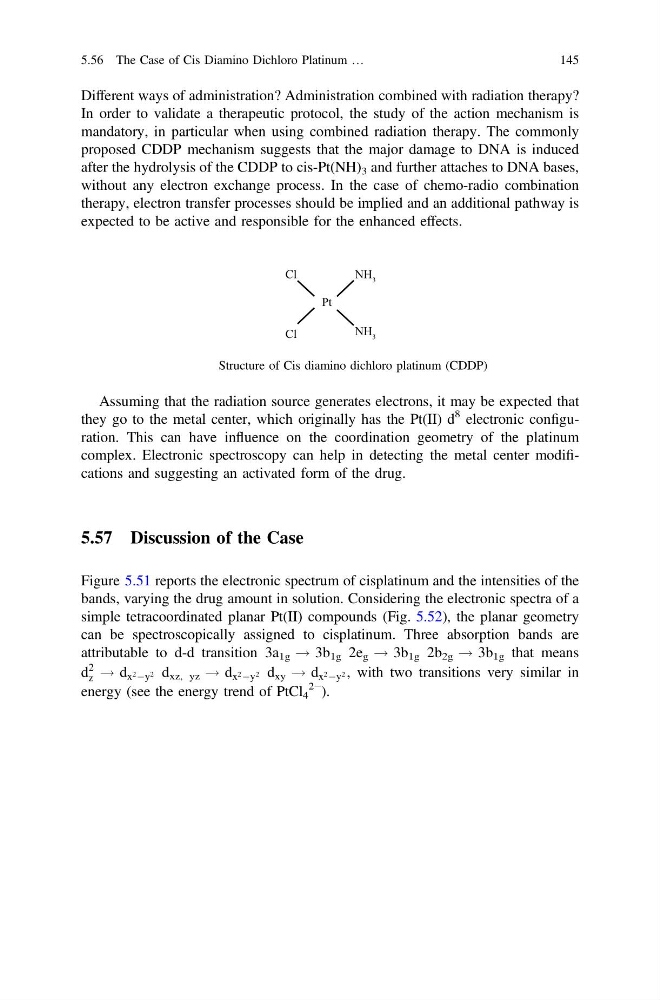
Structure of Cis diamino dichloro platinum (CDDP)
5.56 The Case of Cis Diamino Dichloro Platinum …
145
In order to validate a therapeutic protocol, the study of the action mechanism is
mandatory, in particular when using combined radiation therapy. The commonly
proposed CDDP mechanism suggests that the major damage to DNA is induced
after the hydrolysis of the CDDP to cis-Pt(NH) 3 and further attaches to DNA bases,
without any electron exchange process. In the case of chemo-radio combination
therapy, electron transfer processes should be implied and an additional pathway is
expected to be active and responsible for the enhanced effects.
Assuming that the radiation source generates electrons, it may be expected that
they go to the metal center, which originally has the Pt(II) d
8 electronic configuration. This can have influence on the coordination geometry of the platinum
complex. Electronic spectroscopy can help in detecting the metal center modifications and suggesting an activated form of the drug.
5.57 Discussion of the Case
Figure 5.51 reports the electronic spectrum of cisplatinum and the intensities of the
bands, varying the drug amount in solution. Considering the electronic spectra of a
simple tetracoordinated planar Pt(II) compounds (Fig. 5.52), the planar geometry
can be spectroscopically assigned to cisplatinum. Three absorption bands are
attributable to d-d transition 3a 1g ! 3b 1g 2e g ! 3b 1g 2b 2g ! 3b 1g that means
d
2
z ! d x 2 Ày 2 d xz, yz ! d x 2 Ày 2 d xy ! d x 2 Ày 2 , with two transitions very similar in
energy (see the energy trend of PtCl 4
2− ).
Cl
Cl
NH 3
NH 3
Pt
Structure of Cis diamino dichloro platinum (CDDP)
5.56 The Case of Cis Diamino Dichloro Platinum …
145