

5.53 Chemical Message
The results can be associated with the arrangement and coordination of the surface
atoms in the different crystal facets exposed by the nanocrystals. High energy {221}
and {111} faces, mainly occurring in OCT and DOD, present a higher density of
under-coordinated Sn centers compared to the low energy {110}, predominant in
NBA. Thus, the first two faces appear more able to stabilize defects. The reactivity
which originates the electrical response happens at atomic level.
5.54 The Case of Silica–Natural Rubber Composites
The study of silica–rubber (natural or not) composites is of fundamental importance
for designing tires [27, 28]. SiO 2 particles are now becoming fillers alternative to
the carbon black, previously used. Fundamental to obtain efficient good reinforce of
the rubber is the particle dispersion and as a consequence the prevalence of the
filler–rubber interaction over the filler–filler.
The research makes use of the in situ solgel synthesis of filler inside a natural
rubber matrix and of particles with different shapes, in order to check the most
suitable composite products.
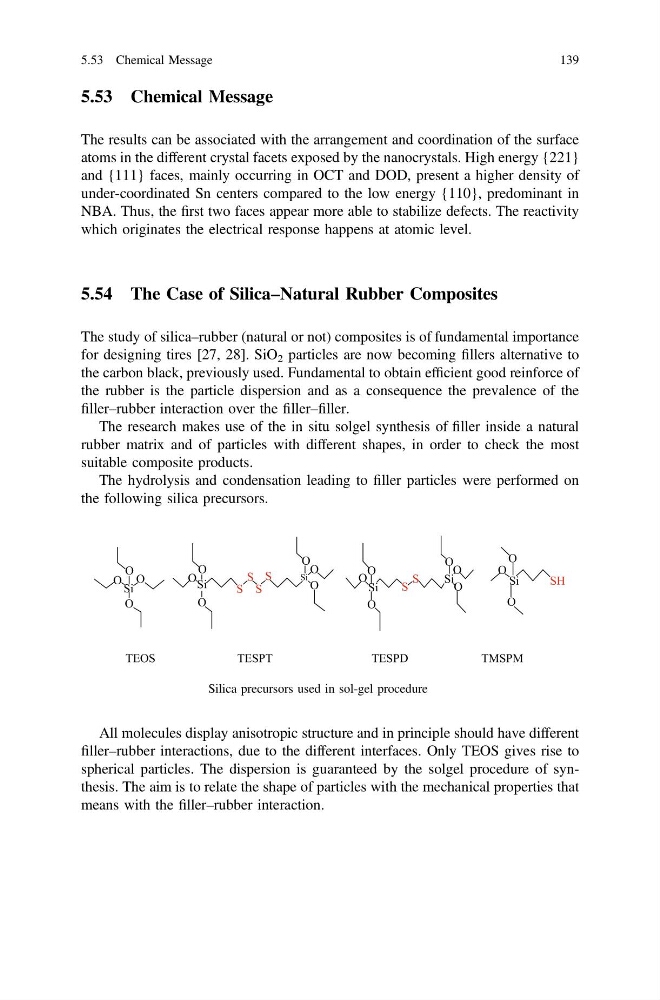
The hydrolysis and condensation leading to filler particles were performed on
the following silica precursors.
All molecules display anisotropic structure and in principle should have different
filler–rubber interactions, due to the different interfaces. Only TEOS gives rise to
spherical particles. The dispersion is guaranteed by the solgel procedure of synthesis. The aim is to relate the shape of particles with the mechanical properties that
means with the filler–rubber interaction.
O
O
O
Si
Si
Si
Si
Si
Si
S
S
S
S
S
S
SH
O
O
O
O
O
O
O
O
O
O
O
O
O
O
O
O
TEOS
TESPT
TESPD
TMSPM
Silica precursors used in sol-gel procedure
5.53 Chemical Message
139
The results can be associated with the arrangement and coordination of the surface
atoms in the different crystal facets exposed by the nanocrystals. High energy {221}
and {111} faces, mainly occurring in OCT and DOD, present a higher density of
under-coordinated Sn centers compared to the low energy {110}, predominant in
NBA. Thus, the first two faces appear more able to stabilize defects. The reactivity
which originates the electrical response happens at atomic level.
5.54 The Case of Silica–Natural Rubber Composites
The study of silica–rubber (natural or not) composites is of fundamental importance
for designing tires [27, 28]. SiO 2 particles are now becoming fillers alternative to
the carbon black, previously used. Fundamental to obtain efficient good reinforce of
the rubber is the particle dispersion and as a consequence the prevalence of the
filler–rubber interaction over the filler–filler.
The research makes use of the in situ solgel synthesis of filler inside a natural
rubber matrix and of particles with different shapes, in order to check the most
suitable composite products.
The hydrolysis and condensation leading to filler particles were performed on
the following silica precursors.
All molecules display anisotropic structure and in principle should have different
filler–rubber interactions, due to the different interfaces. Only TEOS gives rise to
spherical particles. The dispersion is guaranteed by the solgel procedure of synthesis. The aim is to relate the shape of particles with the mechanical properties that
means with the filler–rubber interaction.
O
O
O
Si
Si
Si
Si
Si
Si
S
S
S
S
S
S
SH
O
O
O
O
O
O
O
O
O
O
O
O
O
O
O
O
TEOS
TESPT
TESPD
TMSPM
Silica precursors used in sol-gel procedure
5.53 Chemical Message
139