

It can be hypothesized that the difference in the catalytic activity is depending on
the rate of recombination between holes (h
+ ) and electrons (e
− ) within the particles
that is on the stable separation of the opposite charges. For this reason, the best
pathway seemed to directly investigate these charges, which are both paramagnetic
and ESR active.
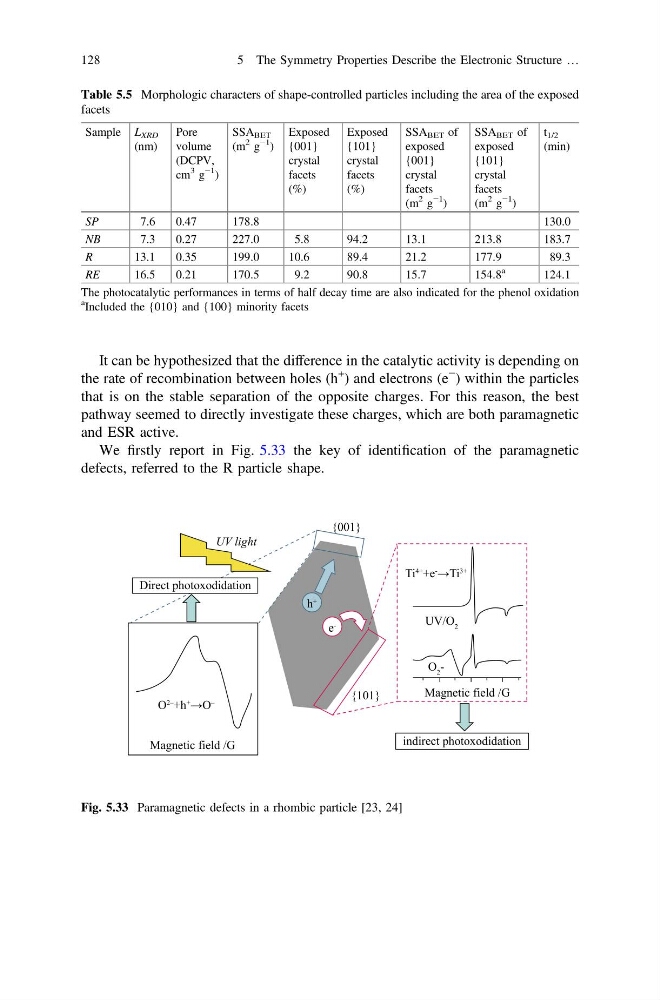
We firstly report in Fig. 5.33 the key of identification of the paramagnetic
defects, referred to the R particle shape.
Table 5.5 Morphologic characters of shape-controlled particles including the area of the exposed
facets
Sample L XRD
(nm)
Pore
volume
(DCPV,
cm
3 g
−1 )
SSA BET
(m
2 g
−1
)
Exposed
{001}
crystal
facets
(%)
Exposed
{101}
crystal
facets
(%)
SSA BET of
exposed
{001}
crystal
facets
(m
2 g
−1
)
SSA BET of
exposed
{101}
crystal
facets
(m
2 g
−1
)
t 1/2
(min)
SP
7.6
0.47
178.8
130.0
NB
7.3
0.27
227.0
5.8
94.2
13.1
213.8
183.7
R
13.1
0.35
199.0
10.6
89.4
21.2
177.9
89.3
RE
16.5
0.21
170.5
9.2
90.8
15.7
154.8
a
124.1
The photocatalytic performances in terms of half decay time are also indicated for the phenol oxidation
a
Included the {010} and {100} minority facets
indirect photoxodidation
{001}
{101}
UV light
O
2– +h
+ →O
–
Ti
4+ +e
-
→Ti
3+
UV/O 2
O 2 -
Magnetic field /G
Magnetic field /G
h
+
e
-
Direct photoxodidation
Fig. 5.33 Paramagnetic defects in a rhombic particle [23, 24]
128
5 The Symmetry Properties Describe the Electronic Structure …
the rate of recombination between holes (h
+ ) and electrons (e
− ) within the particles
that is on the stable separation of the opposite charges. For this reason, the best
pathway seemed to directly investigate these charges, which are both paramagnetic
and ESR active.
We firstly report in Fig. 5.33 the key of identification of the paramagnetic
defects, referred to the R particle shape.
Table 5.5 Morphologic characters of shape-controlled particles including the area of the exposed
facets
Sample L XRD
(nm)
Pore
volume
(DCPV,
cm
3 g
−1 )
SSA BET
(m
2 g
−1
)
Exposed
{001}
crystal
facets
(%)
Exposed
{101}
crystal
facets
(%)
SSA BET of
exposed
{001}
crystal
facets
(m
2 g
−1
)
SSA BET of
exposed
{101}
crystal
facets
(m
2 g
−1
)
t 1/2
(min)
SP
7.6
0.47
178.8
130.0
NB
7.3
0.27
227.0
5.8
94.2
13.1
213.8
183.7
R
13.1
0.35
199.0
10.6
89.4
21.2
177.9
89.3
RE
16.5
0.21
170.5
9.2
90.8
15.7
154.8
a
124.1
The photocatalytic performances in terms of half decay time are also indicated for the phenol oxidation
a
Included the {010} and {100} minority facets
indirect photoxodidation
{001}
{101}
UV light
O
2– +h
+ →O
–
Ti
4+ +e
-
→Ti
3+
UV/O 2
O 2 -
Magnetic field /G
Magnetic field /G
h
+
e
-
Direct photoxodidation
Fig. 5.33 Paramagnetic defects in a rhombic particle [23, 24]
128
5 The Symmetry Properties Describe the Electronic Structure …