

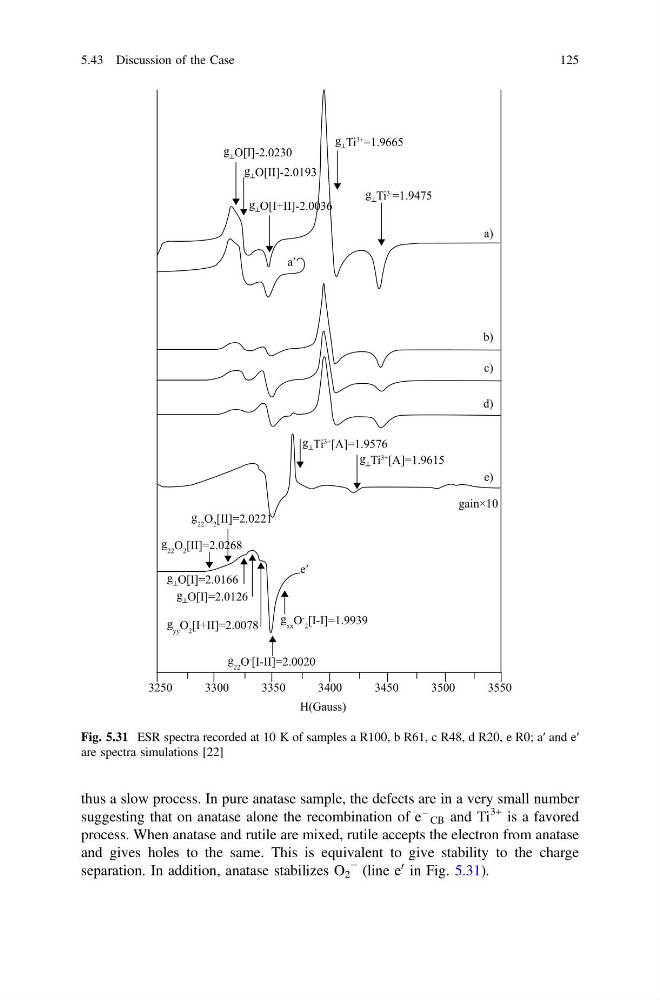
thus a slow process. In pure anatase sample, the defects are in a very small number
suggesting that on anatase alone the recombination of e
À
CB and Ti
3+ is a favored
process. When anatase and rutile are mixed, rutile accepts the electron from anatase
and gives holes to the same. This is equivalent to give stability to the charge
separation. In addition, anatase stabilizes O 2
− (line e
0 in Fig. 5.31).
g ┴ O[I]-2.0230
g ┴ Ti
3+ =1.9665
g ┴ Ti
3+ [A]=1.9576
g ┴ O[I]=2.0166
g ┴ O[I]=2.0126
g yy O 2 [I+II]=2.0078
g xx O
-
2
[I-I]=1.9939
g 22 O
- [I-II]=2.0020
3250
3300
3350
3400
H(Gauss)
3450
3500
3550
g ┴ Ti
3+ [A]=1.9615
g 22 O 2 [II]=2.0221
g 22 O 2 [II]=2.0268
gain×10
g ┴ Ti
3=1.9475
g ┴ O[II]-2.0193
g ┴ O[I+II]-2.0036
a′
a)
b)
c)
d)
e)
e′
Fig. 5.31 ESR spectra recorded at 10 K of samples a R100, b R61, c R48, d R20, e R0; a′ and e′
are spectra simulations [22]
5.43 Discussion of the Case
125
suggesting that on anatase alone the recombination of e
À
CB and Ti
3+ is a favored
process. When anatase and rutile are mixed, rutile accepts the electron from anatase
and gives holes to the same. This is equivalent to give stability to the charge
separation. In addition, anatase stabilizes O 2
− (line e
0 in Fig. 5.31).
g ┴ O[I]-2.0230
g ┴ Ti
3+ =1.9665
g ┴ Ti
3+ [A]=1.9576
g ┴ O[I]=2.0166
g ┴ O[I]=2.0126
g yy O 2 [I+II]=2.0078
g xx O
-
2
[I-I]=1.9939
g 22 O
- [I-II]=2.0020
3250
3300
3350
3400
H(Gauss)
3450
3500
3550
g ┴ Ti
3+ [A]=1.9615
g 22 O 2 [II]=2.0221
g 22 O 2 [II]=2.0268
gain×10
g ┴ Ti
3=1.9475
g ┴ O[II]-2.0193
g ┴ O[I+II]-2.0036
a′
a)
b)
c)
d)
e)
e′
Fig. 5.31 ESR spectra recorded at 10 K of samples a R100, b R61, c R48, d R20, e R0; a′ and e′
are spectra simulations [22]
5.43 Discussion of the Case
125